You can touch the stones set up by our ancestors in Wiltshire

THE COUNTY OF Wiltshire contains some remarkable souvenirs of Neolithic times (c10000BC- c2000BC).

The most famous of these is Stonehenge And because of its justly deserved fame, it has become one of the most popular tourist sites in the UK. It can be seen easily from the A303 road that passes it, but if you wish to see it more closely, you need to pay an entry fee, which for adults is currently (October 2025) more than £23. This allows visitors to circumnavigate the ring of standing stones, without getting close to them, without being able to touch them. Visitors are kept well away from the stones to prevent damaging them or the ground in which they stand.

If you wish to touch Neolithic stones, get close to them, and avoid crowds and the feeling of being herded, then head to Avebury, which is in Wiltshire, about 20 miles north of Stonehenge. The area around Avebury is full of standing stones. Some of them seem randomly placed, and others are more orderly: some are arranged in circles, and others are arranged in parallel lines, rather like trees along an avenue. Although the stones at Avebury are not as uniformly carved as those at Stonehenge, they look like superb examples of modern sculpture. Many of them contain features that, with a little imagination, resemble human faces. Whether these were carved to resemble faces or it is just my imagining that, I cannot say.   The best thing about them is that, unlike at Stonehenge, you can walk right up to them, and touch them. As you feel their texture, you become very much in touch with stones placed in position by our ancestors many, many centuries ago.

A garden of great beauty in Wiltshire

THE COURTS GARDEN is in Holt in Wiltshire. The gardens surround a house that was built for a clothier in about 1720, although some parts of the structure were built 200 years earlier.

In 1900, the house was purchased by the architect Sir George Hastings. It was he who laid out the magnificent gardens surrounding the house. The property changed owners in 1910 and then again in 1920, when it was purchased by Major TCE Goff and his wife Lady Cecile. She was influenced by the garden designer Gertrude Jekyll, and created various new features in the garden. The Goffs donated the house and gardens to the National Trust in 1943.

Well-maintained, this beautiful garden is well worth a visit.

Inspired by Claude Lorraine and Nicolas Poussin in Wiltshire and Somerset

WHEN I WAS a teenager, I made excursions – day trips – to places outside London with a small group of friends. Being too young to have driving licences, we had to rely on public transport. One place that we always wanted to get to is on the border between Somerset and Wiltshire: the gardens at Stourhead. Sadly, despite much research we could never find a way to reach it by public transport. It was only many years later (in the second half of the 1990s) that using a car, my wife and I were able to visit this place that my friends and I yearned to reach in the 1960s. We have visited Stourhead several times, both before and after the covid19 pandemic. Our latest trip there was on the 8th of July 2024. Despite it having rained extraordinarily heavily the previous day, the paths in the garden were not waterlogged.

The gardens were laid out between 1741 and 1780. They were designed to resemble the arcadian scenes as portrayed in paintings by Claude Lorraine, Nicolas Poussin, and Gaspar Dughet. The designer and source of inspiration for the gardens was the banker Henry Hoare II (1705–1785), also known as ‘Henry the Magnificent’. The resulting horticultural creation is a remarkably successful realisation of what had inspired him. A central water feature – a lake – is fed by streams and rivulets. Around the lake, are a series of picturesquely positioned neo-classical pavilions, a bridge, a Tudor cottage (which existed before the garden was created), and a man-made grotto.

One of the neo-classical structures, The Pantheon (designed by Henry Flitcroft; 1697-1769 – he died in London’s Hampstead), contains a set of 18th century sculptures of Ancient Greek gods and heroes. It also contains a well-preserved Ancient Roman statue, which one of the Hoares bought while travelling in Rome. It was interesting to enter this building because on all our previous visits, it had been locked closed. Another pavilion, smaller than The Pantheon, contains a huge white vase made from Coade Stone (made from clay, quartz, and flint), which was regarded as a ‘wonder’ material by architects and designers in the 18th century. In those days, it was cheaper than most stones and timber. It is named after the businesswoman Eleanor Coade (1733-1821), who was very successful at marketing this material invented by Daniel Pincot. The reason I write about this is that currently there is a small exhibition about Eleanor Coade in the small neo-Classical pavilion that faces The Pantheon across the lake.

Even if you are unable to enter any of the pavilions surrounding the lake, a visit to Stourhead Gardens is a magical experience. Here, nature has been guided into creating the 18th century ideal of a classical landscape. It brings to life the Latin expression ‘Et in Arcadia Ego’, which means something like ‘even in Arcadia, there am I’.

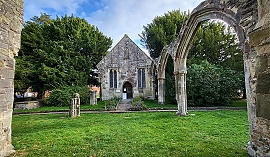
Little of this church remains today

WILTON IN WILTSHIRE was capital of Wessex between the 9th and 11th centuries (AD). Today, it is famous for its carpet manufacturing and the wonderful Wilton House, which has been home to the Earls of Pembroke since 1544, when King Henry VIII gave it to them after the Dissolution of the Monasteries. The House, which contains a fabulous collection of paintings by the great masters, was built on the site of Wilton Abbey (established in 871 AD).

St Mary’s church in the centre of Wilton was originally the first Anglo-Saxon church in the town. It was first built in the 9th century, and then rebuilt in the 12th century. The newer church was further modified in the 15th century. However, by the 18th century it was becoming dilapidated. In 1751, the surving part of the church became used as a mortuary chapel for the Earls of Pembroke. This situation remained unchanged until 1848, when the construction of the large Italianate church of St Mary and St Nicholas was completed in nearby West Street. Then, the old St Mary’s was demolished except for the chancel and the first bay of the nave (than next to the chancel). This survivor is rarely used for services and is now cared for by the Churches Conservation Trust, which looks after historic churches of interest that have become redundant. Outside the preserved part of St Mary’s there are a few gothic arches, remains of the previously much larger church.

We have visited Wilton several times, to see both Wilton House and the Italianate church, as well as to partake of refreshments in the town’s cafés, but it was only today (7th of October 2022) that I first noticed the remains of St Mary’s. This only goes to show that revisiting a place often can be rewarding.

Two similar churches, one in Kensington and the other in Wiltshire

ENNISMORE GARDENS MEWS IS about 380 yards west of Exhibition Road near South Kensington. It is the site of a church with an Italianate façade, now the Russian Orthodox Cathedral of the Dormition of the Mother of God and All Saints. A tall bell tower stands to the right of the façade as you look at it from the street. Pevsner described the style of the façade as “Lombardic Romanesque”. He noted:

“The Early Christian/Italian-Romanesque style was a speciality of the 1840s…”

Russian Orthodox church in Kensington, London

Although many of the fittings in the church are typical of Russian Orthodox places of worship (e.g., iconostasis and icons), the interior is not typical of edifices built specifically for the Orthodox church. The coloured panels above the arches (supported by iron pillars) lining the nave are not typical of the kinds of images usually associated with the Orthodox Church. They have captions in both English and Latin, but not in Cyrillic. The church was designed as the Anglican Church of All Saints in 1848-1849 by Lewis Vulliamy (1791-1871). The tower was constructed in 1871. Most of the decoration within the building is in the late 19th century Arts and Crafts style.

The Anglican parish, which was based in the former All Saints, merged with another in 1955. Then the church was let to the Russian Orthodox faith and its name changed to its present one. In 1978, the Sourozh Diocese purchased the edifice. The Sourozh is under the control of the Patriarchate of Moscow. The church in Ennismore Gardens Mews has a multi-national Orthodox congregation.  I asked a bearded priest how the cathedral differed from the Russian church in Harvard Road, Chiswick. He replied:

“We are the Orthodox Church based in Moscow, but the other one in Chiswick is the Orthodox Church based outside Russia … it is very complicated.”

Wilton in Wiltshire is almost 80 miles southwest of the Russian church in Ennismore Gardens Mews. Famed for its fine carpet manufacturing, the town has a church, St Mary and St Nicholas, whose façade looks not too different from that of South Kensington’s Russian Orthodox Cathedral. The Wilton church has a similar bell tower, but it placed on the left side of the façade. The church was commissioned by Sidney Herbert, 1st Baron Herbert of Lea (1810-1861), a close ally and supporter of Florence Nightingale of Crimean War fame. Sidney was a son of George Herbert, 11th Earl of Pembroke and his Russian spouse Catherine (née Yekaterina Semyonovna Vorontsova). The church, completed in 1845, was designed by Thomas Henry Wyatt (1807-1880) and his assistant David Brandon (1813-1897).

With many features borrowed from Italian Romanesque architecture, and some from Byzantine designs, the edifice at Wilton, despite being an Anglican parish church, felt to me slightly more like an Orthodox church than the converted ex-Anglican, now Orthodox, church in Ennismore Gardens Mews. However, the interior fittings in the church in Wilton borrow from what can be found in traditional Italian churches rather than in typical eastern Orthodox churches. But, the mosaic covered cupola over the chancel in Wilton’s Anglican church, with its depiction of Christ with two saints resembling what is often found in Byzantine churches, contrasts with the undecorated cupola over the chancel in what has now become the Russian Orthodox Cathedral in Kensington.

Placed side by side, many differences could be discerned between the church in south Kensington and that in Wilton. But it is the similarities between two churches designed by different architects that are remarkable.

Doom painting

UNDOUBTEDLY THE CATHEDRAL in Salisbury (Wiltshire) is the city’s ‘star’ attraction and is worthy of many visits. However, the city has other things that should not be missed. One of these is the Parish Church of St Thomas (and St Edmund), about 370 yards north of the cathedral.

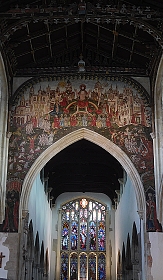
The Doom Painting

The present church was built from the 15th century onwards. Its detailed history can be found on the church’s website (https://stthomassalisbury.org.uk/wp-content/uploads/2021/06/BriefHistory.pdf). On entering the church from its western end, one cannot avoid seeing the colourful wall painting above the chancel arch. This is the Doom Painting, which depicts The Last Judgement. Images such as these used to be common in Christian Europe but are rare today. ‘Doom’ means ‘judgement’ in Anglo-Saxon. The painting in St Thomas is thought to have been created in about 1470 in the Flemish style by an English painter.

During the Reformation, the painting was covered over with whitewash in 1593. It remained hidden until 1819 when faint traces of colour began to appear when the wall was being cleaned. The painting was carefully uncovered in 1881, and then it was restored. In 1953, the image was cleaned again and retouched. Since then, it has remained untouched. Although it has been restored, it gives a good idea of how this superb fresco looked when it was first created.

While looking up at the Doom Painting, you should also examine the decorated timber ceilings above the nave and other parts of the church. These contain almost 100 wood carvings of angels. Also of interest, is a wooden panel on the wall of the south aisle. This bas-relief wood carving depicts Abraham sacrificing his son Isaac and Jacob’s Dream. It was created in about 1660 by the master Joiner Humphry Beckham (1589-1671).

There are plenty of other interesting items to see in the church, which deserves a visit. Had there not been a famous cathedral in Salisbury, this smaller church would have become one of the place’s main attractions.

A post office and an abdication

BRADFORD-ON-AVON is a charming old-fashioned town in Wiltshire. It straddles the River Avon, which flows through Bath and Bristol. Its Town Bridge is not only old (construction includes some 14th century structure) but also it has a small building on it. This was originally a chapel but became used as a lock-up in the 17th century. Also of interest is the Roman Catholic church of St Thomas More, which is unusual in that it is housed on the first floor of what had once been the Town Hall (built 1854).

Despite the many old and attractive buildings in the town, what interested me most was the old post office. It stands in the picturesque Shambles, which used to be the part of the town dedicated to slaughtering animals and butchering. Compared to many of its neighbours, it is a relatively modern building; it was built in 1899 (www.bradfordonavonmuseum.co.uk/post). It was designed by William Henry Stanley. Then, in 1935 it was enlarged. By the time the new extension was complete, King Edward VIII had ascended to the Throne. What makes it most interesting and unusual is that it bears the monogram of King Edward VIII and the date 1936.

King Edward VIII, who succeeded King George V, reigned from the 20th of January 1936 until he abdicated on the 11th of December 1936. As is well-known, he gave up the throne to marry the American divorcée Mrs Wallis Simpson. What is less well-known is that few, only of a handful of, new post offices were opened in Edward’s brief reign (http://britishpostofficearchitects.weebly.com/bradford-on-avon.html), and Bradford-on-Avon’s extended branch was one of them.

I first spotted the Edward VIII monogram when we visited the town about 20 years ago. Then the post office in the Shambles was still in use. About 5 years ago, this special post office closed. It now operates from within a Co-Op supermarket in the town. However, the old office is now a protected building. The monogram remains but the building is now home to various shops.

St Johns Wood and the Crimea

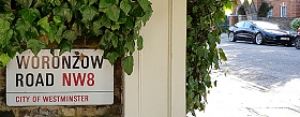
THROUGHOUT MY LIFE, I have been visiting or passing through St Johns Wood in north London. I have often noticed a street called Woronzow Road. It lies between Primrose Hill and St Johns Wood Underground Station. Whenever I have seen this road, I have wondered about the name ‘Woronzow’, but uncharacteristically I have always been too lazy to find out anything about it.

Recently, we visited Wilton House in Wiltshire, not far from the city of Salisbury. Home to the Herberts, the Earls of Pembroke, for many centuries, this is a wonderful place to visit, to see its gardens, the house itself and the outstanding collection of old master paintings within it. The decoration of the rooms that we saw is superb and is kept in good condition by the house’s present occupants, the family of the current, the 17th, Earl of Pembroke. It was whilst visiting this splendid country seat that my ears pricked up hearing the guide mention the name ‘Worontzow’.

In 1808, the widowed George Herbert (born 1759) remarried. His second wife was Catherine Woronzow (1783-1856). Her father was Semyon Romanovich Woronzow (1744-1832), Russian Ambassador to England from 1796-1806, who died in London and was buried in the Pembroke’s family vault. Catharine, who became Countess of Pembroke, did a great deal to improve Wilton House to create much of what we can see today. She is buried in the nearby church of St Mary and St Nicholas, which was built in a neo-Romanesque style between 1841 and 1844. It was built at the instigation of Catharine and her son Sidney Herbert, the 14th Earl of Pembroke (1810-1861).

Between October 1853 and February 1856, the last years of Catharine’s life, Britain was at war with Russia in what is known as The Crimean War. Between June 1859 and July 1861, Sidney Herbert was the Secretary for War in the British government. During the campaign, a supply route called the ‘Woronzow Road’, no doubt named in honour of Catherine’s noble Russian family, ran along the Crimean coast past Sebastopol. Thus, there was once a Woronzow Road in The Crimea. This was an important supply route for the British forces bringing much-needed material south from Alma and Calamita Bay towards Sebastopol. In the winter of 1854, the British lost control of this vital supply route and had to rely on goods reaching them by a far more difficult track,

One of Sidney Herbert’s great contributions to the war effort in the Crimea was his asking Florence Nightingale (1820-1910) to travel to Scutari (now, Üsküdar in Istanbul) with 38 volunteer nurses. She and her team helped to dramatically improve the treatment of the many soldiers who contracted diseases such as cholera and typhus whilst in the Crimea. Incidentally, Florence never visited the Crimea, but remained working in the Turkish city. Herbert and his wife had first met and become friendly with Florence Nightingale in Rome in about 1847.

Now let us return to St Johns Wood in London. Catherine’s father, Semyon Worontzow, lived in the district. The road, where he lived and whose name has intrigued me for decades, is now called ‘Woronzow Road’. It was named after him in 1843. It was not until 2002 that the Russians erected a monument to him on the thoroughfare named after him.

A chapel that became a barn

PHILIP’S NAVIGATOR BRITAIN is a detailed (1 ½ miles to the inch) road atlas covering England, Scotland, and Wales. It is extremely useful for finding one’s way through Britain’s maze of narrow country lanes if, like us, you do not make use of GPS systems. One of the many features of the maps in this atlas is that it marks old buildings and other sites of interest in both towns and deep in the countryside. Recently (June 2021), we were driving around in rural Wiltshire, having just visited the small town of Bedwyn when I spotted that there was an old chapel nearby, close to the hamlet of Chisbury.

The area in which Chisbury is located is the site of an ancient hill fort in which archaeologists have found artefacts from the Palaeolithic era, as well as the Neolithic and Bronze Ages. The fort, whose earthworks are still discernible, was later used by the Romans. Long after the Romans had left England, the manor house of Chisbury was built within its site.

In the 13th century, the Lord of Chisbury Manor built a ‘chapel of ease’, St Martin’s, close to his manor house. According to Wikipedia, such a chapel is:

“…a church building other than the parish church, built within the bounds of a parish for the attendance of those who cannot reach the parish church conveniently.”

The chapel of ease at Chisbury was built to serve the household of the Manor House as well as villagers nearby, to save them having to travel to the nearest parish church which was in Great Bedwyn.

In 1547, during the Reformation of The English Church, the chapel, like many other places of worship in Henry VIII’s realm, ceased to be used. Instead of being demolished, as so many ecclesiastical buildings were at that time, the chapel was re-used as a barn. The barn continued to be used over several centuries until 1925, when it was designated a building of historical importance. Now, it is maintained by English Heritage. This re-purposing of a place of worship reminded me of what I saw when I visited Albania in 1984. At that time, religion of any sort had been made illegal by the Stalinist regime led by Enver Hoxha. Mosques and churches had either been demolished or re-purposed as sports halls, cinemas, and for other non-religious uses.

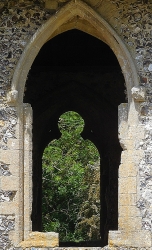
The chapel of Chisbury is beautiful. The glass has been long lost from its windows. Trees can be seen from within the chapel through its carved stone gothic windows. The ceiling of the chapel is timber framed, but I suspect that these are no longer the original timbers. The roof is thatched. The floor is at two levels, higher at the west end than the east. Steps lead from one level to the next. The two levels might reflect the fact that the chapel is built on a steeply sloping hill.

On the inside of the west wall of the building, close to the way into the chapel, there is a faded red painted circle enclosing a cross. Symbols like this were painted on to the walls of buildings during the consecration ceremonies of building about to become churches. What you can see in the chapel at Chisbury must have survived many centuries. Maybe, it has been touched up from time to time.

It is written that Jesus Christ was born in a kind of barn surrounded, as the story goes and many artist have depicted, by farm animals. I wonder whether this went through farmworkers’ heads as they used the former chapel as a barn for a variety of agricultural purposes.

Had it not been for builders working nearby, the chapel would have been silent except for birdsong. I am glad we made the small detour to see this delightful relic of mediaeval life in England.