A drop in the ocean

Just as many associate Spain with sunshine, plenty of folk think of rain when they consider England. Yet, ironically, there is currently a shortage of water in the country. This is partly because there has been insufficient rainfall and also because for years, governments have neglected maintaining reservoirs and other water sources and water companies have been prioritising profit over provision of water to their customers.

So when it rained today after many weeks of dry weather, we breathed a sigh of relief. But this will be short-lived, because what fell today was literally a drop in the ocean.

After the heatwave came the cloudburst … après moi le déluge

FOR OVER A WEEK at the end of June and the beginning of July (2025), temperatures in London hovered around 30 degrees Celsius. Then, it became a bit cooler, and the sky clouded over. Despite the slight decrease in temperature, the air in London remained unpleasantly humid.

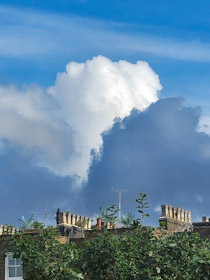
Then, on Sunday the 6th of July, the heavens opened. Rain came streaming down. The downpour was as heavy as monsoon rains I have seen in India.

After less than 10 minutes, the rain ceased, there were several rolls of thunder, and the sky became blue once more.

The photograph shows the disadvantages of a flat roof. With poor drainage, it becomes a swimming pool.

The force of nature and a disappearing car park

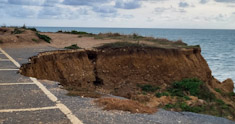
THE CAR PARK at Compton Bay on the south coast of the Isle of Wight is falling into the sea far below. The waves are undermining the cliff upon which the car park is situated. In conjunction with this, wind and rain are literally eating away the cliff. Where there had been a row of marked parking spaces, this has become unusable because the cliff has broken away. The markings are still visible, but they end abruptly at the fractured cliff edge. The local National Trust warden told us that next year, this disappearing car park will be closed and grassed over. A new one will have to be created further away from the clif edge. Seeing the damage being caused brought home how powerful are the forces of nature.

A Ford Zodiac in Notting Hill and hot weather

TODAY THE TEMPERATURE in Athens (Greece) will exceed 35 degrees Celsius, and in Rome it is predicted to reach 42 degrees in two days’ time. Two years ago, a temperature of 48 degrees was recorded in Sicily. So, it seems that so-called Global Warming is happening with vigour. Meanwhile, this Sunday (16th of July 2023) in London, we enjoyed a breezy morning with temperatures not greater than a pleasant 21.

While walking along Portobello Road this Sunday, we spotted a beautifully cared for open-topped Ford Zodiac. These vehicles were manufactured between 1950 and 1972. I remember seeing them in my childhood and teenage years. In those days, I was not much interested in cars, but now when I see one that used to be common in my earlier years, I find them worthy of examination. I took several photographs of the Zodiac and then headed for the bus stop from which we were returning home.

Despite the external temperature being 21 degrees or less, it was far warmer inside the bus although its windows being open. The higher temperatures that we have been experiencing here in London and are now affecting places near the Mediterranean are commonly believed to be at least partly due to emissions produced by fossil fuels, such as petrol. As we moved homewards, a thought struck me. The beautiful Ford Zodiac, which we had just seen, is aesthetically pleasing and a souvenir of one of the great eras of automobile engineering, but it is also an ‘ancestor’ of Global Warming. Beautiful as it is, it too burns fossil fuel and makes its own contribution to what is believed to be causing dangerously high air temperatures in many parts of the world.

Apologising for the weather

I praised Ryanair after our flight from Stansted to Funchal in late April 2023. The return flight to Stansted (in May 2023) was delayed because of weather conditions at Funchal’s airport. This was not the airline’s fault. However, I regret to say that the Portuguese airport staff at Funchal handled this delay badly and rudely.

The flight back to London was as good as can be expected on a budget airline. Despite not being responsible for meteorological conditions, the pilot could not stop apologising for the delay.

A maze at Greys

THE METEOROLOGICAL OFFICE weather forecasting app predicted a very rainy Sunday (23rd of April 2023). Despite this dire prediction, we headed out west from London to Henley-on-Thames. Not far from this charming riverside town is the estate of Greys Court, which we had visited several times before. We were lucky because the spring flowers in the gardens were in gloriously full bloom.

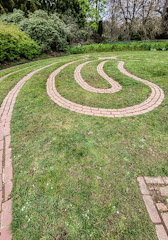
We found one part of the garden that we had not seen on earlier visits, probably because it is only open on Sundays. I believe that today was our first Sunday outing to the place. The section of the garden that is only open one day a week contains a circular maze. It consists of curving paths made of clay bricks set into the soil, and these are separated by low grassy ridges, In the centre of the maze there is a large spherical sundial, which was not working because the sky was overcast.

The maze was dedicated in 1981 by Robert Runcie (1921-2000), Archbishop of Canterbury from 1980-1991. It was created for two purposes. One was to celebrate Runcie becoming Archbishop, and the other to create what a notice described as:
“… a space for reflection, exploring the idea that we should all help each other solve the mystery of the maze of life.”
Well, whatever its intention, it is an attractive garden feature.

As for the weather, we were out of the house for about five hours, and it only rained for less than 15 minutes whilst we were driving to Greys Court. The maze there might in some way solve the mystery of life, but the Met Office needs to do a lot more work on solving the mystery of weather forecasting.