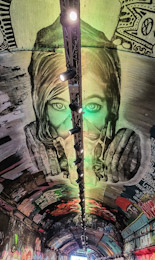
LEAKE STREET RUNS beneath the platforms and tracks of London’s Waterloo Station. It is 300 yards long and its walls and ceiling are covered with colourful graffiti created with cans of paint spray. The artwork creation in this street that runs in a tunnel was inaugurated in May 2008 during the Cans Festival, which was organised by the artist known as Banksy.
Unlike many public places in London, painting the walls in Leake Street is legal. Walking along this highly decorated street is a magnificent experience, which you can repeat often because the images on the wall are frequently changed. If you are lucky, you can watch the artists in action.
WE ARE KEEN on many of the plays put on at the Young Vic Theatre on The Cut near Waterloo Station. Last night (the 11th of March 2024), after seeing a superb performance of a weird but enjoyable play (about a painting by an infamous dictator) called “Nachland”, we walked along The Cut and then further west along a street called Lower Marsh. Sometimes. we return from the theatre via Lower Marsh, and I have often wondered about its name.
About 344 yards in length, Lower Marsh runs southwest from near the Old Vic theatre on Waterloo Road to Westminster Bridge Road. Until the 19th century, much of the northern tip of the old Parish of Lambeth, where Waterloo Station and the South Bank are now located, was marshland. A settlement called Lambeth Marsh (after which Lower Marsh was named) was first recorded on a document in 1377. This settlement ran along a raised road that some believe dated back to Roman Times. The marshland was drained in the 18th century, and by the 19th century isolated individual houses were being built in Lambeth Marsh. In 1848, after the opening of Waterloo railway station, the area known as Lambeth Marsh became known as it is now – as Waterloo. Lower Marsh and its neighbour The Cut formed the commercial area of the district.
There has been a market in Lower Marsh since the early 19th century. As I have only ever walked along Lower Marsh in the late evening, I have never seen the market in action. The street, which was already marked on a map drawn in 1690, linked two bridges (Waterloo and Blackfriars) constructed in the mid-18th century, and ran past:
“Leisure activities, including pleasure gardens, circuses, theatres which characterised the south bank in the late eighteenth and early nineteenth centuries [and] were present in and around Lower Marsh.” (www.lowermarshmarket.co.uk/).
During the 19th century
:“The building of Waterloo Station in 1848 and its subsequent expansion cut the street off from the riverside, creating a number of yards and cul de sacs from former streets. In the twentieth century war damage, and subsequent housing redevelopment significantly changed the historic street patterns, confining the street market to Lower Marsh.”
Until quite recently (in the 21st century) Lower Marsh and its surroundings would have been described as somewhat ‘run down’. But of late, the area has undergone ‘gentrification’ and become quite a ‘trendy locale. As the Lower Marsh Market website related:
“The current buildings on Lower Marsh Street represent many different phases of development and several styles. Amongst the diverse buildings are some interesting examples of early nineteenth century vernacular architecture, continuing the Georgian vernacular patterns and layouts of the eighteenth century. Good examples of shop-fronts from different eras are present on the street and courts and alleyways and some original paving can still be seen on streets off to the sides. This variety gives the area great character, enhanced by the market.”
In 2015 and 2016, the market took first place in the shopping category of The Time Out Love London Awards. Next time we go to a matinée at either The Young Vic or The Old Vic, we will leave early enough to take a look at the market.
IN THE LATE 1930s, my mother studied commercial art at the Michaelis School of Art in Cape Town (South Africa). One of her earliest jobs after leaving college was hand-painting posters advertising cinema films. Many years later, long after her death, I began visiting India and have been making regular visits there since January 1994. During the first few years of making trips to India, I used to notice the huge hand-painted cinema posters both in and out of towns. I recall seeing men perched on precarious looking bamboo scaffolding painting these enormous images. To someone, like myself, used to seeing printed cinema posters, seeing these men in action was an eye-opener.
A few years ago, I was walking near Shepherds Bush in west London when I saw a group of men colouring in details of a poster beneath a railway bridge. Like the painters in India, their scaffolding also looked slightly precarious, given the current preoccupation with health and safety in this country.
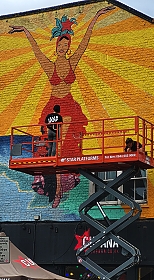
These memories of hand-painted posters came to mind a couple of days ago (late July 2002) while we were walking towards Lower Marsh (near Waterloo Station) from the Young Vic Theatre, where we had just watched a poorly acted, and badly written play called “Chasing Hares”. We spotted two ladies perched on a very adequate scaffolding device painting a colourful mural on a large expanse of brick wall above the Cubana Restaurant. It was good to see that in an age where machine produced images are common (and have largely replaced hand-painted adverts in India), traditional methods are still being used to create large images for attracting the public.


 yamey
yamey 