
Facing the water
The dark mouth of a cavern
Once used to make lime

Facing the water
The dark mouth of a cavern
Once used to make lime
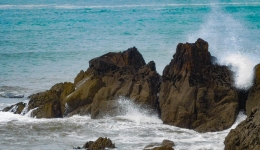
Waves hit rough rocks
Spray flies everywhere
Joy of the English seaside
AS A SPECIAL TREAT when I was a young child, I was allowed to feed the pigeons on Piazza Signoria in Florence (Italy), a city we visited annually during my childhood. My parents used to purchase paper cones filled with corn kernels for my sister and me. We used to put a few of these in the palms of our hands and allow the pigeons to perch on our fingertips whilst they fed on the corn. Looking back on this activity, which gave me great pleasure, I am surprised that my health and hygiene conscious mother allowed what the former Mayor of London, Ken Livingstone, called ‘rats with wings’ to risk sullying our hands and harming our health.

Oddly, when we were kids, we fed the pigeons in Florence but never fed their cousins that flocked around Trafalgar Square in London. Today, the 25th of April 2022, my wife and I walked across Trafalgar Square and observed that nowadays there are signs that indicate that feeding pigeons is forbidden. However, this activity, which I enjoyed as a child on holiday in Florence, is not the only thing forbidden in Trafalgar Square. The lovely fountains in the square now contain signs in the water, on which the words “No Entry” are written. Yet another activity in the square is no longer allowed. There are signs to deter visitors from climbing on the sculptures of the lions that lie at the base of Nelson’s Column. So, when you next visit Trafalgar Square with plans of feeding the pigeons, or bathing in the fountains (even to celebrate New Year), or straddling a lion, do not realise any of them: they are all outlawed.
REMNANTS OF LONDON’S ROMAN wall can be seen from various points in the Barbican Estate, whose construction began in 1965. The not entirely unattractive residential brutalist concrete jungle, known as The Barbican is sited next to the northern edge of what was formerly Roman Londinium. According to a history of the area (www.cityoflondon.gov.uk/services/barbican-estate/barbican-estate-history):
“The name of the Barbican comes from the Low Latin word ‘Barbecana’ which referred to a fortified outpost or gateway: an outer defence of a city or castle or any tower situated over a gate or bridge which was used for defence purposes. The “Barbecana” was probably situated somewhere between the northern side of the Church of St. Giles Cripplegate and the YMCA hostel on Fann Street.”

By the 1850s, the district of Cripplegate, where the Barbican is located, was very crowded with dwellings and business premises. Much of the area now occupied by the Barbican had been destroyed by bombing during WW2. The Estate was built to replace what the Luftwaffe had destroyed.
Apart from several water features, there is one oasis of greenery on the otherwise extremely urban site. This is the Barbican Conservatory. Opened in 1982, it is located above the Barbican’s main theatre and can be entered through an entrance close to that of the Barbican’s Art Gallery. Despite it having been in existence for so many years and having known about it for several decades, it was only yesterday (6th of April 2022) that I first ventured inside it. We had just viewed the current exhibition in the Gallery, “Postwar Modern: New Art in Britain 1945-1965”, an impressive display of rather unexciting artworks. Entering the Conservatory was literally “a breath of fresh air” after viewing the exhibits that had been arranged to illustrate the depressing emotional aftermath of WW2 as depicted by artists in Britain.
I was surprised to learn that the Barbican Conservatory is:
“… the second largest in London (after Kew Gardens) and home to over 1,500 species of plants, but is one of the city’s lesser-known green spaces.” (www.atlasobscura.com)
Apart from the plants, many of them exotic, which are arranged on various levels and can be viewed from both a lower floor and an elevated walkway, there are three ponds. One contains koi carp and the other, raised above ground level, is home to two terrapins, which were found in ponds on Hampstead Heath. The Conservatory is divided into two main sections. The larger is the tropical section, where visitors are permitted to wander about. The other, which was locked up yesterday, is the arid section, containing cacti and succulents.
Despite being in the midst of a manmade, visually intriguing, but harsh urban environment, the Conservatory with its tall trees, bushes, flowers, and other vegetation, feels like another world – a primaeval paradise from which the modern world can be glimpsed in the background.
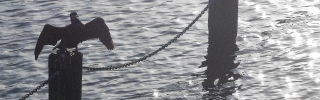
Black wings outstretch’d
A cormorant perching in the sun
A wondrous sight
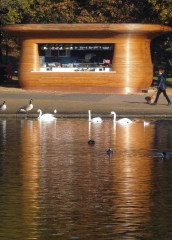
Swans sail serenely
Passing the lakeside kiosk
Very silently
NEEDING BREAKFAST ON our way from Warwick to visit Baddesley Clinton House, we chose to stop at the Hatton Locks Café, which we had noticed on our road map. What we did not know is that the café is located next to the uppermost of a flight (or series) of 21 canal locks. The locks are situated on a stretch of the Grand Union Canal that was, when it opened in 1799, the Warwick and Birmingham Canal, which was built to carry locally mined coal for use in power stations and nearby factories (https://canalrivertrust.org.uk/enjoy-the-waterways/canal-history/history-features-and-articles/the-history-of-hatton-locks). It became an important transportation link between London and The Midlands.

The 21 locks are spread along an almost 2 mile stretch of the canal and the towpath along this section of the waterway is popular with cyclists, walkers, and their dogs. Some of the locks are narrow. They were built when the canal was first constructed. Other locks on the flight are far wider. They were built in 1932 and allow two craft to use the lock simultaneously. The newer locks were built at a time when the canal system began to have to compete with motorised road and rail transport.
The café is about 310 yards northwest of a small car park and is reached by walking along the towpath. Near the café, there are some unusual looking tables and benches made of old timber. Most of the timber pieces are planks with a short semi-circular projection at one end. These wooden piles used to be driven into the floor of the canal between parallel wooden blocks that held them straight upright against the walls of the waterway. Their purpose was to prevent the banks of the canal from being eroded by the water flowing past them. Nowadays, they have been replaced by coir matting that serves the same purpose because it is considered to be more eco-friendly that timber. The wooden piles were driven into place by a mechanised hammer system aboard a motorised boat that plied along the canal. One of these boats, now disused, has been preserved near the café.
The locks on the Hatton Flight looked different from the many other canal locks we have seen on our travels around the country. Each lock is flanked by what looks like a pair of tall, stout candles. These things house the mechanisms that control the flow of water into the locks and are operated by canal users equipped with a special handle or windlass that fits onto a projection that is linked to the gearing that operates the valve.
The Hatton Locks Café is a real treat, both visually and gastronomically. Both inside and outside, it is decorated with a profusion of objects, some folkloric, some whimsical, and others related to the life and traditions on the canal. A team of friendly workers produce simple but excellently prepared English breakfast items as well as very acceptable coffees. So good was our breakfast that we made a detour to return to this place on the following morning. Most of the clientele seemed to be locals, many of whom were on friendly terms with the staff. Although we had only been once before on a busy morning, the staff remembered exactly what we ate and drank on the day before. When we are next nearby, we shall certainly visit this wonderful establishment again. On our next visit, we will join the other walkers and stroll past all the 21 locks.

Rusting but floating
She waits in the still water
For what? I know not
ACCIDENTALLY, WE BOARDED a bus, which we believed would take us to Gunnersbury station in west London, but instead it took us to the edge of Chiswick Business Park furthest away from the station. This meant that we had to walk through the business park, and this was no bad thing.

The business park has been built on land that used to be owned by the Rothschild family, who owned nearby Gunnersbury Park for much of the 19th century and the early part of the 20th. In 1921, a bus company built a 33-acre bus maintenance establishment on the site where the Rothschild’s used to have orchards and where today the business park stands. This was closed in 1990, and various architects, including Norman Foster, drew up plans to develop the site with buildings around a central ‘piazza’.
Eventually, after gaining planning permission, the first building was completed at the end of 2000. Gradually, the rest of the buildings were constructed. The site was completed in 2015. The result is spectacular. The buildings are uncompromisingly modern, almost sculptural, and, most importantly, pleasing to the eye. They are arranged around an attractive lake or pond, complete with waterfalls, a bridge, and some metal sculptures. A number of small spherical glass and metal ‘meeting pods’ have been placed close to the water feature and there are several refreshment kiosks dotted around the place.
In 2019, a long footbridge, suspended from a series of giant oxidised steel hoops was constructed between the place where our bus (route 70) terminated within the business park and Chiswick Park Underground station. It is an elegant piece of engineering.
We have often passed the Chiswick Business Park whilst travelling by car or bus along Chiswick High Road that forms its southern border, but never bothered to walk in it. Today, we did, and it was a pleasant new experience.
EVERY NOW AND THEN, a canal needs repairing. For example, it might have sprung a leak either in its retaining walls or in its clay bottom. In such circumstances and no doubt others, the repair work can only be carried out if the canal is emptied of water, a tall order in a canal that might be many miles in length. Recently, we were walking along the towpath of the Macclesfield Canal, which links Marples Lock on the Peak Forest Canal with Hardings Wood Junction on the Trent and Mersey Canal, when we spotted something that we had never noticed before whilst walking along a canal towpath.
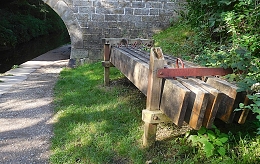
What we saw was a pile of sturdy wooden planks, each with two metal handles attached to their narrowest edges. They looked quite modern. We asked a man, who was walking his dog, about the planks. He explained that they were used to block both ends of a section of canal between two consecutive bridges. When these barricades are lined with plastic sheeting, the water between the two barricades can be drained from the part of the canal between the two waterproofed wooden barriers, Then, work can be carried out on the drained stretch of the canal. The planks are known as ‘stop planks’
Our informant pointed out notches carved in the stonework near to a bridge. The notch is opposite another identical one across the canal. It is into these pairs of notches that the planks we had noticed ate inserted to create a dam, I regard myself as being quite observant, but I have never seen or noticed either this kind of notch or the wooden planks for inserting in them during many long walks along canals in other parts of England. Maybe, they are common, but until we walked beside the Macclesfield Canal, I had never seen them before, Maybe, this is because other methods of damming (see: https://www.rchs.org.uk/wp-content/uploads/2017/01/OP-128.pdf) are also employed in addition to that which we spotted on the Macclesfield Canal at Bollington in Cheshire.
 yamey
yamey 