WATER STORAGE TANKS and wells are subject to changes in the water level. In small wells such as are commonly found in England, a bucket and winch system allows the water gatherer to reach the water in the well. In India where water tanks and wells can be quite large, occupying a substantial area of ground, another system is used to allow users to get to whatever level the water has reached. The walls of the sides of the tank/reservoir/well are lined with a series of staircases, which are used to reach the water. Often the sets of steps lining the walls of the so-called stepwells are arranged in attractive geometric patterns.
At the Toorji stepwell
Since first seeing a (disused) beautiful stepwell in the ruins of the medieval city of Vijayanagara at Hampi in Karnataka thirty years ago, I have been fascinated by stepwells. I have seen many while travelling around Gujarat, and was pleased to find one near our guest house in Jodhpur (Rajasthan). It’s name is Toorji ka Jhalra Bavdi.
The Toorji stepwell was built in about 1740. Its construction was ordered by the Queen Consort of Maharaja Abhay Singh. Back in those days, ladies of the royal family often commissioned the building of water tanks and wells. The Toorji stepwell was used mostly by women, who traditionally did household chores including the fetching and carrying of water.
Toorji stepwell is constructed with the rose red sandstone of Jodhpur. It is decorated with carvings of various sizes. Nowadays, as with so many interesting places all over the world, it is a popular location for taking ‘selfies’ and for posing for photographs. Despite this, it is a stepwell worth seeing and is a remarkably tranquil spot surrounded by a maze of narrow, busy streets and lanes.
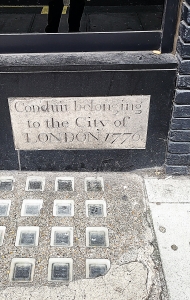
IT IS EASY to miss this small, inscribed stone set low down close to the pavement of Marylebone Lane just south of its intersection with Wigmore Street. The stone is inscribed with the following:
“Conduit belonging to the City of London 1776”
Noticing it for the first time today (14th of November 2024) although I have passed it many times before, I was puzzled by it.
Marylebone Lane runs between Oxford Street and Marylebone High Street. It is far from straight because it follows the course of the now hidden Tyburn River, one of the tributaries of the Thames. Since the middle of the 18th century, this river has run in an underground culvert. Water from this river was once taken from it to supply the City of London with water. As a website (https://coalholesoflondon.wordpress.com/2012/02/21/marylebone-conduit/) informed, the inscribed plaque:
“… reminds us where the water was once piped to the City of London, close by the Lord Mayor’s old Banqueting House, which once stood in fields now occupied by nearby Stratford Place. Alongside this field was a small lane leading to Marylebone – the present day ‘Marylebone Lane’ – where on this corner stood the chief conduit, now marked by this commemorative stone inlaid into the wall and dated 1776 with its City of London claim.”
Had this modest plaque not been placed and preserved, an interesting feature of London’s hydrological history might have been lost for ever. Apart from avoiding pitfalls on London’s not always perfect paving stones, looking where you are walking can often be quite interesting.
WE TAKE IT FOR GRANTED that when you turn on a tap in your bathroom or kitchen, fresh water will flow. And when, usually for maintenance purposes, the mains water supply is turned off temporarily, we can be truly inconvenienced. There are still many parts of the world where piped water is not available to domestic users, but the UK is no longer one of these.
During a recent (May 2023) trip to Lavenham in Suffolk, my wife noticed something next to a pavement. It was a now obsolete bit of plumbing, which has been preserved to demonstrate that even as late as 1936, the small town did not have a public piped water supply for its dwellers. I suppose that before that date, the people had to rely on springs and wells.
The object that can be found on the east side of Church Street, south of Water Street, is a public standpipe. A notice near it explained that piped water came to Lavenham in 1936 to 1937. Several standpipes were erected to give the public access to the water. At that time, people had to collect water from the standpipes and take it to where they required it. However, they did not yet have the luxury of having taps that supplied water in their own homes. The standpipe, which we saw, is now non-functional, but is one of nine such items still to be found in Lavenham.
Lavenham is full of small reminders of how different life was many centuries ago. The standpipe is a small souvenir that makes us realise how different life was less than 100 years ago.
LIFE DEPENDS ON WATER. A few days ago, at the end of March 2021, we drove to a village in Oxfordshire to see two old wells. They are no ordinary wells: they were gifts from India while it was still part of the British Empire.
Maharajah’s Well at Stoke Row
Edward Anderton Reade (1807-1886) was a British civil servant in India between 1826 and 1860. Brother of the novelist Charles Read (author of “The Cloister and the Hearth”), Edward was born in Ipsden, a village in Oxfordshire (www.oxforddnb.com/). He entered the East India Company in 1823. In 1832, he was transferred to Kanpur (Cawnpore), where he introduced opium cultivation to the district. In 1846, he became Commissioner to the Benares Division, a position he held until 1853 when he was moved to Agra.
Edward encouraged genial relations with the local Indian gentry and aristocracy. One of his Indian acquaintances, who became his good friend, was Ishri Prasad Narayan Singh (1822-1889), the Maharajah of Benares, who reigned from 1835 to 1889. During the years before the Indian Rebellion of 1857 (aka ‘First War of Independence’ or ‘The Indian Mutiny’), Reade and the Maharajah discussed much about England including the shortage of water that existed in Ipsden, the part of Oxfordshire where his family lived. Apparently, the villagers in this part of the Chiltern Hills had little or no access to clean drinking water, much as must have been the case for many villagers in India.
During the Rebellion of 1857, the Maharajah remained loyal to the British. In June 1857, the town of Kanpur was besieged by Nana Sahib and his forces. After 3 weeks, the British garrison surrendered under condition that the British inhabitants would be given safe passage out of the town. However, Nana Sahib decided to hold about 120 women and children and kept them housed in a house known as the ‘Bibighar’. This ended badly when some of the hostages were killed. Some of them tried to escape their grizzly end by jumping into a well at the Bibighar. This well became one of the most powerful images of the Rebellion in the minds of those who lived in Britain.
I do not know whether or not it was the tragedy at Bibighar that brought the conversations he had with Reade to the forefront of the mind of the Maharajah of Benares after the Rebellion was over, but in 1862, after his loyalty to the British had been formally recognised, he consulted Reade as to making a charitable gift to the poor people of Ipsden, whose plight he recalled. The Maharajah financed the construction of a well at Stoke Row, not far from Ipsden. It is also possible that the Maharajah remembered the help that Reade had given him when constructing a well in Azamgarh (now in Uttar Pradesh) back in 1831.
Work commenced on the well in March 1863. The well shaft was dug by hand, a perilous job for the labourers as they removed earth from the depths of an unlit and unventilated shaft, bucket by bucket. The shaft, 4 feet in diameter, was 368 feet in depth, greater than the height of St Pauls Cathedral in London, for this is depth of the water table at Stoke Row. Special winding machinery constructed by Wilder, an engineering firm in Wallingford, was installed. It is topped with a model elephant. The mechanism and the well stand beneath an octagonal canopy topped with a magnificent metal dome with circular glazed windows to allow better illumination. It resembles a ‘chhatri’ or architectural umbrella such as can be seen at war memorials on London’s Constitution Hill and on the South Downs near Hove. The structure, restored in recent times, looks almost new today. Reade, who helped plan the Maharajah’s well, planted a cherry orchard nearby; dug a fish-shaped pond (the fish was part of the Maharajah’s coat-of-arms); and constructed an octagonal well-keeper’s bungalow next to the well. The profits from the cherries harvested from the orchard were supposed to help to finance the well, for whose water the villagers were not charged anything. The Maharajah’s well at Stoke Row was the first of many such gifts given by wealthy Indians to Britain. Other examples include the Readymoney drinking fountain in Regents Park and a now demolished drinking fountain in Hyde Park, close to Marble Arch. According to the Dictionary of National Biography:
“Reade was wryly amused that an Indian prince should thus give a lesson in charity to the English gentry.”
The well at Stoke Row provided the locals with fresh water until the beginning of WW2, when, eventually, piped water reached the area. It provided 600 to 700 gallons of water every day. The Maharajah’s Well at Stoke Row is relatively well-known compared to another Indian-financed well next to the parish church at Ipsden, where Reade’s grave is located. The well, whose winding mechanism is similar to that installed at Stoke Row, is not covered by a canopy. It stands by a cottage next to the entrance to the churchyard. It was presented to Ipsden in 1865 by ‘Rajah Sir Deon Narayun Singh of Seidpor Bittree’ (I am not sure where this is: these are the words on the well), who had, like the Maharajah of Benares, remained loyal to the British during the 1857 Rebellion.
The Ipsden well is deep but not nearly as deep as that at Stoke Row. A lady, who lives in the cottage beside the well, told us that she had tasted water from the well and it was ice cold, deliciously clean, and tasted pure, having been filtered by many feet of chalk through which it has seeped. She said that once a year, the local water board opens the well and takes a sample of its water to check its purity.
Both wells are worth visiting. We parked in Benares Road in Stoke Row close to the Maharajah’s gift. After viewing the well head and its surroundings, we bought hot drinks at the village’s shop-cum-café, which his run by a couple of friendly people from Zimbabwe. I am grateful to Dr Peter U for bringing the existence of this unusual well to my attention.




 yamey
yamey 