
Call it what you will
Drawing or maybe graffiti
But there it is

Call it what you will
Drawing or maybe graffiti
But there it is
FACING THE THAMES near to The Dove pub in Hammersmith, there is an interesting little museum dedicated to exhibits relating to William Morris. In my book “BEYOND MARYLEBONE AND MAYFAIR: EXPLORING WEST LONDON”, I wrote about the museum as follows:
“ … Kelmscott House. Built on the site of an old warehouse, this became the home of Sir Francis Ronalds (1788-1873) in the early 19th century. Sir Francis, an inventor, laid eight miles of insulated electrical cable in the house’s extensive garden, which in his time stretched as far inland as King Street, and with that he demonstrated the use of telegraphy for the first time in history in 1816. When he reported his discovery to Lord Melville, the First Lord of The Admiralty, he was told (by Melville) that telegraphs were totally unnecessary, because the semaphore did the job of communication just as well.
In 1878, Ronalds’s house, known then as ‘The Retreat’, was bought by the writer and artist William Morris (1834-1896), who was a leading exponent of the Arts and Crafts Movement and a social reformer. According to his biographer Fiona MacCarthy, Morris did not like its name because ‘Retreat’ suggested that it might be regarded as an asylum. So, he renamed it Kelmscott House (the name of Morris’s Thames side dwelling in Oxfordshire).”
I wrote that the museum is housed in the:
“… long narrow coach house attached to the west side of Kelmscott House which was used as a lecture hall in William Morris’s time. It hosted many meetings of groups sympathetic to socialism, including one that which Morris joined in 1883: the ‘Democratic Federation’, later known as the ‘Social Democratic Federation’. Like some of today’s leading British socialists, Morris was also far wealthier than the people whom he hoped to help with his left-wing political sympathies.

Today, the coach house, which bears a plaque in memory of Sir Francis Ronalds, houses the offices of the William Morris Society and a small museum.”
Recently (June 2024), we visited the museum, which has a temporary exhibition called “The Art of Wallpaper: Morris & Co. in Context”. It will remain in place until the 11th of August 2024. According to the museum’s website (https://williammorrissociety.org/whats-on/):
“This exhibition focuses on William Morris (1834–1896), placing his wallpaper designs within the context of the radical changes in taste witnessed during the Victorian era. His distinctive patterning is set against a backdrop of the fanciful, naturalistic patterns that typified fashionable English and French papers in Morris’s youth.”
The visitor can admire a collection of framed, highly decorative wallpaper samples, including many designed by Morris and his associates. Apart from the Morris designed wall papers, there are examples of styles that were fashionable in the 19th century: French style, Reform Movement Styles (e.g., by Pugin), Japanese-influenced designs, and the Arts and Crafts Movement. The most interesting exhibit was a wooden printing block, which would have been carefully inked up in different colours, and used to create the wall papers. Next to this, there were a couple of pages from the Morris logbook used to record the colours and designs of the papers produced by Morris and his company.
The small museum is well worth a visit. It is a shame that the main house to which it is attached is not open to the public at present.
PS The book is available as a paperback and a Kindle from AMAZON
YOU CAN SEE MURALS painted on walls throughout the Indian city of Bangalore (and in many other places in India). These paintings transform otherwise boring walls into something worth looking at.

Today, the 12th of November 2023 – Diwali, I visited Airlines Hotel in Bangalore. This place has an alfresco café and a large parking area. I saw some young people painting a mural. The design they were creating was a copy of a picture on the screen of a tablet or ipad. The building on which they were painting faces a long wall that marks the boundary of both the car park and the Airlines compound.
Since we last visited Airlines in February 2023, the boundary wall has been covered with a long painted mural. At first sight, this colourful painting brings to mind the work of the Dutch artist Vincent Van Gogh, who died long before it was made.
Though it resembles the style of the Dutch artist, on closer examination you can easily tell it is not by him. But its creator has certainly done a good job capturing the essence of Van Gogh’s style, and has livened up a hitherto unsightly, high breeze block wall. The other murals adorning the compound are visually engaging, but not as much as the Airlines “Van Gogh “

Walls need not be dull
With decorative plasterwork
They can give joy
SHEEP WITH THEIR LAMBS were grazing or resting in the sunshine in a meadow beside the roadway leading to the entrance of Greys Court near Henley-on-Thames in Oxfordshire. Although the main house at Greys Court was closed (because of the covid19 pandemic) when we visited the estate in April 2021, there was plenty to enjoy in the gardens and fields that are contained in its extensive grounds. The highlight for me was the formal garden enclosed within ruined stone walls that extend from two sides of a tall tower topped with crenellations.
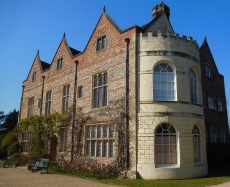
Greys Court has an interesting history, most of which I have summarised from what is contained in a good guidebook published by the National Trust, to which Greys Court and its grounds were donated in 1969. I have also consulted “Elizabeth’s Rivals” by Nicola Tallis. The tower and the attached ancient wall are the only remains of what was constructed by the De Grey family, who had been living on the estate since (or before) the Domesday book was compiled in the late 11th century. One of the family, Walter de Grey (died 1255), Archbishop of York, was a supporter of King John when he was forced into signing the Magna Carta in 1215.
In December 1346, the then owner of the estate Sir John, 1st Baron Grey of Rotherfield (1300-1359) was granted a licence to ‘crenellate’ Greys. What this means is that he was authorised to surround his home with a fortified curtain wall. It is the remains of this mediaeval wall that surrounds the walled garden that attracted me. After Robert, 4th Earl of Grey died in 1387, the estate passed to his daughter Joan, who was married to Lord John Deyncourt. Then, it was inherited by their daughter Alice, who married Lord William Lovell (died 1455). Through this marriage, the estate became owned by the Lovell family.
When Alice died in 1474, she left Greys to her grandson Francis Lovell (1456-c1487), who managed to ‘back the wrong horse’ by being a supporter of the Duke of Gloucester, who became King Richard III. After fighting alongsid the king, who was defeated at the Battle of Bosworth (1485), the Crown confiscated Greys and awarded it to Jasper Tudor (1431-1495), uncle of King Richard’s successor, King Henry VII. In 1514, Greys was leased to a member of Henry VII’s court, Robert Knollys (died 1521). His rent was a single red rose to be paid each Midsummer.
Sir Robert’s son Sir Francis Knollys (1511-1596), a devout Protestant, spent most of the Roman Catholic Queen Mary Tudor’s reign (1553-1558) abroad, returning following the accession of Queen Elizabeth I, who was a cousin of his wife Catherine (1524-1569), whose mother was Mary Boleyn (sister of Henry VIII’s wife Anne Boleyn). One of Francis’s many important jobs was guarding the imprisoned Mary Queen of Scots.
Sir Francis demolished much of the mediaeval Greys Court building and rebuilt it with three gables in the Elizabethan style. His renewed building is what we see today as Greys Court House. One of his reasons for this and other constructions was that he hoped that he would be able to host Queen Elizabeth there, but she never visited. The works were carried out between 1559 and 1596. Francis’s son Sir William Knollys (1544-1632) inherited the Greys estate. It is thought that Shakespeare’s character Malvolio in “Twelfth Night” was based on William. The Knollys family made several modifications and additions to the buildings on the estate but by the late 17th century they began to lose interest in maintaining it. Lettice Kennedy (died 1708), the last of the Knollys to live at Greys sold it to James (or William, according to one source: “Greys Court Volume 2 – Historic England Research Report”: research.historicengland.org.uk) Paul in 1688. Mr Paul and his wife Lady Catherine Fane had a daughter Catherine, who inherited Greys Court. The daughter, Catherine, married Sir William Stapleton (1698-1739) in 1724. Thus, the Stapleton family acquired the property.
Sir William was wealthy. Some of his money came, as the National Trust discreetly puts it:
“…also from sugar plantations in Antigua and Nevis, acquired in the 17th century.”
His son, Sir Thomas Stapleton (1727-1781) inherited Greys. He was a member of the infamous Hell-fire Club along with its principal member and founder, his cousin Sir Francis Dashwood (1708-1781) of nearby West Wycombe. Sir Thomas did not live at Greys Court but arranged for the transformation of the mediaeval remains into ‘Gothick’ follies including the addition of the crenellations that can still be seen on the Great Tower. He also added the two-storey bow windows to Knolly’s Elizabethan house after his marriage to Mary Fane in 1765. She was responsible for many more modifications of the house and its outhouses.
The Grey estate remained in the Stapleton family for several generations, but it was only in 1874 that another male member of the family, Sir Francis Stapleton (1833-1899) began living in it. With no heirs, he left it to his nephew Miles Stapleton, who showed no interest in the place, eventually selling it to a widow, Mrs Evelyn Fleming, in 1934. Both her sons became extremely well-known. Ian Fleming was the creator of the fictional character James Bond. Ian’s brother Peter was an adventurer, soldier, and travel writer, whose life was far more exciting than that led by James Bond. Mrs Fleming was hoping that Greys would be a place where her son Peter could write between his travels, but his marriage to the actress Celia Johnson in 1935 put an end to this idea. So, she sold the property in 1937. The buyers were Sir Felix Brunner (1897-1982) and his wife Elizabeth (1904-2003).
Sir Felix was grandson of the politician and industrialist Sir John Brunner (1842-1919), who was one of the founders of the Brunner Mond & Co chemical company, which became part of ICI in 1926. Sir John was also a supporter of Octavia Hill (1838-1912), the founder of the National Trust, which was formed in 1895. Incidentally, Octavia was also involved with saving London’s Hampstead Heath from disappearing by being built on. As well as serving in WW1, Sir Felix was a Liberal politician. He stood in various Parliamentary elections but was never elected to become an MP. In 1926, he married the actress Elizabeth Irving (1904-2003), a granddaughter of the famous actor Henry Irving (1838-1905).
In 1969, Sir Felix and Lady Elizabeth donated Greys Court to the National Trust and continued to live there. After she was widowed, Elizabeth continued to live at Greys Court, where she died in 2003. During their occupation of the Greys Court estate, the Brunners did much to improve and beautify it, rendering it one of the loveliest National Trust properties that I have visited so far.
I had never heard of Greys Court until a few weeks ago when we drove past a road sign pointing at a road leading to it. As we had never come across the name before and were curious about it, we returned a few weeks later and discovered what a gem of a place it is. While it is relatively simple to describe its history, the opposite is the case when it comes to describing its appearance. Photographs help to do justice to its attractiveness but the best way to appreciate it is to visit it yourself.
DURING RECENT TRIPS TO villages and small towns in Essex and Suffolk, we have noticed that some of the plastering on the external walls of buildings is decorated with patterns and illustrations in bas-relief instead of being flat and featureless, as it often is. I first became aware of this decorative plasterwork on a house in the tiny village of Tollesbury in Essex. As we begun to see more examples, my curiosity about it grew. When we visited Saffron Walden, we saw that the outer wall of a bookshop was covered with plasterwork with patterns and symbols. I decided that if anyone would know about this kind of plastering, it would be someone working in what looked like a serious bookshop.
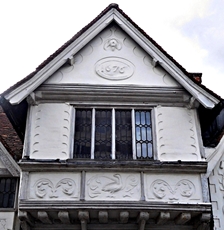
In Saffron Walden
I entered Harts bookshop and noticed two things. Firstly, the shop was very well stocked. It was a place where one might spend quite a long time browsing. Secondly, the shelving units looked very familiar. I mentioned to the sales assistant that the shelving resembled that used by branches of the excellent Daunt’s bookshop chain. She replied that despite its name, Hart’s is now a branch of Daunt’s. Saffron Walden is lucky to have such a fine bookstore. I asked the assistant about the plasterwork with decorations that was on her shop and other buildings in the area. Another customer overheard me and explained that what I was asking about is called ‘parget(t)ing’. According to Wikipedia:
“Pargeting derives from the word ‘parget’, a Middle English term that is probably derived from the Old French pargeter or parjeter, to throw about, or porgeter, to roughcast a wall.”
However, the frequently fine and intricate patterns and illustrations created on the plaster suggest that creating pargetting involves little if any ‘throwing about’ of plaster but rather much care in its application.
The patterns or drawings were/are often produced by filling moulds with plaster while the wall is being plastered. An important ingredient in the plaster used to create these three-dimensional images and to give them some cohesive strength is fibre.
The website http://www.buildingconservation.com suggests that:
“English plasterwork became increasingly elaborate in the 16th century and the dramatic external decoration of Henry VIII’s Nonsuch Palace (1538) was contemporary with early plaster friezes in the great houses. Some of the most opulent pargeting was produced over the next 150 years with a high point around 1660 (for example, Ancient House, Ipswich, and the Sun Inn, Saffron Walden), then the technique began to fall out of fashion.”
Later in the 19th century, some architects like Norman Shaw who were involved in the Arts and Crafts Movement revived pargetting, but the effects produced were far less spontaneous looking than those produced by earlier craftsmen. The same website explains:
“The simplest pargeting takes the form of lines scratched with a stick across wet plaster to create, for example, a lattice within a border. More complexity comes from using fingers and combs or moulded templates, incising or impressing chevrons, scallops, herringbones, guilloches, fantails, rope patterns and interchanging squares.”
To create the images that can be seen in pargetting, the plaster used needs to have sufficient cohesive strength. This can be achieved by adding fibre to the plaster mix. According to the http://www.plasterersnews.com website:
“Early pargeting was always worked in lime plaster which had three main ingredients; lime, aggregate and hair … Traditionally it was probably cow or horse hair but BSE stopped them being used and imported goat and yak hair became popular.”
Modern craftsmen conserving pargetting sometimes use synthetic fibres instead of natural hair because some of the modern sources of natural hair have been washed and this removes natural oils, which prevent the hair dissolving in the plaster.
If you, like me, did not know about pargetting before, now you do. When the man in Harts bookshop mentioned ‘pargetting’, “The Archers”, the British radio serial set in a country village, sprung to mind. One of the memorable characters in this series, which was first broadcast in 1950, is a man called Nigel Pargetter. Sadly, his death was recorded in The Guardian newspaper on the 3rd of January 2011. The paper recorded:
“Pargetter, played by Graham Seed for almost 30 years, was felled by the combination of a loose slate, a flapping happy new year banner on the roof of his home, and the need for a rousing climax to the special half-hour 60th anniversary episode, which the producers promised would ‘shake Ambridge to the core’. It had been, the BBC said, ‘a tough decision’”
You will be relieved to learn that Grahame Seed, the actor who played the role of Nigel Pargetter, still thrives. Nigel might be dead but pargetting still survives and serves to add visual interest to many buildings in East Anglia.
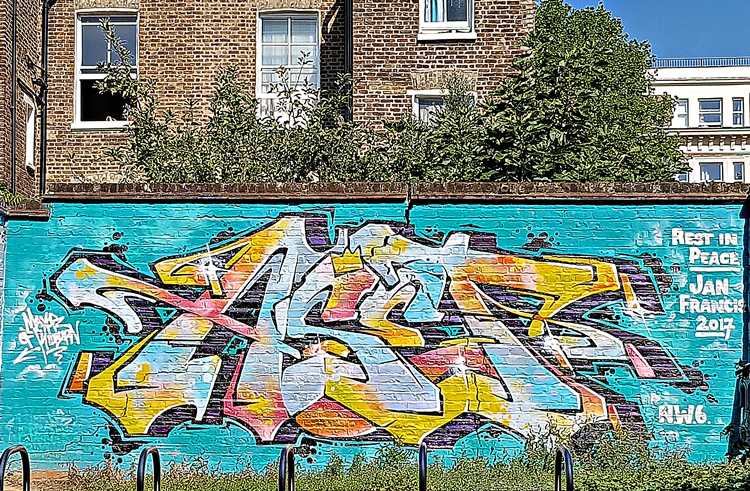
The graffiti on the wall fades
the stones weather
memories wither

 yamey
yamey 