
AN artist born in Egypt who makes sculptures in Switzerland

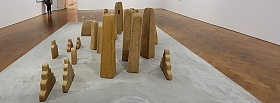
THE WADDINGTON CUSTOT Gallery in Mayfair’s Cork Street puts on excellent exhibitions and the current show, which goes on until 10 April 2025, is no exception. It is an exhibition of sculptures by Yves Dana, who was born in Alexandria (Egypt) in 1959. He moved with his family to Switzerland in 1961. It is there that he lives and works. In the early 1980s, he set up a sculpture studio in Lausanne (Switzerland). In 1996, he paid a return visit to Egypt. Following that, his approach to sculpture changed dramatically. The sculptures on display at Waddington Custot were made long after that visit to the land of his birth; they date from 2004 until 2024.

Each of the works we saw, both at the gallery and outdoors in Smithson Plaza (near Bury Street), is pleasing to the eye. Many of the sculptures allude to the art of Ancient Egypt in subtle ways. Several of the artworks brought to mind the simple beauty of Cycladic sculptures and others evoke the harshness of desert climates.  The gallery’s website revealed that Dana:

“… sources the best quality stone from around the world, including limestone from Egypt, France and Turkey, serpentine from Italy and diabase from Germany. He combines innovative carving techniques with traditional tools to create precise planar forms. With each work created over several weeks or months, the physicality of carving stone, with deep sensitivity to its tones and texture, is evident in the subtlest details of each work.”

This is very evident as one looks at the often sensuously shaped abstract forms of his sculptures. Where there is an interesting detail inherent in the material, he shapes the sculpture so that the viewer’s eyes are drawn to it. Although Dana imposes his artistic will on the materials he employs, he is also sympathetic to their original forms and textures and does not force them to submit totally to his compositional ideas. `Put another way, it seems that Dana’s compositions are guided by the physical properties and shape of the materials he is using.

As you can gather from what I have written, brief though it is, I enjoyed seeing this show and getting to know the work of an artist, whom I had not known about before.

Picture this: art and photography

SOME OF MY REGULAR readers will know that recently I published a short book about the Victorian photographer Julia Margaret Cameron (1815-1879). Her photographic creations, which she produced mainly between 1863 and 1875, differed significantly from those of her contemporaries. At the time that she was taking pictures, most other photographers concentrated on using their cameras to produce slavishly accurate renderings of their subject matter – often portraiture. In contrast, Julia experimented with her focussing, film processing, and other aspects of creating photographic images, to create imaginative artworks, often achieving effects that had been hitherto impossible for painters to produce. She used the camera not to reproduce nature but to produce often expressionistic or impressionistic renderings of her subject matter. For her, the camera was not merely a method of mirroring reality, but a pathway to creating works of art.

Today, the 23rd of May 2023, I visited the Waddington Custot gallery on London’s Cork Street. My wife and I enjoyed viewing an exhibition, “Picture This: Photorealism 1966-1985” – Photorealism was a term created by Louis K Meisel in 1969. The show continues until the 24th of June 2023. At first sight the pictures on display seem to be enlarged, well-focussed photographs. Soon, you will notice that these fabulous pictures of scenes in the USA are not photographs, but paintings created using oil and acrylic paints. One of the gallery staff explained that some of them are not images of actual places, but scenes imagined by the artists. Furthermore, he made an interesting point about them. He remarked that the artists have not painted the scenes as they would have appeared to the naked eye, but instead they have painted them how they would have looked if the images of them had been created using photographic techniques. In addition, by making their paintings of often imagined scenes in this way, the viewer is forced into questioning the assumption that photographs capture the truth.

After seeing the exhibition, it occurred to me that whereas Julia Margaret Cameron was using her camera to create art, the Photorealists were doing quite a different thing – creating artworks that imitate what can be achieved by accurate photography.

[You can get a copy of my book from Amazon: https://www.amazon.co.uk/dp/B0BZFCVLX9/]

Art appealing to eye and brain: two exhibitions near Piccadilly

THADDEUS ROPAC GALLERY, in a most elegant building on central London’s Dover Street is four minutes’ walk from Waddington Custot Gallery on Cork Street. We visited both today (the 13th of September 2022). At Thaddeus Ropac, we saw an exhibition, “City of Silence” by Wolfgang Laib (born in Germany in 1950), and at Waddington Custot, we saw “In the Studio”, a collection of works by March Avery (born 1932 in New York City).

Works in beeswax by Wolfgang Laib

Laib’s works, the best of which is a collection of objects made in beeswax that resemble towers and ziggurats, were not particularly visually appealing at first sight. Neither were his numerous minimalistic works on paper or even a set of identical model boats made in brass. It was only after reading some of the explanatory material provided by the gallery that these artworks began to become interesting. They did not become more appealing to the eye, but they began to make some kind of sense to me. For example, the beeswax towers and other objects alongside them are supposed to evoke thoughts of dwellings in the Middle East and the Towers of Silence where Zoroastrians leave corpses to be devoured by vultures. To some extent, these objects achieve the artist’s mental vision of the structures, which inspired them. However, without the explanations, Laib’s exhibition would have ‘left me cold’.

Immediately on entering Waddington Custot, Avery’s colourful, mostly figurative paintings appealed to my eyes and provided feelings of visceral satisfaction. Although it is highly likely that the paintings are manifestations of the artist’s thoughts and ideas, the viewer can get enjoyment from the artworks without knowing anything about what was going through Avery’s mind while she was creating them.   

We left Avery’s exhibition both visually and intellectually satisfied. In contrast, we felt that Laib’s works on their own without explanation were far less fulfilling than Avery’s.