From rural Cornwall to the Royal Academy in London

ONE OF MY FAVOURITE National Trust properties in England is Trerice, which is about 2.3 miles south of the Cornish town of Newquay – not one of my favourite places in Cornwall.  We visit the house and gardens at Trerice every time we spend time in Cornwall, and always discover soothing there that we had not noticed before.

This tine (June 2024), one of the volunteers working in the house pointed out a painting by John Opie (1761-1807). I had not come across his name before. Our informant told us that he had been born in Cornwall, and thought that he had been involved with the establishment of the Royal Academy. He was born at Trevallas between St Agnes and Perranporth, both of which are not far from Trerice. At an early age, his artistic talents became evident, but his father, a carpenter, wanted John to become a carpenter. A physician, Dr Wolcot, met him at the place where he was an apprentice, and reecognising John’s artistic skills, paid for him to be released from his apprenticeship. Wolcot encouraged Opie, and by the start of the 1790s, he was a successful portraitist in Cornwall.

In 1781, Wolcot took Opie to London, where his works were admired by great artists of the time including Sir Joshua Reynolds, who compared John’s work to that of Caravaggio and Velasquez. A year later, Opie began working independently of Wolcot, who had been supporting him up until then. An acquaintance of Dr Wolcot introduced Opie to the court of King George III. This led to Opie being commissioned to paint portraits of people of high rank in English society and royalty. In 1886, he was elected a full member of the Royal Academy, and in 1805 he was appointed a professor in that esteemed institution.

There are three paintings by Opie hanging on the walls of Trerice house. One is a portrait, and another a self-portrait. The third, which depicts three people playing cards, is a copy of the same picture that can be seen at Petworth house. The version at Trerice is believed to have been painted by Opie and others in his studio. Each of the three people in it have smiles. It is thought that in this painting, Opie was experimenting with the depiction of smiling. Although attractive, this picture is not as attractive as his other two paintings in Trerice.

It is always pleasant to re-visit places, and always exciting to discover something one had missed on earlier trips to that same location. As well as the lovely interiors at Trerice, the gardens surrounding it are always a joy to behold.

Sleeping tightly in Cornwall and India

DURING A WANDER through the rooms of Trerice House in Cornwall, which was constructed in the 15th and 16th centuries, we came across a 16th century four-poster bed in one of the bedrooms. Unlike most four-poster beds, which can be seen in many National Trust properties, this one was missing its mattress. What could be seen is a rope threaded through holes drilled around the rectangular base of the bed. A long single rope was threaded through the holes so that a lattice of ropes formed a set of adjoining squares – a grid. The mattress would have been supported on the rope lattice. From time to time, the lattice would have become loose, -and the mattress would have sagged. The solution was to untie a knot at one end of the rope, and tighten the latticework before re-tying the rope.

My wife pointed out that this latticework arrangement resembled what is commonly seen in India: charpoys. A charpoy looks like a bed frame with four legs, but without a mattress. Ropes or strips of plastic are tied to the frame to produce a latticework very much like what we saw at Trerice. In India, charpoys are used to rest upon. Mattresses are not usually used.

A lady volunteer in the room at Trerice told us that the phrase “sleep tight” originated from the process of tightening the rope that supported mattresses on beds made long ago. This is the most common explanation of the expression. However, there is another (www.straightdope.com/21342710/what-s-the-origin-of-the-expression-sleep-tight), which is based on a definition in the Oxford English Dictionary:

“… what they say: ‘It seems that tight in this expression is the equivalent of the only surviving use of the adverb tightly meaning ‘soundly, properly, well, effectively.!’”

So, it is up to you to decide which of these two explanations sound most likely to you. Or, perhaps, you know of another.

A numerical oddity in Cornwall

TRERICE HOUSE IN Cornwall was built mainly between 1570 and 1573. It is one of the loveliest National Trust (‘NT’) properties in the county and one of my top ten. In one of the upper rooms there is an ornate bas-relief above the fireplace. The top of this bears the following:

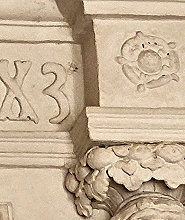
“ANNO: DOMINI: M : CCCCC : LXX3”

It is clearly a date in mostly Roman numerals, (i.e., 1573). However, this date has several odd features.

‘CCCCC’ is 500, but usually abbreviated to ‘D’ in Roman numerals. There is a surplus of colons (‘:’) and instead of ending in a Roman numeral, there is the Arabic numeral ‘3’.  Or is it the symbol for a serpent, rather than a ‘3’? It is a curiously shaped 3: it is widest at the top and tapers towards its lower end.

The NT volunteer offering information in the room with this curious date suggested three possible explanations for this peculiar form of the date above the fireplace. One is that the creator of this date miscalculated the amount of space, and instead of ending the date in ‘: III’, used the Arabic ‘3’ to fit in the last part of the date. Had he used ‘D’ instead of the unusual ‘CCCCC’, there would have been plenty of space to fit in the entire date using only Roman numerals. Another explanation offered is that the ‘3’ is really a stylised serpent, a symbol of wisdom often associated with Queen Elizabeth I, during whose reign the house was built.

3 or a serpent?

The last explanation was provided by a builder, who had visited Trerice some weeks before us. He suggested that the ‘3’ was added to indicate that the building works were supposed to have been completed in 1570, but had finished 3 years later than expected; the builders were running behind schedule.

Whatever the explanation of the curiously written date, and you might have another theory, Trerice is well worth a visit.