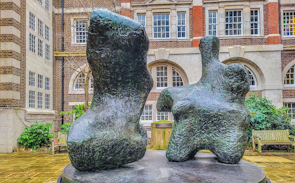
RECENTLY I NOTICED a sculpture close to Tate Britain but not within it.
When the Chelsea School of Art – now the Chelsea College of Art and Design – moved from Chelsea to Millbank next to Tate Britain, so did this sculpture by Henry Moore (1898-1986). Called “Two Piece Reclining Figure No 1” and created in 1959, this was originally placed in the Chelsea campus of the art school, where for a time in the 1930s Moore was Head of Sculpture. When the college relocated to Millbank, the Sculpture moved with it.
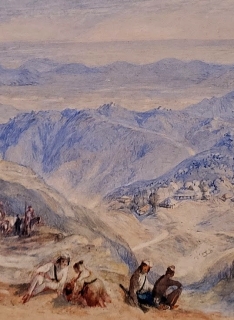
ALTHOUGH THE ROYAL Academician John Zoffany (1733-1810) visited India and created paintings there, the younger and more famous Academician JMW Turner (1775-1851) never visited the country. Yet, an exhibition at the Tate Britain in London, which is showing until 12 April 2026, contains two of Turner’s depictions of Indian landscapes.
Both Zoffany and Turner lived and worked before the birth and full exploitation of photography. Travellers could record their impressions of places both by writing and by sketching or painting. Amongst the many who went out to India in the nineteenth and earlier centuries, there were plenty of officials (both military and civilian) who recorded what they saw by sketching and with paints. It would seem that these people were skilled artists probably because art was included in their education. The images created were important for surveying and topographical purposes as well as, perhaps, a way of passing time in outposts where there was little else to do when the work of the day was over.
Turner, who had become a successful artist, was often commissioned by print publishers to create images that could later be reproduced as mass produced editions of engravings. He painted images of places he had visited as well as places he had never been to. India was one of the latter. However, he created beautiful watercolour depictions of Indian landscapes based on sketches that had been made by British army officers when they were based in India. The two ‘Indian’ watercolours on display in the exhibition are “Musooree and the Dhoon from Landor” (painted in 1835) and “Rocks at Colgong on the Ganges in Bihar” (painted c1835). Both are exquisitely executed and less ethereal than some of his better-known paintings.
“Turner was a great and inventive colourist. If you look at his work from the beginning to the end of his life, the early works are quite dark and sombre, but the later ones are full of colour – brilliant yellow, red, blacks, crimsons, blues. Even if he hadn’t been to somewhere like India, he lived in a place where a lot of people had and they were bringing back descriptions of a more colourful place than England, which was smoky and dark and dull and raining all the time. People were coming back to this England with memories of a place that was full of colour. This was bound to change people’s ideas. In Sir John Soane’s museum in London, there is a bright yellow living room, almost an Indian yellow. That was a yellow that was introduced in Turner’s lifetime, much brighter than anything available before. The tastes for those colours would definitely have been brought back from the empire.”
Even if we cannot be certain, it is possible that some of the pigments brought back from India might have found their way on to his glorious canveses.
The two Indian landscapes form only a minute part of a large, well-attended show setting the works of Constable and Turner side-by-side. Yet, seeing them really helped make the exhibition a ‘hit’ for me. Soon, I will write about other aspects of this show that caught my interest.
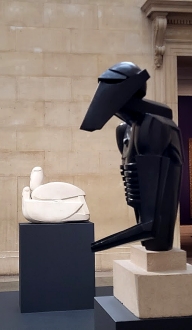
THE DUVEEN GALLERIES in London’s Tate Britain provide a wonderful space to display sculptures. The rooms are wide, long, and have high ceilings. Their walls are plain and do not distract the viewer. Until 30 March 2026, these magnificent spaces contain a selection of sculptures by Jacob Epstein (1880-1959), who was born in New York City. He joined the Art Students League in New York, before moving to Paris in 1902, where he studied sculpture at the École des Beaux Arts and Académie Julian. He settled in London in 1905. Both in Paris and London, he studied non-European sculpture, and what he learned from it often influenced his work. Some of the stone carvings in the Duveen Galleries are evidence of this. Soon after arriving in London, he began receiving important commissions to produce sculptures for significant institutions in London such as the British Medical Association (now Zimbabwe House). He became naturalised as a British citizen in 1910.
The collection of sculptures in the Duveen Galleries includes several stone carvings in different styles. The Tate’s website noted:
“In the 1910s, Epstein became a key figure in the ‘direct carving’ movement in Britain. This approach emphasised a ‘truth to materials’, in which sculptors worked directly with the stone, using its natural qualities rather than making wax or clay models first. He was influenced by the techniques and imagery used in ancient Egyptian, West African and Oceanic carvings, which he collected. At the time, his portrayal of sexuality as well as the simplified forms of his monumental figure carvings drew both admiration and intense criticism, limiting his opportunities for public commissions.”
Some of the sculptures on the former British Medical Association (now Zimbabwe House) building were criticised as being too explicit for Edwardian tastes, when they were completed in 1908. Sadly, these sculptures that can still be viewed from the Strand are badly damaged by being exposed to the weather and pollution.
The stone carvings in the Duveen, which vary from figurative to almost abstract, were all new to me. The bronze busts of famous and not-so-famous people include portraits of family members, artists, writers, entertainers and other public figures. These are the works that I tend to associate with Epstein. So, seeing his stone sculptures was a new and pleasant revelation for me. Each of the sculptures on display is accompanied by an informative panel. The works are well spaced so that each one can be admired in splendid isolation. This is an exhibition worth seeing.
THE PAINTER REX WHISTLER (1905-1944) was commissioned by the Tate Gallery (now the Tate Britain) to create a mural for what was its refreshment room in 1926. Assisted by Katharine Ann West (1904–1930), it was completed by 1927. Completely surrounding the room, it illustrates a narrative, which has been summarised on the Tate’s website as follows:
“Whistler’s mural depicts an expedition in search of rare food and drink, led by the fictional Duke of Epicurania. A hunting party sets off from the steps of the gallery. It travels across rivers and seas, through pastoral landscapes and wild forests. The group shoots at leopards and deer and meets unicorns and mermaids. They pass islands topped with Italian cities, encounter shipwrecks and ruins, and visit the Great Wall of China. They return home laden with spoils, greeted by a cheering crowd.”
Usually, the former refreshment room and its mural are not open to the public. Recently, it has been opened and within it a large screen has been set-up. A short film is projected on the screen. The film has two actors, one playing the part of Rex Whistler, and the other of a fictional academic, Professor Shepherd, who discusses the mural with him. Unfortunately, because the film is being screened, the former dining room has subdued lighting, which makes it difficult to fully appreciate Whistler’s superbly painted mural.
Most of the mural is gloriously picturesque, and cannot give rise to any objections. However, if you look closely, there are two insensitive depictions of Black people that might easily cause offence to viewers today. Whether they would have upset the Tate’s visitors in the late 1920s, I do not know. The bulk of the dialogue in the film being screened in the room relates to the presence of these two frankly racist images on the mural. During the film, the fictional prof gives the artist a hard time about the way he represented the two Black people. I got the impression that the person who wrote the script wished to convey that Whistler could not see why the prof was upset by the way he had painted these figures.
The mural was painted eight years after WW1, during which Black and Asian soldiers fought and sacrificed their lives for the British who had colonised the countries from which they came. Whistler must have known about them. Only seven years before the mural was created, countless numbers of Indians were slaughtered at Jallianwala Bagh in the Punjab. Their massacre was ordered by Reginald Edward Harry Dyer. After he was reprimanded for this, and had returned to England, the public, regarding him as a hero rather than a murderer, raised over £26000 (approximately £1,485,000 today) for him. And that was after 1920. It might be a big leap, but it struck me that if the British public felt justified raising so much for such a man in the 1920s, maybe many of them would have seen nothing to complain about when seeing how Whistler portrayed people of colour in 1927.
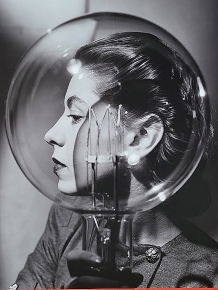
AT TATE BRITAIN in London, there is an exhibition of photographs taken by the highly talented Lee Miller (1907-1977), which is showing until 15 February 2026. We visited it today, 15 October 2025. There is a vast number (about 250) of Miller’s photographic works on display. And there was a vast number of people looking at them. Plenty of the images are quite small, and viewing them was not easy because of the crowd of other visitors.
After leaving the exhibition, I looked at the catalogue that has been prepared for it. Many of the exhibits are reproduced well in this huge volume. Whereas in almost all other exhibitions, viewing the actual artworks in ‘real life’ is far more satisfactory than seeing them in a catalogue. I felt the reverse was the case with the Lee Miller show. With the catalogue in your hands, you cans get close to the images, and enjoy them for as long as you wish without being disturbed by others around you.
Unless you are a Member of the Tate, you need to pay about £20 (per person) to see the exhibition. The catalogue costs £32 (paperback). In the case of this exhibition, but not most others, I would suggest buying the catalogue without purchasing an entry ticket. It is a case of see the book, not the exhibition.
UNTIL I ATTENDED the superb display of the paintings of Edward Burra (1905-1976) at a special exhibition at London’s Tate Britain, I associated him only with depictions of the USA. Despite his Italian sounding surname, Burra’s father came from a long-established British family. Edward trained as an artist at Chelsea School of Art, then at the Royal College of Art. In 1925, he contracted rheumatic fever, and for the rest of his life he suffered ill-health. However, this does not seem to have affected his ability to produce an impressive number of beautiful paintings.
The exhibition at Tate Britain displays Burra’s paintings and drawings chronologically. Throughout his life, he produced works of art that are not only attractive and intriguing but also sensitive portrayals of his views of the times in which he lived. Some paintings exhibit his interest in surrealism, but although many of his paintings have a dreamlike quality, they are in the main not what could be described as Surrealist. His images of France, although highly original and imaginative, capture the ‘atmosphere’ of French life between the two World Wars. Burra was keen on jazz. Many of his paintings include jazz musicians, particularly those he made while visiting the USA, and New York City in particular. The exhibition includes a collection of some of the artist’s collection of jazz music records.
Burra lived through two World Wars and the Spanish Civil War. The Tate’s exhibition includes many of his paintings depicting the horrors of these conflicts. The final room of the show displays Burra’s portrayals of Britain. The artist’s depictions of landscapes is stylistically original, slightly abstracted, but evokes their nature perfectly.
Whether Burra is painting people or objects or machinery or landscapes, the impact of his painting is in each case powerful. This wonderful exhibition will continue until 19 October 2025, and is well worth seeing. I am glad I went because now I realise that although his paintings of New York and jazz are wonderful, they are only a fraction of Burra’s amazingly artistic output.
THE FIRST ROOOM of the Tate’s exhibition of photographic images of Britain in the 1980s, “The 80s Photographing Britain”, was disappointing. There were too many small photographs, which would have been far easier to appreciate by seeing them in a catalogue or book. However, the other rooms of this show, which is on until 5 May 2025, contain many photographs that are often interesting as well as artistic. As the Tate’s website explained, during the ‘80s:
“… photography was used as a tool for social change, political activism, and artistic and photographic experiments.”
It continued to say that the visitor to the exhibition will:
“See powerful images that gave voice and visibility to underrepresented groups in society. This includes work depicting the Black arts movement, queer experience, South Asian diaspora and the representation of women in photography.”
After my initial disappointment in the first room of the exhibition, I soon began enjoying the exciting range of pictures on display in the rest of the show. During most of the 1980s, I was working as a dentist in a small, rather conservative provincial district in Kent, and was largely unaware of the social changes that were going on around me. So, now, many years later after having seen the exhibition at the Tate Britain, it has only dawned on me what had passed me by while I was concentrating on looking after the dental health of some of the inhabitants of the Medway Towns.
Would I recommend seeing this show? My answer is ‘yes’, but hurry because it is ending soon.
THE EXHIBITION WE saw today (the 3rd of June 2024) at London’s Tate Britain exceeded our expectations. Called “Now You See Us”, it consists of about 150 artworks created by over 100 women, working between the years 1520 and 1920. Apart from their gender, these artists shared at least one other thing in common: they were professional artists who worked in Britain, rather than talented amateurs. The earliest works on display are by women working in the Tudor Courts during the 16th century. They include Susanna Horenbout (1503–1554) and Levina Teerlinc (c.1510s–1576), some of whose exquisite paintings can be seen in the exhibition.
There were too many artists to be able to describe them all in this short essay. Some of them (for example: Angelica Kauffman, Artemisia Gentileschi, Mary Beale, Mary Moser, Laura Knight, Julia Margaret Cameron, and Elizabeth Forbes) are now well-known, but others whose works are exhibited are somewhat obscure. One notable artist, Élisabeth Vigée Le Brun (1755-1842), who lived (and painted a little) in England for about three years, is not exhibited in the show, which is a pity because from what I have seen of her work (at Ickworth House in Suffolk), she was a highly competent artist. Next, I will highlight several things that particularly interested me in this superb exhibition.
There are several small paintings created on sheets of ivory. They reminded me of the glass paintings I have seen in India. One of these is a beautifully executed self-portrait by Sarah Biffin (1784-1850). She was born without arms or legs, yet learned to sew, write, and paint using her mouth. Early in her career, she worked at country fairs, where people used to pay to watch her draw and paint. Later, she established herself as a professional portraitist.
There were three photographs by the Victorian photographer, Julia Margaret Cameron, about whom I have written a short book. I am glad that her works are included in the exhibition because her skill was creating painterly works of art, rather than accurate images, with photography. Here work was greatly admired by the pre-Raphaelites.
I was interested to see a painting by Frances Reynolds (1729-1807), who was the sister of the famous artist Sir Joshua Reynolds. Although the painting is not a great work of art, its presence in the exhibition exemplifies the situation for women artists before they were first admitted to art schools in the second half of the 18th century. Before that time, several of the artists, whose work is on display, had to learn to paint from male artists in their family – fathers, husbands, and so on.
For a very personal reason, I was interested to see a painting by the poet and painter Anne Killigrew (1660-1685). Her father was the playwright Henry Killigrew (1613-1700). The reason that this Killigrew family is of interest to me is that their coat of arms includes the double-headed eagle, indicating the family’s connection with the mediaeval Earls of Cornwall. Sadly, Anne, whose works are attractive, died young following a smallpox infection.
One room of the exhibition contained works by women artists working in the Victorian era. These, often sentimental, works did not appeal to me. However, the final room, which contains works created in the first two decades of the 20th century, is spectacular. Many of the exhibits in this room demonstrate how artists were abandoning tradition, and exploring new techniques. This period coincided with the gradual improvement in women’s rights in Britain.
The exhibition continues until the 13th of October 2024, and is well worth visiting.
LAST YEAR, THE exhibits at Tate Britain were re arranged – or ‘rehung’ as the gallery likes to put it. In addition to rearranging the paintings and sculptures – very excellently I might add – previously unseen exhibits were added to the galleries. One of these is in a small gallery containing sculptures and some drawings by the British artist Henry Moore (1898-1986).
The additional exhibit in this gallery devoted to Moore is a glass cabinet containing a Ban the Bomb poster – a photomontage – designed by Henri Kay Henrion (1914-1990). I went to school in Belsize Park with one of his sons for a few years. The rest of the contents of the cabinet are documents – mainly press cuttings – about one of the sculptures near to the cabinet. They relate to a sculpture Moore created for the University of Chicago. The bronze sculpture, which at first sight resembles a combination of an atomic ‘mushroom cloud. with a distorted face beneath it, is called “Atom Piece (Working Model for Nuclear Energy)”. The Tate’s website (www.tate.org.uk/art/research-publications/henry-moore/henry-moore-om-ch-atom-piece-working-model-for-nuclear-energy-r1171996) explained:
“As its subtitle suggests, Atom Piece (Working Model for Nuclear Energy) 1964–5 represents the intermediary stage in the development of a much larger sculpture, Nuclear Energy 1964–6, which Moore was commissioned to make for the University of Chicago to mark the twenty-fifth anniversary of the first controlled generation of nuclear power, conducted by the Italian physicist Enrico Fermi in 1942.”
The sculpture next to the cabinet is one of 13 bronze castings that Moore had made from one of his plaster maquettes that were created whilst planning the larger sculpture commissioned by the University of Chicago. Moore donated it to the Tate.
The photomontage by Henrion shows a human skull superimposed by a mushroom cloud. He created it in about 1959. The Tate’s website mentioned that Moore was most probably aware of Henrion’s terrifying image long before he created the sculpture for Chicago:
“Moore is likely to have been familiar with Henrion’s photomontage: in 1950 he had signed a letter published in the Times protesting against the potential use of atomic weapons, and in 1958 had become one of the founding sponsors of the CND.”
Although I have seen the ‘atomic’ sculpture by Moore at Tate Britain many times, I had not taken any special interest in it. However, thanks to the superb ‘rehang’ at the gallery and the addition of the glass case containing Henrion’s image, I began to appreciate the atomic sculpture, and strangely also began to enjoy Moore’s sculptures even more than I had before.
WHAT IS YOUR EARLIEST memory of a news item? In my case, I remember my parents discussing something about Cuba. This was The Cuban Missile Crisis of October 1962. I had little or no idea about it, but later I learned that US President John F Kennedy was involved in its resolution. A year later, when we were staying in the USA, we were there when he was assassinated. I well recall that and my feelings about it at the time. That remains in the forefront of my memory, but far back in the fleshy recesses of my grey matter, the name Grunwick resides. While visiting an exhibition at the Tate Britain recently, I saw several photographs that brought this vague memory back into my consciousness.
Grunwick Film Processing Laboratories (‘Grunwick’), located at Willesden in northwest London, processed photographic films and produced finished prints from them. Photographers (mostly amateurs) put their undeveloped exposed films into an envelope along with payment, and sent them to Grunwick, who later returned the developed film and the prints made from it. In 1973, some workers at Grunwick joined a trade union and were subsequently laid-off by the company. The company employed many workers of Asian heritage – including a substantial number of ladies. As the then Labour politician Shirley Williams pointed out, the Asian ladies were being paid very much less than the average wage, and conditions were bad – hours were long, overtime was compulsory (and often required without the employer giving prior notice).
On the 20th of August 1976, Grunwick sacked Devshi Bhudia for working too slowly. That day, three other workers walked out in support of Devshi. Just before 7 pm that day, Jayaben Desai (1933-2010) began walking out of the factory. As she was doing so, she was called into the office and dismissed for leaving early. When she was in the office, Jayaben said (see guardian.com, 20th of January 2010):
“What you are running here is not a factory, it is a zoo. In a zoo, there are many types of animals. Some are monkeys who dance on your fingertips, others are lions who can bite your head off. We are those lions, Mr Manager.”
Thus began a two-year long strike, which was supported not only by the company’s workers but also by many politicians and trade unions, including, for a short time, the Union of Post Office Workers, who refused to cross the Grunswick picket lines.
Jayaben was born in Dharmaj, now in the Anand district of the Indian state of Gujarat. Soon after marrying, she and her husband migrated to what is now Tanzania. Just before the Commonwealth Immigrants Act (1968) made it difficult for Commonwealth citizens to settle in the UK, the couple moved to England. There, she was obliged to take up poorly paid work, first as a sewing machinist, and then as a worker at Grunwick.
Not only did Jayaben initiate the strike, but she helped keep it going until the dispute was resolved. In November 1976, when the Post Office workers stopped supporting the strike, she told an assembly of Grunwick’s workers:
“We must not give up. Would Gandhi give up? Never!”
Later, like Gandhi, she employed his tactic – the hunger strike – outside the Trade Union Congress in November 1977. During the court of enquiry led by Lord Justice Scarman, she gave powerful evidence against her erstwhile employer. When the strike was over, she went back to sewing, and then later became a teacher of sewing at Harrow College. After passing her driving test at the age of 60, she encouraged other women to do so to increase their freedom. After her death, some of her ashes were deposited in the Thames, and the rest in the Ganges.
The reason that Grunwick came to mind at Tate Britain was that its current exhibition “Women in Revolt! Art and Activism in the UK 1970-1990” (ends 7th of April 2024) includes several photographs taken at Grunwick during the strike. Three of them include portraits of Jayaben in action.
As I wrote earlier, I had heard of Grunwick, but I could not recall why until I saw the exhibition. As for the remarkable Jayaben Desai, I am happy that I have become aware of her and her amazing achievements.




 yamey
yamey 