Off with his head in the centre of Norwich

THE CHURCH OF St Peter Mancroft stands above the marketplace in the centre of Norwich. Built between 1430 and 1455, it is an elegant example of the Perpendicular style. It was constructed to show off the wealth of the 15th century citizens of Norwich. It is filled with interesting features. I will discuss two of them.

The church contains a Resurrection tapestry, which is in fine condition. It was woven by Flemish weavers in 1573, and might have once been used as an Easter Day covering for the front of the high altar. The tapestry depicts the Easter story in three episodes. The central panel shows Christ emerging from his tomb. In another panel of the tapestry, Jesus is depicted as a gardener, which is how he appeared to Mary after he had left his tomb (John, chapter 20).

The tapestry is kept at the west end of the church close to the font. The other feature that I will describe is in the chancel in the eastern half of the church. It is a memorial to the polymath and writer Sir Thomas Browne (1605-1682), who was a parishioner of St Peter Mancroft. He was buried in the church and lay undisturbed until 1840, when workmen accidentally broke open his coffin. Then, his skull was removed from the rest of his skeleton for phrenologists to study it. It was only in 1922 when the detached skull was reburied in St Peter Mancroft, but not in the same place as the rest of Browne’s body. The burial register for 1922 recorded the skull as being aged 317 years,

Browne, who was interested in everything in a scholarly way, would most likely have approved of having his skull investigated by phrenologists.

Although visiting the Anglican cathedral is one of the highlights of a trip to Norwich, St Peter Mancroft should not be missed.

Art works by Graham Sutherland for Coventry Cathedral on display in a country house in Berkshire

ON THE FOURTEENTH of November 1940, Coventry’s cathedral was badly damaged by bombs dropped from aircraft of the German Luftwaffe. After WW2, a new, modernist cathedral was constructed next to the shell of the damaged one. Designed by Basil Spence, the new cathedral was built between 1956 and 1962. Visitors to this magnificent replacement cathedral can hardly miss seeing the enormous tapestry that hangs at the eastern end of the church. Depicting “Christ in Glory in the Tetramorph”, it was the creation of the artist Graham Sutherland (1903-1980). I have seen this work and admired it on several occasions, but little did I expect to find a connection with it when visiting a National Trust property not far from Reading – Basildon Park.

Set in lovely grounds surrounded by rolling hills that lead down to the rows of trees growing near the Thames, the house at Basildon Park was largely completed in the Palladian style by 1783. After a series of owners, including the military during the two World Wars, it was bought by Lord and Lady Iliffe (later known as ‘the 2nd Baron and Lady Iliffe’) in 1953. They restored the house, and filled it with artworks they collected. A great patron of the arts, Lord Iliffe was a friend of the artist Graham Sutherland. He and his wife were able to purchase many of the studies that Sutherland made when planning the great tapestry that hangs behind the high altar in Coventry Cathedral. Some of these were donated to the Herbert Museum in Coventry, and several of them are on display in a room on the ground floor of Basildon Park. The studies exhibited in Basildon Park demonstrate Sutherland’s great artistic talents. Each of them, although sketches of details to be included in the final tapestry, is itself a lovely work of art.

Sutherland’s studies are (for me) the highlights of the Iliffe’s artworks on show in their former home – they gave it to the National Trust in 1978. In addition to these fine works, a few others caught my attention. In one room on the first floor, there are four sketches of places in India by William Daniell (1769-1837). It is quite appropriate to find these in Basildon Park, which was originally built by Frances Sykes, who made his fortune in the British East India Company. Another, more recent, painting that interested me was a portrait of Lady Iliffe painted in the 1940s by Frank Salisbury (1874-1962). A society portrait painter, he interested me not because of his art, but because he owned a spectacular neo-Tudor mansion, Sarum Chase, on West Heath Road in London’s Hampstead. I came across him when I was doing research for my book about Hampstead.

For some reason, despite visiting many National Trust properties around it, today (the 19th of May 2024) was the first time we went to see Basildon Park. The house is worth seeing – its rooms are spacious and well-lit, and the artworks are, as I hope I have explained, of great interest. Also, it stands in beautiful grounds – an idyllic English countryside.

Burne-Jones in London

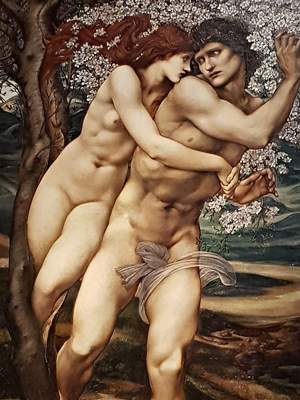
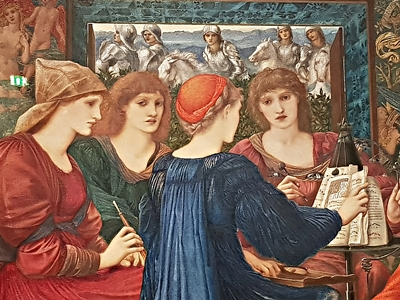
Until 24th February 2019, there is an excellent exhibition of the works of the Pre-Raphaelite artist Edward Burne-Jones (1833-98) at London’s Tate Britain.

BURNE 1


For Victorian art  

looking back to the past

Burne-Jones does excel


BURNE 2