
ST MARGARET LOTHBURY CHURCH stands on Lothbury, facing the north side of the Bank of England. It is, so the rector told us, the only one of the churches designed after the Great Fire of London (1666) by Christopher Wren, which did not suffer damage during WW2. It contains some beautifully crafted wooden features including a choir screen originally erected in the Church of All Hallows the Great (demolished 1894) in about 1683. In a side chapel, my wife spotted a gravestone that aroused our interest.
The black grave stone is to commemorate the Barnes family. The name at the top of the carved inscription is “James Barnes Jnr” of Tokenhouse Yard, who died in 1830. Other members of the family, who died later than him are listed below his name. What interested us was James’s address. Tokenhouse Yard, which is just under 100 yards in length, still exists and runs in a northerly direction beginning a few feet away from the west end of St Margaret’s church.
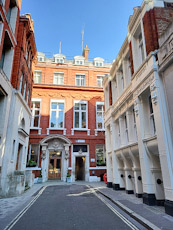
Tokenhouse Yard was laid out by the economist Sir William Petty (1623-1687) during the reign of King Charles I on land which had been occupied by the house and garden of the Earl of Arundel. Petty was, in addition to being an economist, a physician, physicist, philosopher, and one of the first members of the Royal Society. According to an online history of London (www.british-history.ac.uk/old-new-london/vol1/pp513-515) the Yard:
“… derived its name from an old house which was once the office for the delivery of farthing pocketpieces, or tokens, issued for several centuries by many London tradesmen. Copper coinage, with very few exceptions, was unauthorised in England till 1672.”
Daniel Defoe (c1660-1731), who was a child when the Great Plague broke out in London in 1665, later wrote that he remembered terrible sounds and scenes in the then densely populated, and probably somewhat squalid Tokenhouse Yard, many of whose inhabitants were infected. As it was during the worst days of our recent covid19 pandemic, back in 1665 there was nobody out in Tokenhouse Yard. He wrote:
“Passing through Tokenhouse Yard, in Lothbury, of a sudden a casement violently opened just over my head, and a woman gave three frightful screeches, and then cried, ‘Oh! death, death, death!’ in a most inimitable tone, which struck me with horror, and a chilliness in my very blood. There was nobody to be seen in the whole street, neither did any other window open, for people had no curiosity now in any case, nor could anybody help one another. Just in Bell Alley, on the right hand of the passage, there was a more terrible cry than that, though it was not so directed out at the window; but the whole family was in a terrible fright, and I could hear women and children run screaming about the rooms like distracted; when a garret window opened, and somebody from a window on the other side the alley called and asked, ‘What is the matter?’ upon which, from the first window it was answered, ‘Ay, ay, quite dead and cold!’ This person was a merchant, and a deputy-alderman, and very rich.”
Today, few, if any, people live in Tokenhouse Yard. It is now lined with office buildings, some quite elegant. At the north end of the Yard, there is a large decorative terracotta coloured Victorian edifice – number 12, named Token House. This was built for Huth’s Bank in 1872 to the designs of EA Gruning, a German immigrant. The bank was founded by another German – Frederick Huth (1777-1864). Today, the building houses offices.
An archway in the façade of Token House is the entrance to a covered alleyway – effectively a tunnel – that leads to Telegraph Street. This is so-named because it was near the building housing the Electric and International Telegraph Company (founded in 1855). Of interest, if you happen to be in the area, there is a nice coffee house, Ravello, on this street.
The Fire of London destroyed many buildings in 1666. Although these were replaced by newer ones, many of which have been demolished since, the conflagration did not destroy the medieval street layout of pre-Fire London. Thus, today we can enjoy the quaint narrow streets of yesteryear even though many of them, including Tokenhouse Yard and Telegraph Street (formerly the eastern part of ‘Great Bell Alley’) are lined with buildings constructed after Queen Victoria ascended to the Throne. The archaic network of streets in the old City of London add charm to what otherwise would have become a far less interesting urban area.


 yamey
yamey 