
A church with maps in Venice

SANTA MARIA DEL GIGLIO, or ‘Santa Maria Zobenigo’ as it is commonly named in Venice, is a baroque church with a magnificent façade. It was built between 1678 and 1681. The edifice was constructed by Giuseppe Sardi for Admiral Antonio Barbaro, who died in 1679. Amongst his many achievements he was Provveditore Generale (Governor General) of Venetian Dalmatia and Venetian Albania in 1670-71.

During my many visits to Venice, most of which were made annually with my parents during the 1960s, I have passed the church and noted an interesting feature of its façade. The base of this is decorated with six carved stone bas-relief maps. These have always fascinated me, but it was only after our recent trip to Venice in September 2022 that I finally got around to investigating them.

The maps are of Spalato (Split in Croatia); Corfu; Roma (Rome); Padoa (Padua); Candia (Haraklion in Crete); and Zara (Zadar in Croatia). Except for Rome, these are all places that were once governed by Venice. The maps depict places where Antonio Barbaro served in one capacity or another.

Wnen James (later Jan) Morris wrote “Venice” (published 1960), which is I believe the best book written about Venice, he/she noted of the façade of Santa Maria Zobenigo that:

“… it is notorious because not one item of its convoluted design has any religious significance whatsoever.”

Morris also pointed out something I have never noticed on that façade. Namely, that it bears a crest with a double-headed eagle, the crest of the Barbaro family. As this symbol interests me, I checked it out. The Barbaro family might have used it because of their connection to the Vlasto family, who were prominent in Rome by the end of 2nd century AD (see; www.christopherlong.co.uk/per/vlasto.byzantium.html). By the end of the 11th century, the Vlasto family was members of important families including the Barbaro’s. The Vlasto family crest includes the double-headed eagle, which amongst other things, was a Byzantine symbol. Interestingly, the Vlasto’s had already begun using it in the early 1st century AD, while the Byzantines only began using it in the 12th – 13th centuries. Maybe I never noticed the double-headed eagle because whenever I have passed the church, my eyes have been drawn to the maps on its fine façade. They fascinated me so much that I never bothered to look upwards.
Reform and destruction in an English cathedral

SPLIT IN FORMER Yugoslavia, now in Croatia, is a city that developed in the ruins of a great establishment, the Roman Diocletian’s Palace. Likewise with the city of Ely in Cambridgeshire: it developed within the remains of another great establishment, the large Abbey of Ely, which was dissolved by King Henry VIII in 1539. By 1541, after having its charter renewed by the king, its then bishop, Thomas Goodrich (1494-1554), instigated an orgy of iconoclasm, to which I will return soon.

In 1975, I visited the city of Prizren in the former Yugoslavia, now in Kosovo (Kosova). I was impressed by what I saw in one of the place’s fine mediaeval churches. The caretaker showed me that the frescos on the walls inside the building were badly damaged, but only up to a certain height above the ground, Above this, they were as intact as one could hope for paintings of that age. He explained to me that many centuries ago, the Ottoman soldiers were ordered to destroy the figurative images depicted on the walls. They used the tips of their spears to do the job, but they only destroyed what they could reach from the ground (i.e., without using ladders). Sadly, the iconoclasts working under the orders of Henry VIII and Bishop Goodrich were more diligent in their destructive activities.

Under Goodrich’s orders, first the shrines to Anglo-Saxon saints were mutilated. Then, the vandals attacked all the stained glass and many of the statues in the cathedral, before getting to work on the large Lady Chapel on the north side of the body of the church.

The spacious, airy, light-filled, Lady Chapel is at first glance a magnificent example of 14th century gothic architecture, which was created in 1321. The excellent article in Wikipedia (https://en.wikipedia.org/wiki/Ely_Cathedral) describes an important and interesting aspect of the chapel:

“Below the window line, and running round three sides of the chapel is an arcade of richly decorated ‘nodding ogees’, with Purbeck marble pillars, creating scooped out seating booths. There are three arches per bay plus a grander one for each main pillar, each with a projecting pointed arch covering a subdividing column topped by a statue of a bishop or king. Above each arch is a pair of spandrels containing carved scenes which create a cycle of 93 carved relief sculptures of the life and miracles of the Virgin Mary. The carvings and sculptures would all have been painted.”

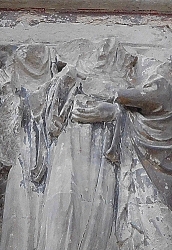
When we entered the Lady Chapel, we were in so much awe of its beauty that we did not at first notice something, which a church official soon pointed out to us. In each of the booths or alcoves lining the walls, the statues are either missing their heads or their faces have ben erased crudely. The deliberate damage to these statues was ordered by Bishop Thomas Goodrich. He also removed some of the larger statues that once adorned this fine chapel. It was seeing this destruction that reminded me of my trip to Prizren so long ago.

After looking at the Lady Chapel, we explored other parts of the cathedral, where I found other examples of statues that had lost either their faces or their heads. The iconoclasm that occurred in the so-called Reformation, which began in the 1530s, can be seen in many English churches, especially with regard to the acres of stained glass that were wantonly destroyed during that period of religious reform. Maybe, this destructive era should also be known as the ‘de-formation’. Some valuable examples of the pre-Reformation stained-glass can be seen in Ely Cathedral’s fascinating Stained-Glass Museum, which is well worth visiting. Incidentally, apart from European stained glass from across the centuries, the museum has recently acquired a fine example of stained glass from the USA, depicting a black African American.

Although I have concentrated on aspects of destruction, there is plenty of Ely Cathedral left for the visitor to enjoy, including fine gothic and pre-gothic (Norman) architecture. Many mediaeval and Tudor buildings that were once part of the abbey still exist and are now part of the daily life of modern Ely, just as some parts of Diocletian’s Palace in Split are still in use today. Some of these buildings in Ely are used by Kings School Ely, which was one of about 12 schools founded by Henry VIII. These few schools were the only part realised of a more ambitious plan to build many more schools and other new establishments.

We spent a whole day in Ely but could easily have stayed longer without being able to see all of its attractions. Prior to our departure for the city, a friend had told us that it was an unlikeable place not worth visiting. We discovered how wrong he was.