
Coffee,  Silks, sweaters,and Air India

UNITY BUILDINGS IS a collection of low blocks near to Bangalore’s Town Hall. The buildings are arranged each side of a long Central avenue. I am not sure when they were built but my suspicion is that they were constructed in the 1970s.
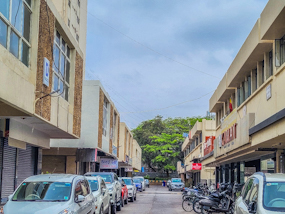
 

Unity Buildings

At one end of the central avenue, there is an older building, Haigh Memorial Hall, which was built in the 1920s. Constructed to commemorate a Wesleyan missionary,  Reverend Henry Haigh, this grey coloured edifice houses an Air India office. Haigh arrived in India in 1875, and during his long stay there he did much work to produce publications in the Kannada language. He returned to England in 1903. The Unity Buildings complex stands on land owned by one of the churches in Bangalore.


We visit Unity Buildings for several reasons. First, there is a Kashmiri shop, where over the years I have bought excellent woollen Pullovers (sweaters). Another reason is to visit two shops that offer good selections of silk scarves and other garments. One of them is Janardhana Silk House and the other, the less costly Shobha Silks.


The third reason to visit the complex is to enjoy good South Indian filter coffee and vegetarian snacks a the Unity Buildings branch of Kamat. According to a sign within the restaurant, this Kamat company has been in business since 1948, when it was founded by Sri Rangappa Pandurang Kamat (1919-1993). Other branches of Kamats were established by Rangappa’s younger brother Sri Sheshagiri Pandurang Kamat (1926-2002). The Unity Buildings branch of Rangappa‘s company was opened in 1972, and maintains its original appearance, apart from new overhead lights.


Usually full of customers, Kamat in Unity Buildings was almost empty on Republic Day this year (2026). When we stepped inside, we were given a warm welcome by the manager, whom I imagine was pleased to see at least two customers on such a quiet day.


On normal working day,  Unity Buildings is a bustling place, but never as busy as, say, Bangalore’s Commercial Street area and KR Market (City Market). However, it is a pleasant place to shop for various things.

Knots, threads, and folds

THIS MARCH (2023), we have seen several exhibitions of works of art and craft involving the use of braiding, knotting, weaving, and other methods of employing threads. We saw the exhibition of Kimohimi braiding at the Japan House in Kensington. At the Tate Modern, we saw the quipus created by Chilean Cecilia Vicuña and the wonderful exhibition of imaginative fabric sculptures made by the Polish Magdalena Abakanowicz. Today, the 26th of March, we visited the Serpentine North (formerly ‘Sackler Serpentine’) Gallery in Kensington Gardens. We visit this place often because it usually has exhibitions which are always of interest and frequently pleasing aesthetically. Until the 10th of April 2023, the Serpentine North has a display of sculptures by the African American artist Barbara Chase-Riboud (born 1939 in Philadelphia, USA). We had never heard of her, but that did not surprise us as the gallery often shows works by artists, who are new to us.

A talented child, she entered the Fleischer Art Memorial School in Philadelphia. This establishment, which was opened in 1898, offered free art classes to children. After a successful school career at the Philadelphia High School for Girls between 1948 and 1952, she was awarded Bachelor of Fine Arts from the Tyler School at Temple University in 1956. By 1960, she had moved to Paris (France). Just before that, her eyes were opened-up to non-European art when she made a trip to Egypt.

The beautifully produced exhibition hand-out related that in Paris, she:
“… found herself among a diverse community of socio-politically engaged writers, artists and thinkers including James Baldwin, Alexander Calder, Max Ernst, Dorothea Tanning, Lee Miller,and Man Ray. Moreover, through extensive travelsto Egypt, Turkey and Sudan, she deepened herknowledge and appreciation of global art and architecture, which continued to shape her artistic production from this point onwards.”

The Serpentine exhibition is called “Infinite Folds”. This is a good name because many of Barbara’s works involve the use of folded materials, be they sheets of fabric or of cast metal. In many cases folded sheets of metal are combined with bundles of silk or wool threads, often knotted in places. Some of the metal sculptures appear to have skirts of fabric threads. The artist makes these works seem as if the metal is being supported by the threads – giving, as she said, the impression that the wool has become the stronger material and the folded metal sheets the weaker of the two.

Some of the works are the artist’s interpretations of ancient cultures and traditions of places she has visited such as India and China. Other artworks celebrate famous figures from the past including Josephine Baker, Malcolm X, Nelson Mandela, the Queen of Sheba, and others.

The works in the exhibition are intriguing, well-crafted, and beautiful. They have been placed attractively and well-spaced in the within the old armoury, now the Serpentine North Gallery. When we headed for the exhibition, we had no idea what to expect. What we found was breath-takingly wonderful. Although there is no entry charge, I would have been happy to pay to see this artist’s works.