
LESS FAMOUS THAN William Wilberforce (1759-1833), but equally important in helping to end Britain’s involvement in the slave trade, was Granville Sharp (1735-1813). Born in Durham, Sharp was apprenticed to a linen draper in London at the age of 15. A scholar at heart, he left his apprenticeship to become Clerk in the Ordnance Office at the Tower of London, a job that gave him more time to pursue his scholarly studies and music. One of his brothers, William Sharp (1729-1810), was a physician, who is believed to have treated King George III.
One of William’s patients was Jonathon Strong (c1747-1773), a black slave from the West Indies, who had been badly beaten-up by his master, a lawyer called David Lisle. William and Granville helped tend to Strong’s injuries and paid for him to spend four months in St Bartholomew’s Hospital. Lisle instigated a number of court cases to protect his ‘possession’ of Strong. Granville was deeply involved with making sure he lost them and that Strong became a freed man. The Strong case was the beginning of his keen and active involvement in the movement to abolish slavery. His involvement with this and subsequent legal cases connected with the unjustness of the slave trade gave him the reputation of being a “protector of the Negro”.
In 1787, Granville became one of the founder members of the Society for Effecting the Abolition of the Slave Trade. Though sometimes overshadowed today by other abolitionists such as Wilberforce and Thomas Clarkson (1760-1846) played a major role in hastening the end of the slave trade and slavery in places ruled by the British.
By the 1780s, there were approximately 15,000 ‘black’ people in Britain, many of them without employment. Ideas began to circulate that it would be a good idea to form a settlement in Africa to which the Africans could ‘return home’ and live as free individuals. One place that was suggested was Sierra Leone. Granville Sharp was consulted on this and felt that it would be an ideal location to set up a model community for the ‘blacks’. He suggested calling it ‘The Province of Freedom’. Sadly, the well-intentioned province that included a settlement called Granville Town was a failure.
Granville lived long enough to learn that the Act of Abolition received Royal Assent in 1807, but not long enough to know about the final abolition of the slave trade in the British Empire (in 1833). Granville’s brother William had a country dwelling, Fulham House, in Fulham. It was here that the ageing Granville moved after William died. He lived there with William’s widow, Catherine, and her family. It was in this house that Granville breathed his last.
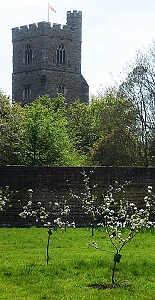
Probably Fulham’s greatest resident, Granville Sharp was buried in the cemetery of Fulham’s parish church (All Saints). His funerary monument, which stands close to the boundary fence of Fulham Palace commemorates him, his brother William, and his sister Elizabeth Prowse. William’s wife Catharine (née Barwick) is also buried beneath this stone, which was restored in 2007.

 yamey
yamey 