Saved from the funeral pyre: an airport is named after this remarkable queen

AHILYABAI HOLKAR WAS born in 1725. She married Khanderao Holkar (1723-1754), the only son of Malhar Rao (1693-1766),  the founder of the kingdom of Indore.
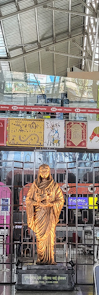
 

Statue of Ahilyabai Holkar at Indore airport

When Khanderao was killed in battle, his devastated wife wanted to commit sati: to throw herself onto his funeral pyre. However, her father-in-law and the subjects of the kingdom successfully persuaded her not to commit suicide. Following that, her father-in-law trained Ahilyabai in military matters. Khanderao’s only son, Malhar’s successor, Male Rao Holkar, ruled from 1766-1767. After his brief reign, cut short by illness, Ahilyabai became ruler of the Kingdom of Indore, which was part of the Maratha Empire.


Ahilyabai was one of the world’s most remarkable queens. As Wikipedia summarised:

“She is renowned for good governance, social welfare, and humanitarian work along with religious, educational, and cultural advancements. She contributed to the growth of Indian architecture through the commission of various temples, Ghats, and Dharmshalas. Ahilyabai’s Matha, or charitable endowments, spread across India.”


As a result, she is now revered as a saint. Apart from her philanthropic activities, she was also involved with military matters (in 1765, she commanded the artillery during an attack near Gwalior), and transferring her capital from Indore to the holy town of Maheshwar.  As if this were not sufficient,  she also transformed Indore into a modern city where commerce and industry were encouraged.


In view of the above, it is very apt that Indore’s airport bears her name. It is called Devi Ahilya Bai Holkar Airport. We flew from it to Bombay. A statue of Ahilyabai greets passengers as they arrive in the hall with the airline check-in desks.

  The airport is smallish, but lovely. The departure lounges are spacious and airy, and there is a good variety of refreshment counters. Some of the walls of the airport have fine examples of art in the style practised by the tribal Gond people. Compared with many other airports I have used, that serving Indore is one of the most pleasant. Ahilyabai would have been pleased to have this place named in her honour.
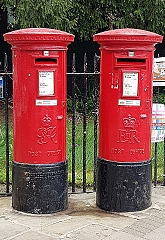
A pair of post boxes

WHILE WALKING IN CAMBRIDGE, I spotted a pair of pillar boxes. At first sight they looked identical but soon I realised that they were not. One had a wider orifice for inserting letters than the other. The wider one bears the ‘logo’ of Queen Elizabeth II and its neighbour with the narrower slit bears the logo of the Queen’s father, King George VI. Apart from these differences, there were much the same.

The two pillar boxes I saw in Cambridge are not particularly old. The first post box on the British mainland was placed in Carlisle in 1853. The idea of using such receptacles for collecting mail is connected with the author Anthony Trollope (1815-1882). An informative website (https://www.postalmuseum.org/collections/highlights/letter-boxes/#) related:

“Anthony Trollope, now more famed as a novelist, was, in the 1850s working as a Surveyor’s Clerk for the Post Office. Part of his duties involved him travelling to Europe where it is probable that he saw road-side letter boxes in use in France and Belgium.He proposed the introduction of such boxes to Britain and a trial on the Channel Islands was approved. Four cast-iron pillar boxes were installed on the island of Jersey and came into use on 23 November 1852. In 1853 the trial was extended to neighbouring Guernsey. None of the first boxes used on Jersey survive. It is possible that one still in use on Guernsey together with another in our collection, originally sited in Guernsey, date from the 1853 extension to the trial.”

Before the introduction of pillar boxes:

“… there was [sic] principally two ways of posting a letter. Senders would either have to take the letter in person to a Receiving House (effectively an early Post Office) or would have to await the Bellman. The Bellman wore a uniform and walked the streets collecting letters from the public, ringing a bell to attract attention.”

Well, all that history is news to me and I might not have bothered to find out about it had I not seen the father and daughter pillar boxes standing side=by-side in Cambridge’s Market Square.

A miniature man with a big story

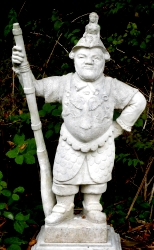
FROM A DISTANCE, the small stone statue in Folkestone’s Kingsnorth Gardens looked like an oriental character, maybe a Hindu god or a Chinese warrior. Getting near to it, you can see that it depicts a small man in armour. The sculpture’s left hand rests on his waist and he holds a stout staff in his right. On the top of his hat or helmet, there perches a female figure, which on further examination proves to be a sphinx. And what fascinated me most was seeing that his breastplate has a double-headed eagle in bas-relief. This curious statue is supposed to be a depiction of Sir Jeffrey Hudson (1619 – c1682).

Jeffrey Hudson

Hudson was baptised in Oakham in the county of Rutland, which used to be one of England’s smallest counties. Maybe, this was appropriate because Jeffrey was only 30 inches tall when he reached the age of 30 years. However, he eventually reached the height of 42 inches (www.nationaltrustcollections.org.uk/object/1129288). Despite his shortness, which might have resulted from a disorder of the pituitary gland, he was perfectly proportioned and therefore a dwarf.  Small as he was, his life story (https://en.wikipedia.org/wiki/Jeffrey_Hudson) reads like a tall tale.

Aged 7 years, Jeffrey was presented to the Duchess of Buckingham, who welcomed him into her household. Soon after his arrival in this august household, the Duke and Duchess entertained King Charles I and his young wife, Queen Henrietta-Maria (1609-1669), at a party in London. The highlight of the evening was the arrival of an enormous pie:

“…two footmen enter the hall carrying a glorious pie, gilded in gold leaf, 2ft high and 2ft wide. The pie is placed before the queen and, as if in labour, it begins to move. A small hand pops through the crust, and a fresh-faced boy emerges with a cheeky smile, dark brown eyes and light brown hair. He wears a miniature suit of armour and marches up and down the banqueting table waving a flag. He returns to the queen and gives a bow.” (www.historyextra.com/period/stuart/amazing-life-jeffrey-hudson-queen-henrietta-maria-dwarf/)

The queen was so delighted by the dwarf that the Duke and Duchess presented her with Jeffrey as a gift.

Jeffrey joined the collection of live ‘curiosities’ that the queen kept in her court. There were two other dwarves, a giant porter, and a monkey, to list but a few. As Jeffrey grew up, he was educated, learned to ride and shoot, and joined in the court’s leisure activities. After the Civil War broke out in 1640 Jeffrey travelled to France with the queen and members of her household. By 1644, Jeffrey had become fed up with being a ‘pet’, a ‘curiosity’, and the butt of cruel jokes. In October of that year, he challenged a man called Crofts to a duel. Out of contempt for tiny Jeffrey, Crofts brought water squirt guns to the duel. However, when hit in the forehead by Jeffrey’s water emitting weapon, Crofts fell down dead.

Duelling was already banned in France. The queen sent Jeffrey back to England. Soon after leaving her court, Jeffrey was on a ship that was attacked by Barbary pirates. He was captured and enslaved. Nothing is known about his life in slavery. However, he is recorded as being back in England in 1669. He lived in Oakham for several years, returning to London in 1676. Convicted for being a Roman Catholic, he spent a long time in the Gatehouse Prison, which used to be in the gatehouse of London’s Westminster Abbey. He died a pauper sometime after being released. Thus ended the life of a very small man.

We wondered what Hudson’s connection with Folkestone was and why the town is blessed with a statue depicting him as he must have looked when he emerged from a pie. It turns out that he has no known connection with the town, but his statue has stood there since Victorian times and was placed in Kingsnorth Gardens in 1928. What we see today is a replica of the original, which had deteriorated over the years (www.gofolkestone.org.uk/news/welcome-return-of-sir-jeffery-hudsons-statue-to-kingsnorth-gardens/). As for the double-headed eagle on the statue’s breast plate and the sphinx on his head, I need to look into this at a later date.