
Dali and Dante in London’s Bermondsey Street

EAMES FINE ART Gallery is in south London’s Bermondsey Street. It specialises in original prints and paintings by Modern and contemporary masters. Whenever we are in Bermondsey Street (usually to visit the White Cube Gallery and the wonderful Vietnamese eatery called Caphe House), we take a look at what is being shown at Eames. Until 18 May 2025, they are showing a collection of wood engravings that the surrealist artist Salvador Dali (1904-1989) first created as watercolours before supervising their transfer onto woodblocks to make prints based on these paintings.

In 1950, the Italian government commissioned Dali to produce a set of images to illustrate the “Divine Comedy”, which was composed by Dante Aligheri (c1265-1321) between about 1308 and 1321 AD. Dante’s work is one of the treasures of Italian literature, and the commissioning of Dali, who was not an Italian, was so controversial that it was debated in the Italian Parliament, after which Dali’s contract was cancelled. As the gallery’s website notes:

“Undeterred, Dalí, with the help of the French publisher Joseph Forêt, decided to complete the project himself and produced 100 sumptuous watercolours in a searing evocation of Heaven, Hell and Purgatory in response to Dante’s text..”

It was these watercolours that were transformed, under Dali’s supervision, into the prints, which are currently on display at Eames. I was interested to see them because usually the only works by Dali that I have seen have been his oil paintings. The images that have been created from these watercolours by Dali are more impressionistic and freer in form than the almost crystal clarity of the images in his oil paintings. I am pleased that we took a look inside Eames. We had no idea that they were showing such an interesting collection of works.

A prolific artist and his amazing output of prints

SOME MIGHT DISAGREE with me, but I was extremely unimpressed by the “Silk Roads” exhibition that is being shown at London’s British Museum (‘BM’) until 23 February 2025. It seemed to be like an overcrowded, poorly lit antiques fair. Additionally, it appeared to be a rather sketchy overview of what is a highly interesting period in the history of international trade. In contrast to the over-hyped Silk Roads show, another exhibition, “Picasso Printmaker”, showing at the BM until 30 March 2025 is magnificent.

Just as Rembrandt (1606-1669) was one of the best European painters of the seventeenth century, Picasso (1881-1973) was one of the best European painters of the twentieth century. Like Rembrandt, Picasso not only painted but also created prints. During his life, Picasso created at least 2400 prints. The BM has by far the UK’s largest and most representative collection of his prints. Some of these are on display in the beautifully curated show at the museum. The exhibition displays a series of Picasso’s prints ranging from some of the earliest (created around 1905) to those he made during the very last days of his life.

The prints on display were made using several techniques including: aquatint, drypoint (engraving), etching, linocut, lithograph, sugar aquatint, and transfer lithography. He learned these techniques from some of the best printers in France, and experimented with methods of his own. Many of the exhibits are prints made with black ink on white paper, but a few contain other colours. Although the black on white images are of the highest artistic quality, the coloured prints are particularly spectacular

The prints on display at the BM illustrate that throughout his long creative life, Picasso was a highly skilled artist who was not lacking in imagination. Each print in the exhibition increased my appreciation and admiration of Picasso’s artistic output. This exhibition should not be missed if you are keen on twentieth century art and are spending time in London.

It was the fashionable thing to do

I AM READING A most fascinating book at present (June 2023). Published in 1984, it is “Staying Power: The History of Black People in Britain” by Peter Fryer (1927-2006). In it, the author described how during the 18th century, it was fashionable for wealthy British people living in England to have at least one ‘black’ servant (or slave, in some cases) amongst their teams of domestic staff. Including a black servant in a portrait painting was believed to add to the perceived status of the subject being portrayed. Putting it crudely, just as sporting a Prada handbag or driving a Maserati is supposed to enhance the status of their owners today, exhibiting the ‘black’ servant did the same for the vanity of the wealthy in the 18th century. Sadly, many wealthy British people in the 18th century did not see the ‘black’ servants as human beings but as valued possessions or accessories.  

Today (3rd of June 2023), we paid a visit to Hogarth’s House in Chiswick. Located next to the busy A4 dual carriageway and the often-congested Hogarth Roundabout, it is now hard to believe that in 1749, the artist William Hogarth (1697-1764) bought this place to use as his country home. For, in those days this 17th century house was surrounded by countryside. The house and its garden are open to the public free of charge. The visitor gets to see a series of wood-panelled rooms, very much like those I have seen a friend’s 18th century house in the oldest street in Kensington. Unlike our friend’s house, the walls of the rooms of Hogarth’s former country place are lined with a large number the artist’s wonderful, printed works. Most of these depict scenes portrayed with many fine details. They express Hogarth’s satirical views of the life and behaviour of his contemporaries.

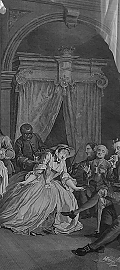
Some of the prints portray the lives of the poor and less well-off. A few depict life in ‘high society’. In several of the latter, there are a few black faces amongst the people in the pictures. All of them are obviously servants. In one of these prints, a black woman with her back facing the viewer can be seen attending to something at her white mistress’s foot. The lady is reclining, and she is looking up from a book propped in front of her. In another print, a black man is shown carrying a cup and saucer into the room filled with white people and there is also a black child playing with a small statue or toy. I examined all the prints on display and noticed that it was only those with scenes of the lives of rich people that included black people. The people in all the other prints were white only.

The depiction of black people with rich people in Hogarth’s satirical depictions of life in 18th century England helps to back up what I have read so far in Fryer’s book. That said, and I might not have noticed what I have described had I not been reading the book, Hogarth’s House is a delightful place to visit. It does not offer refreshments but the lovely café at Chiswick House is only a few minutes’ walk away.

Morandi or bore-andi

CALL ME A PHILISTINE if you wish but I was underwhelmed by the much-hyped temporary exhibition of the works of the Italian artist Giorgio Morandi (1890-1964), which is being shown until the 28th of May 2023 at the Estorick Collection of Modern Italian Art in London’s Canonbury district. Morandi, who was born in Bologna (Italy), where he lived most of his life and died, was primarily a still-life and landscape artist. Without doubt, his works are both carefully and extremely well executed. However, his numerous still life works depicting bottles, jars, and other containers, did little to excite my interest in them. His landscape images appealed to me more, but not much more. For me, almost the best work in the show is a self-portrait, showing Morandi seated.

Compared with the other works in the Estorick’s permanent collection (e.g., Balla, De Chirico, Modigliani, Boccioni, Music, Greco, Manzu, and Russolo), all of which are highly creative and visually exciting, poor old Morandi’s work pales into insignificance. Having expressed my opinion about the temporary exhibition, I must admit that many of the other viewers I saw today seemed to find Morandi’s works of great interest. Many of them stood staring intensely at individual works for minutes rather than a few seconds. Few of the works in the exhibition grabbed my attention for more than a few instants.

Well, maybe I missed something that other people see in Morandi’s art, but if someone were to give me a genuine Morandi, I would sell it as quickly as possible, and might spend the money on a work by a more interesting Italian artist.

Vanishing point

OF JAMAICAN HERITAGE, the artist Barbara Walker was born and brought up in Birmingham where she lives today. During her childhood, she was taken to see museums and galleries. She noticed that in many works (paintings and other images) of western art, Black people play a peripheral role, depicted as servants and so on, serving the ‘white’ people who play a central role in a picture. Recently (April 2022), we visited an exhibition of her works at the Cristea Roberts Gallery in London’s Pall Mall. Called Vanishing Point, this superb display contains artworks, prints, which address the issue that Barbara noted when she was younger.

At first sight, most of the framed prints appear to be large sheets of white paper with a few beautifully drawn details depicting black people or parts of their bodies. Closer examination reveals that there is more to the white spaces than first meets the eye. The white areas are embossed. The black people, who have been drawn, are surrounded by the embossed areas of the print. Together, the drawings and embossed sections of the print can be seen to be a whole picture. Walker has processed an original image to create a new one in which only Black people in the original are easily visible and the rest of the picture forms a ghostly background. Unlike the pictures she saw when a youngster, the Black people in the picture are prominent and the others are barely detectable.

I am not sure exactly how the artist achieved this interesting effect and these powerful images, but I will have a go at explaining, using my experience of having once made etchings in the past. Metal plates are first coated with a photographic material. Then images of an original painting are projected on to it and processed in some way that produces a photographic reproduction on the plate. The artist, then blocks out selected areas on the plate with an acid-resistant material to produce a pattern that includes many details of the original image, including all of the parts of it that contain depictions of Black people or the parts of their bodies in the original painting or image. The plate is then immersed in acid, which eats into all the parts of it, which have not been painted over with the blocking agent. Then, a sheet of dampened paper is placed on the plate and the two are run through a printing press. The pressure exerted by the rollers of the press force the dampened paper into the depressions on the plate caused by the action of the acid. The result is a sheet of paper with embossed indentations. When the paper has dried, the artist then draws on the flat areas, which are in fact silhouettes of the Black people (or details of them) which appeared in the original painting. The rest of the embossed area, containing details and enough outlines of the original image to make it recognisable, is left white. The result is an image in which Black people become the focus of the viewer’s attention.

Barbara Walker’s works on show at Cristea Roberts (until the 23rd of April 2022) are ingenious and extremely engaging. She has employed an interesting technique to make her statement. Rather than reinforcing the fact that Black people were often depicted as being menial as is the case in the recent display of paintings by Hogarth at the Tate Britain, she has found a way of raising their status in artworks that sought to portray them as mere subsidiaries.

Packed with art in St Ives, Cornwall

THE TATE GALLERY has two branches in the picturesque fishing port of St Ives in Cornwall. The artworks displayed at Tate St Ives are contained in a building overlooking Porthmeor Beach, constructed between 1983 and 1993. It replaced a disused gasworks, but I feel that the gallery’s almost fascistic architecture neither does anything to enhance the town or to match the beauty of many of the items displayed within it. The other part of The Tate in St Ives is house and gardens of the sculptor Barbara Hepworth (1903-1975). A visit to her former home and its garden, filled with her sculptures, is a delightful experience.


Barbara Hepworth and her sculpture in the Penwith Gallery

Not far from the Tate St Ives, there is another ‘must-see’ attraction for lovers of modern and contemporary art. This is the Penwith Gallery on Back Road East. Less visited than the two Tate institutions in St Ives, the Penwith is the home of the Penwith Society of Arts, one of whose founders was Barbara Hepworth. The gallery contains one of the loveliest Hepworth sculptures that I have seen to date. Maybe I like it because it recalls the works of the Romanian born sculptor Constantin Brancusi (1876-1957), a sculptor whose works are much to my taste. To be frank, I am not a great lover of Hepworth’s sculpture and this piece in the Penwith is less typical of what I do not like about her work.

Returning to the gallery itself, its website reveals (https://penwithgallery.com/):

“The society was founded in 1949 by Barbara Hepworth,Ben Nicholson, Peter Lanyon, Bernard Leach, Sven Berlin and Wilhelmina Barns– Graham, amongst others. Later members have included Patrick Heron, Terry Frost and Henry Moore (honorary member). This association with so many progressive and influential artists has given the Penwith Society a unique place in British art history.

Today the society continues to play a central role in the thriving and vibrant St. Ives art community, exhibiting contemporary art from Cornwall and beyond.”

The gallery is housed in a former pilchard packing factory. Its ceiling is supported with roughly hewn granite pillars, painted white. Part of the ceiling is glass-covered, allowing natural light into the largest of the three main display areas. The rest of the ceiling does not transmit light.

The gallery displays an ever-changing collection of artworks, which are on sale. Created by members of the Society or artists, who have worked in the Society’s studios, they include sculptures, prints, paintings, and ceramics. Some of the works are figurative and many of them are abstract. Some are halfway between the two extremes. I have enjoyed abstract art since my childhood. This is probably because my mother, who was a sculptor who enjoyed creating abstract pieces. The lovely Hepworth piece that stands next to a fine photograph of its sculptor, and several other works, form part of the Penwith’s permanent collection. A small range of books and cards are available for visitors to purchase.

Every time I visit the Penwith, I enjoy the gallery’s spaces and the works displayed within them.  Instead of being packed with pilchards, as it was in the past, and other tourists, as are the two Tate establishments, the Penwith is comfortably packed with pleasing works of art, which you can take home if you can afford them, and some of them are not excessively costly.