Revolt in two colonies of Portugal in western India

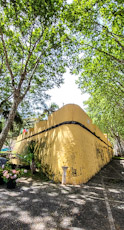
THE TOWN OF SILVASSA is just under 100 miles north of Colaba in Bombay. Known to the Portuguese as ‘Paço de Arcos’, it was the administrative capital of their colony of Dadra and Nagar Haveli, now an Indian Union Territory. Dadra is a small district, roughly circular in shape. It is separated from the larger Nagar Haveli by a small stretch of what is now the Indian State of Gujarat. Between about 1780 and 1954, these two landlocked territories were colonies of Portugal.

During the period when Portugal ruled Dadra and Nagar Haveli, the indigenous people living there were exploited mercilessly and treated harshly by the Portuguese and wealthy local landlords. Neelesh Kulkarni has recently (2024) published a book, “Uprising: The Liberation of Dadra and Nagar Haveli” which describes the struggle to free the two tiny colonies from Portuguese rule, and their eventual incorporation into the Republic of India. His account is not only based on published sources but also interviews with surviving freedom fighters and members of other fighter’s families.

After 1947, when most of what is now India became independent, Portuguese colonies on the Indian Subcontinent remained territorial possessions of Portugal. Kulkarni relates how at least two groups of freedom fighters struggled to evict the Portuguese from Dadra and Nagar Haveli. The Indian government, under the leadership of Jawaharlal Nehru, who had professed to the world to adhere to the principle of non-violence, was unwilling to send troops into the two rebellious Portuguese territories, yet did nothing to hinder the activities of the rebels. The book shows how the rebels planned their attacks on the Portuguese police and militia, collected funds, accumulated weaponry, recruited fighters and trained them.

Being landlocked and separated from their coastal colonies (Daman being the closest) by land, which after 1947 was Indian sovereign territory, made it difficult for the Portuguese to send military aid to their people in Dadra and Nagar Haveli. The Indian government was unwilling to allow military supplies to pass from Daman and Goa through India to the beleaguered landlocked Portuguese colonies. Using guerilla tactics and aided by the Warli tribal people, who had suffered much at the hands of the Portuguese, the Portuguese were eventually driven out of Dadra and Nagar Haveli. At times the situation was hair-raising, and there was a large possibility that the better armed Portuguese might have suppressed the rebellion.

I began reading Kulkarni’s book while waiting at a departure gate in Bangalore’s international airport, and finished its 220 exciting pages several hours later during a flight to London. His book about a relatively unknown freedom struggle in an obscure colony of Portugal is not only well-researched and interesting, but it is also written like a fast-paced thriller. I am really glad that I bought a copy, and will treasure it amongst my slowly growing collection of books about Gujarat and its history.

The azulejo tiling of Portugal is moving onwards

ONE OF THE CHARMING aspects of Portuguese culture is the use of the mainly blue and white decorative tiling known as ‘azulejo’. It can be found in Portugal and wherever else the Portuguese had colonies. One of the former colonies was Brazil. It was there that the artist Adriana Varejão was born in 1964 (in Rio de Janeiro). Today (the 11th of October 2024), at the Frieze Masters art show in London’s Regents Park, we saw a fine exhibition of her works in the booth set up by the Victoria Miro Gallery.

It was fascinating to see how Adriana subverts the azulejo, which was introduced to what is now Brazil by its Portuguese conquerors. Clearly inspired by the traditional tiling, her works both refer to it and distort the technique to create attractive, imaginative artworks that allude to the distortive effects of colonialism on indigenous culture.

I love seeing traditional azulejo. Seeing Adriana’s work was particularly enjoyable given that, to use a well-worn expression, ‘I know where she is coming from’. And I like the way that she has been moving the age-old art of azulejo into pastures new.

There was trouble in the Indian Ocean

EVER SINCE ROMAN times (and probably before), people in Europe yearned for products from Asia. Before 1498, highly prized goods such as spices and precious stones reached Europe from India and places further east via the Indian Ocean, and then overland, passing through places in the Middle East like Egypt and Turkey, before crossing the Mediterranean. Another route used for transporting these wares between India and Europe involved the use of rivers and overland caravan trails that carried them to the Caspian and Black Seas, and thence to Europe. At many points along these routes, the goods attracted taxes, which greatly increased the prices that people in Europe had to pay to purchase them.

In 1498, the Portuguese explorer Vasco da Gama (c1460s – 1524) discovered a sea route from Portugal to India via the Cape of Good Hope. This discovery allowed Portuguese vessels to carry the highly prized goods from India to Europe by sea without having to pass through the lands where hitherto they had attracted high taxes and customs duties. Thus, the Portuguese were able to import the spices and other precious goods from the Orient at much lower prices than prior to Vasco’s discovery of the Atlantic route.

However, the Portuguese found that they were not the only traders making use of the Indian Ocean during the 16th century. Their competitors included Gujaratis, Egyptians, Arabs, Turks, and many others. It was not long before the Portuguese instituted measures to stifle competition and monopolise trade in the Indian Ocean. Naturally, this upset the merchants of other nations who traded in this sea. To stifle competition, the Portuguese resorted to harsh measures designed to make it almost impossible for their competitors to trade by sea. Over many years during the 16th century, attempts were made to oppose the monopolistic measures being forcibly imposed by the Portuguese, whose military and naval prowess was very formidable.

In 1508, a man called Khwaja Safar travelled from Egypt to begin trading in the Sultanate of Cambay (now ‘Gujarat’). Born in the south of Italy, his parents were Albanians. Having fought in armies in Europe in his youth, he was well-informed about the latest military techniques of European armies. By 1530, he began offering his services and military advice to the Sultan of Cambay. It was not long before he became involved both with negotiating with the Portuguese in India whilst simultaneously plotting against them. With the military experience he had gained as a young man in Europe, he became the commander of forces that repeatedly attacked the Portuguese, particularly in their important stronghold on the island of Diu – a place from which the Portuguese were able to watch and exert control on shipping to and from India.

My book, “An Albanian in India”, follows Khwaja from his birth in the ‘Heel of Italy’ to Egypt, then to Yemen, from there to Gujarat where he became a man of importance, and then to his untimely end during the attack on a Portuguese fortress on the coast of Gujarat. My book is available from Amazon, e.g.: https://www.amazon.co.uk/dp/B0D7HX2B8Q

Imported from India

IN THE FIFTEENTH century, the Portuguese made an important set of discoveries, which were kept a closely guarded secret. These discoveries brought great wealth to Portugal. The Portuguese navigators found routes from Portugal to India via the Atlantic Ocean and the Cape of Good Hope. By using these, they were able to transport spices and other valuable commodities from Asia to Portugal directly. Prior to the discovery of this sea route, goods from India and further east arrived in Europe via Egypt and the former Ottoman Empire. This overland route undoubtedly added various middle-man costs to the goods.

Once the Portuguese began sailing in the Indian Ocean, they successfully created a monopoly over trading in this area. However, after a period of uninterrupted use of the Indian Ocean, competition arrived in the form of mainly Dutch and British trading vessels.

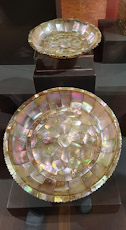
Mother of pearl bowls from India

Madeira was one of the places that the early Portuguese ships called in at during their voyages. This was brought home to me during a visit to Funchal’s superb Museum of Sacred Art. In two of its rooms we saw religious artefacts – sculptures and two mother of pearl bowls – which were labelled as having come from India. There were others that came from ‘Portuguese Asia’. One item, a beautiful inlaid tortoise shell box, came from Japan.

Unlike the religious sculptures we have seen in old Portuguese churches in Goa, which often feature Indian looking faces, those in the museum had European facial appearances. An exception is a 16th century carved panel depicting St Francis Xavier asleep on the Island of Shangchuang. He is accompanied by two saints – one Indian and the other Chinese.

Seeing these beautiful old sculptures and other objects, which were made in Asia and then brought to Madeira, helped make the history of Portugal’s former pioneering navigational achievements a little more vivid for me.

Islets on the island

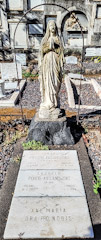
MANY PEOPLE VISIT Madeira to improve their health or to retire. Some of these people die on the island and are buried there. Today (5th of May 2023), we took a look at the small English Cemetery in central Funchal. This well tended burial ground, founded in 1770, contains graves of British and some Portuguese people – Protestants mainly. In addition, there are graves of men and women born outside Portugal in places including Germany, Finland, Romania, USA, Holland, Sweden, and Poland.

One of the Americans buried in the cemetery is Harry C Stone “Late Captain Cavalry USA”. His simple yet moving gravestone bears the date 1972 and the words:
“He believed in God”

Three graves particularly intrigued me. One of them marks the burial place of Lady Sarah Bonetta Davies (née Forbes). She was born in Ogun State in 1843 and died in Funchal in 1880. The gravestone informs that she was: “Princess of the Egbada Omoba people, West Africa. God-daughter of HM Queen Victoria.”
She was born an aristocratic member of the Egbada clan of the Yoruba people and was enslaved by King Ghezo of Dahomey, who ‘gifted’ her to Captain Frederick Forbes of the British Royal Navy. She became a god-daughter of Queen Victoria, and later married the Nigerian businessman James Pinson Labulo Davies of Lagos in West Africa. She died of tuberculosis in Funchal.

Another black African, George Oruigbiji Pepple, also lies buried in the cemetery. Between 1866 and 1883, he was the King of Bonny which was a small state in the Niger River delta. He was deposed in 1883 and restored to the throne in 1887. Why he was buried in Funchal , I have not yet discovered.

The third grave that interested me greatly is that of Paul Langerhans (1847-1888). This German pathologist and physiologist is best known for his discovery of the cells in the pancreas that produce insulin. Although he was unaware of the function of these distinctive cells, they have been named in his honour as The Islets of Langerhans.

Langerhans came to Madeira in 1875, having contracted tuberculosis. He recovered a little, researched marine worms, and practised medicine. In 1885, he married the widow of one of his patients. They lived together until his death. According to his wishes, he was buried in the English Cemetery in Funchal.

The cemetery is a lovely place to visit. It has plenty of flowers and is peaceful. On a future visit to Madeira, I would like to spend more time investigating the biographies of those whose remains lie there.

Blooms with a view

I AM ALWAYS WARY of ‘must see’ attractions because I dislike crowds and waiting in queues. So, last year when we visited Madeira, I thought it wise to avoid seeing the famous Botanical Gardens. In any case, most of Madeira’s capital, Funchal, is full of exotic plants and flowers – a veritable botanical garden in itself.

This May (2023), we decided to ‘bite the bullet’, and visit the Botanical Gardens high above Funchal. Getting there and back by local bus was easy. At the entrance to the Gardens, there was hardly any queue for tickets. And despite plenty of large tour buses parked nearby, the Gardens were not at all crowded.

Although I once owned a house with a 180 foot long garden in Gillingham, Kent, I am no gardener, and can hardly name any plant accurately. However, I love visiting gardens. The Botanical Gardens of Funchal are on the slopes of a hillside. All of the plants or groups of them are labelled. There are several terraces from which you can enjoy superb vistas of central Funchal, the sea, and the mountainous countryside.

The Gardens, which were opened to the public in 1960, are on land previously owned by William Reid, the founder of Funchal’s Reids Hotel. A bust in the garden commemorates Rui Vieira (1925-2009), a botanist who contributed much to the development of the botanical Gardens.

The highlight of the Gardens for me was a collection of mostly huge cacti, many of them bursting into flower. Everything else was also worth seeing in this well-kept, beautifully arranged garden. I am very glad that we visited this ‘must-see’ attraction on Madeira.

Water from on high

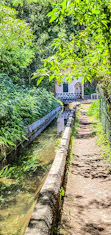
WHEN THE PORTUGUESE first landed in Madeira in the 15th century, the area that they settled – the southeast corner of the island – it was not well watered. Using slave labour, they constructed a series of irrigation channels to bring water from the mountains to the drier area, where they later planted valuable crops such as sugar cane. These channels that snake their way gradually downhill along the mountainsides are called ‘levadas’. The construction of these channels continued into the early 20th century, when they were built by Salazar’s political prisoners.

Today, the levadas continue to carry water and are well maintained. Paths run alongside each levada. Walking along them is a popular pursuit for tourist. Some of the paths are quite hazardous, and there are guided tours to shepherd groups of walkers safely along these waterside pathways.

We do not enjoy group tours. So, we had to find a levada that is not too hazardous and was easily accessible from Funchal. I homed in on the Levada dos Tornos, which passes under the hilltop village of Curral dos Romeiros – the terminal of bus number 29.

When we reached Curral, we asked the bus driver about the levada. He suggested where we proposed to walk was not good for us. We returned downhill in his bus, and he dropped us off at a staircase that led up toa section of the Levada dos Tornos, which he told us was not too narrow and led to a tea house.

We had a pleasant 3 mile walk along the levada, which wound its way gently downhill. All along the rout, lizards darted across the footpath as we approached them. Our way was lined with flowers and trees, many of them eucalyptus. Short stretches of the levada were shaded by bushes and trees. Other stretches provided views down wooded valleys. Sometimes, the port of Funchal could be seen far away and far below us. Most of the pathway was without hazards, but short lengths of it ran alongside sheer drops. Eventually, we reached the compound of the Jasmine Tea House, which caters for British tastes (cakes, scones, etc.) We did not have time to sample its wares because we did not want to miss the next bus (route 47) back to central Funchal.

Although we walked along a tame stretch of levada, we were able to gain an impression of Madeira’s remarkable network of irrigation channels.

Standing on a bench in Funchal, Madeira

ON THE FLIGHT FROM Stansted to Funchal, I sat next to a young man who was born in Madeira and now lives in the UK. He told me that we were just in time for the grand parade of the island’s annual flower festival. It would be happening on the afternoon of Sunday, the 30th of April (2023) at 430 pm, and that it always attracts large crowds.

At about 2.50 pm on the Sunday, we found an empty bench on the Avenida do Mar. This is a wide dual-carriageway that runs close to the seafront. Our bench was beside one of the carriageways. The parade was due to proceed along the other carriageway. By as early as 3 pm, people were gathering on the grassy divider that separates the two carriageways. They were between us and the route to be taken by the parade. More and more people assembled there, and we wondered how we would be able to see the proceedings.

At about 3.30, an elderly English couple joined us on the bench. We did not speak with them until a few minutes before 4.30. Then, the rather frail looking old lady said to us:
“We’re going to stand on the bench to watch the floats pass by.”
I had thought about doing this but had been concerned about the stability of both the bench and me. But when this older lady and her even older husband climbed on the bench we joined them.

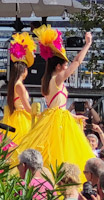
The colourful floats covered with floral decorations and lively girls and ladies moved a little faster than snail’s pace. They were separated by crowds of girls in folk costumes, who were singing and dancing as they proceeded. From our vantage point, we could see the floats easily, but the dancing girls were mostly hidden by the crowds on the grassy divider; only their headdresses could be seen.

After three floats had passed, the lady hopped off the bench, and said to me:
“We’ve got to go now. We don’t want to miss our team, Liverpool, playing.”

All this goes to show that one should never judge people by how old they look. Even some the oldest members of our species can be surprisingly full of life.

Looking familiar in Funchal

THEY STAND SIDE by side on a pavement outside a post office on the sloping Avenida Zarco in central Funchal. There are two sets of them. In each pair, one is painted red, the other is blue. They are postboxes (letter boxes). These cylindrical mailing boxes have a familiar look about them, especially if you live in England.

Having seen several old British style post boxes in various places in India, seeing these boxes in Funchal aroused my curiosity. I looked at their bases. The two red boxes had no manufacturer’s marks. However, both the blue ones had the following on them in English: “Cooperative Industrial Society”. This suggests that at least these two boxes were made in the UK. It appears that many Cooperative Industrial Societies have existed. So just by looking at them, it cannot be said exactly where these boxes were made. In any case, it seems that these items were imported from the UK.

As for the two colours – red and blue – there are two postal methods/speeds in Portugal. Red boxes are for normal mail, and blue for priority or express mail.

Where the Portuguese landed

A GUIDE BOOK to Madeira suggested that before the Portuguese set foot on Madeira, there had been others from different places. Some of these earlier settlers are said to have been travelling on an English ship from England to Portugal. However, the boat was blown off course and ran aground on the shore of Madeira, near where the town of Machico stands today. Two of the passengers on the ship were the English lovers Robert Machim and Anne d’Arfet, who were fleeing England where their relationship was not approved of. They are supposed to have died on the island. Later, their (?) graves were discovered. Fascinating as this is, the veracity of the story is questionable.

18th century fort in Machico

What is most certain is that the Portuguese Joao Goncalves Zarco and Tristao vaz Teixeira landed on the beach at what is now Machico in July 1419, and in so doing helped initiate the erstwhile worldwide Portuguese empire.

In 1440, Teixiera and his descendants were awarded the Captaincy of Machico – the first on the island of Madeira. In the middle of the 15th century, the settlers on Madeira began growing sugar cane. In those days, sugar was a valuable commodity, much desired in Europe. The prosperity of Machico increased.

Today, Machico is a pleasant town with a promenade running along the seafront. Three churches survive from earlier times. We visited the Igreja de Nossa Senhora da Conceição, whose construction was completed by the end of the 15th century. Between it and the sea front, there is a small fortress – Forte de Nossa Senhora do Amparo, which was constructed in about 1706. We saw a few market stalls next it. One if them, a florist, was selling gorgeous pink proteas.

Machico is a 50 minute bus ride from Central Funchal, the city that replaced it as Madeira’s capital by the early 16th century . The journey is spectacular with great views of the sea and the mountains, but because of the incredible windiness of the roads, it is not ideal for those prone to motion sickness.