
The Sport of Kings and a bar in Bangalore

I MUST ADMIT that I have never been much of a sportsma, and I know hardly anything about the game of polo, apart from the fact that it involves both horses and humans. Yesterday evening, as I enjoyed a postprandial brandy in the recently renamed ‘Polo Bar’ (formerly, ‘The Mixed Bar’) at the Bangalore Club, I spotted a large ‘coffee table’ book by Jaisal Singh about Polo and India.

What surprised me is the great age of the game of Polo. It seems to have been existence in some recognisable form as long ago as the 6th century BC. Then, it was played by some nomadic peoples in Central Asia. The book in the Polo Bar has a photograph of a terracotta model of a Chinese woman playing polo. This model was made between the 7th and 11th century AD. Another photograph shows the earliest known picture of a Polo player. This depicts a man on a horse, and was created in the same era as the model.

Much of the rest of the book is about polo in India. It charts the rise in popularity of the game amongst the wealthy rulers of the Princely States and the upper echelons of the British administrators and military in India.

The Polo Bar, which until recently was known by another name, has been decorated with polo memorabilia (e.g., photographs, trophies, and horseshoes). The handle on the door leading into the bar is horse-shaped. However, for me, the most interesting polo related item is in the Club’s Gardens. It is an inscribed stone block, which was the foundation stone of the Domlur Polo Pavilion laid in January 1914 by Lady Daly, wife of the British Resident.

The stone includes the information that one Major C Rankin was “Hon-Secy” and R Evans Esq was the architect. Both were military personnel, members of the “7th (Q.O.) Hussars”. The pavilion’s building contractor was BV Venkataswami Naidu.

In “Bangalore, the Story of a City”, by M Jayapal, the author wrote that initially the race course was out at Domlur. [Hence, the existence of Old Race Course Road]. In the late 19th century it moved to near Lalbagh, and then to its present position near to High Grounds. Presumably, because there had been equine facilities at Domlur, this would have been a suitable place for the Bangalore Club to locate its polo club there. I am not sure whether anything remains of the polo club pavilion whose foundation stone stands in the Bangalore Club gardens.

According to a blog article (https://wp.me/p1YuI1-1xA) about the pavilion, this is of interest:
“Information, thanks to the Bygone Bangalore group on Facebook: The Polo Club was located on Cambridge Road, in the area that is now Cambridge Layout. Opposite the Sai Baba Temple, there exists a portion of an old building which is said to be a part of the Polo Club.”
Incidentally, the centre of Cambridge Layout is less than a mile from the heart of Domlur.

As for the Bangalore Club’s association with polo, the following words quoted from the Club’s website (www.bangaloreclub.com) are of interest:
“Bangalore Club was established in 1868 as the Bangalore United Services Club for the officers of the British Empire. Originally the buildings were occupied by the Polo Club which moved out in the beginning of the 1860’s.”

I do not know how many current members of the Club play Polo these days. Even if it is not many, the Club’s former associations with the military ( the Club was formerly a club for military officers) and the land upon which it stands justify the naming of one of its bars to commemorate what was once known as “The Sport of Kings”.

A polo player in India and Somerset

LYTES CARY is a mediaeval manor in the English county of Somerset. This beautiful building, maintained by the National Trust, was owned by the Lyte family since the 15th century, if not earlier. The Great Hall of the manor house was built in the 1460s. The manor remained in the Lyte family until 1755, when the indebted Thomas Lyte IV surrendered all rights to their family home. Between then and 1907, the property fell into decay.

In 1907, the dilapidated Lytes Cary was purchased by Sir Walter Jenner (1860-1948) and his wife Flora, who died in 1920. They lived with their daughter Esme (1898-1932), a keen horse rider, who died of pneumonia after having been drenched in a rainstorm. Sir Walter was the son of Queen Victoria’s physician, Sir William Jenner (1815-1898), who studied at my alma mater University College in London. At his death, he left a great fortune.

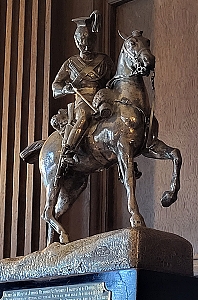
Polo trophy

Sir Walter had the house repaired and filled it with furniture and objets d’art appropriate to the age of the house. The result was a comfortable home with fascinating contents. One of the many objects that caught my eye is a trophy depicting a military man on a horse. This item bears an engraved plate:

“Major Sir Walter Jenner Bt, from Lt Colonel Forrester Colvin 1915 to commemorate joining the Ninth Lancers together December 1880. The many happy years spent therein and the following polo tournaments won by the regiment…”

Below this, there is a long list of tournaments played in India, England, Wales, and Ireland. In India, he was in the winning teams in Umballa (Ambala) in 1883 and 1884, and in Meerut in 1885. The latest tournament listed on the trophy was in Dublin in 1893.

Educated at Charterhouse School, Sir Walter became a magistrate in Somerset after retiring from the Ninth Lancers. He served in his regiment during WW1 and was awarded the DSO for his services in that conflict.

I enjoy visiting old houses like Lytes Cary and always find it interesting when I discover links between them and the history of India. Sir Walter’s polo trophy is not one of the most attractive pieces on display at Lytes Cary, but for me it was most fascinating.

Harrods department store

POLO


In the early 1960s, my parents installed a Permutit water softening unit in our family home. I have no idea why they did this. Maybe it was to save soap and the furring up of pipework. I am not sure that they would have done it had they known of the research that shows that heart disease is reduced as the hardness of drinking water increases.

The apparatus consisted of two cream coloured cylinders, each about five feet high, which stood next to each other in our garage by the side of the house. One of the cylinders was sealed shut and surmounted by a circular metal control wheel. Its neighbour could be opened by lifting a lid. Once a week, my father had to refresh the ion-exchange resin in the sealed container. This was done by adding salt in large quantities to the other cylinder, having removed its lid. By turning the control wheel at intervals dictated by an instruction manual, the refreshing cycle was completed over a period of about two hours. When the procedure was completed, my father used to test the softness of the water in our taps by mixing it with a soap solution supplied by Permutit. If a stable foam was produced, this indicated that the refreshment cycle had been completed successfully.

A special salt, called dendritic salt, was required for the weekly process described already. There was only one store that would both supply sacks of dendritic salt and, also, deliver it to our home. That store was the world-renowned Harrods in Knightsbridge, which brought us the salt in their silent electrically-powered delivery vehicles.  In order to get these regular deliveries, my parents had to open a Harrod’s account.

Harrods has never been a store that one would enter hoping to find a bargain. In the sixties, they provided their customers with very attractive carrier bags. My late mother liked these, but she was not particularly interested in buying anything from the store in Knightsbridge. So, she used to enter Harrods and buy a packet of Polo mints, one of the least costly things on sale, and have the payment of them put on the family account. This low-cost purchase allowed her to get what she really wanted: a Harrods’ carrier bag.

All ‘aggro’ : my Allegro

I passed my Driving Test in 1982. Naturally, I wanted a car after that. A good friend, a dental colleague who was keen on motor cars, suggested quite sensibly that it would be best if my first car was not brand new. He felt that as I was an inexperienced driver, I was more likely to damage it. With his assistance, I chose a second-hand Austin Allegro, which looked in good condition and had not done a huge mileage. Neither he nor I would have guessed what a challenge this vehicle would prove to be.


allegro 1

Austin Allegro [source: Wikipedia]


All went well at first. After a few weeks, I was driving along a motorway between the Medway Towns, where I worked, and London when suddenly the car lost power. I managed to steer the Allegro to the hard shoulder. The engine was not working. I turned the ignition key and the engine sprung back into life. I continued to London uneventfully.

The problem, the engine’s spontaneous and unexpected switching off, occurred on a number of other motorways and main roads, sometimes at night. I returned to the garage where I had bought the car, and their mechanics checked the car thoroughly (so they said). They could find nothing wrong. Reassured, I continued using it, but the same problem recurred regularly. I got to a point where I used to drive along the motorway with my hand holding the ignition key in the start position, so that the motor could not turn off.

After a few months in rented accommodation, I decided to buy a house when I discovered that the monthly mortgage repayments were the same as my monthly rental payments. After looking at about nine properties, I chose one. Before moving in, I used to visit its soon to be former owners in order to settle details of the house sale. On one visit, I parked my Allegro in front of the driveway where two of the occupants’ cars were parked. When I was ready to leave, the Allegro would not start. The owner’s son, a man in his twenties, came out to look at the car. Within minutes, he discovered what the garage mechanics had missed. The lock into which the ignition key fitted was loose: it did not engage firmly in the ‘on’ position. So, when the car vibrated, the key could be thrown out of the ‘on’ position into an ‘off’ position.

When the boy’s father, who was taking an interest in the proceedings, saw what his son had discovered, he fetched a wire, and touched its two ends to a couple of places in the engine. Suddenly, there was a blue flash followed by a strange smell and some white smoke.

“Aw, now look what you’ve gawn and done, Dad,” said the son, “I reckon you’ve blown a fuse.”

Almost as quick as a flash, the young man said that he would run up the road to buy a new fuse, which he did. He inserted it, and then carefully started my car.

I continued using the car for a while. Soon after the fuse incident, the car began belching black smoke instead of the normal exhaust. Once again, I returned to the dealer, who had sold me the car. After I told him what was wrong, he said:

“Sounds like you’ll need a new engine, my friend.”

“But,” I protested, “I’ve only had the car for four months.”

“Such is life, young man.”


I took the car to another repair shop. This was run by a wizened old man. He looked at the engine, and said:

“I can do something about that smoke, but it won’t last long. My advice to you is to sell it as soon as I’ve mended it and before the problem returns and the engine burns out.”

I took this wise man’s advice. The local Volkswagen dealership were happy to take my Allegro as part payment for my brand-new Polo vehicle.


allegro 2

Volkswagen Polo [source: Wikipedia]

Soon after taking possession of the Polo, I visited my aunt and uncle in London. Their reaction to my new car gave away something of what they had secretly thought about me in the thirty years they had known me. After spending a few hours with them, they accompanied me to the road. I had not told them about my purchase. When they saw me unlocking my pristine Polo, my aunt said:

“Is that yours, Adam?”

“Yes.”

Then my uncle said:

“I never imagined you would have ever bought a new car. It’s the first normal thing you have ever done.”