DURING A RECENT VISIT to Cambridge, we spent some time in the magnificent chapel of King’s College. It is difficult to avert one’s eyes from the masterpiece of gothic fan-vaulting that forms the ceiling of this edifice, but it is worth doing so because the chapel is filled with other wonderful things. These include a painting by Rubens, another by Gert van der Lon, and yet another by Girolamo Siciolante de Sermoneta. The brass lectern that stands in the choir was made in the early 16th century and is surmounted by a small statue of King Henry VI. There are many other items of great historical interest to be seen including the stained-glass windows, which have survived since the 16th century. Interesting as all of these are, what caught my attention was something in a small side chapel – The Chapel of All Souls.
This chapel was converted in the 1920s to house a memorial to those members of King’s College (academics, students, choristers, and servants) who died during WW1. The names of those who perished are listed on engraved stone panels on one wall of the small chapel. Amongst these names is that of the famous poet Rupert Brooke (1887-1915).
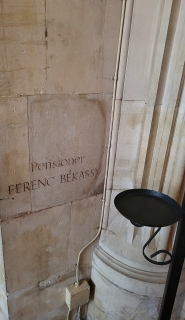
On another wall of the chapel, separate from the list of names, I spotted an inscription carved into the stone. It reads:
“Pensioner Ferenc Békassy”
Ferenc Istvan Dénes Gyula Békássy (1893-1915) was a Hungarian poet born in Hungary. In 1905, he was enrolled at Bedale’s School in Hampshire. In 1911, he began studying history at King’s College Cambridge. He was what is known as a ‘pensioner’. In Cambridge University usage, this word was used for a student, who has no scholarship and pays for his tuition as well as his board and lodging. During his time at the college, he was elected a member of The Apostles and courted the same woman as Rupert Brooke. He composed poetry both in Hungarian and English.
Just before the outbreak of WW1, Ferenc returned to Hungary, where he enlisted as a hussar in the Austro-Hungarian Army. On the 22nd of October 1915 he was killed in action whilst fighting the Russians in Bukovina. He was buried on his family’s estate in Hungary.
After the war, the memorial in King’s College Chapel was established. Because it was considered objectionable for the name of an enemy soldier to be listed amongst those who fought and died for Britain, his name was not included on the memorial. Instead, it was placed on another wall nearby.
Though separated from Rupert Brooke’s name by a few feet, this small chapel serves as a memorial to two great poets, who were killed in their prime.
IN 1916, A FAMOUS poet, TS Eliot (1888-1965) taught at Highgate School in north London. I was a pupil at this establishment much later, between the year when Eliot died and 1970. One of Eliot’s pupils during his short spell at Highgate was to become one of Britain’s Poet Laureates: John Betjeman (1906-1984). Betjeman wrote (quoted in https://bradbirzer.com/2015/07/06/john-betjeman-remembers-t-s-eliot-as-teacher/):
“In 1914-15 I spent two unsuccessful terms at Highgate Junior School. Mr Eliot was a tall, quiet usher there whom we called ‘The American Master.’ Some of the cleverer boys from Muswell Hill (I was from Highgate) knew he was a poet. How? I have often wondered, for I cannot imagine him telling them or anyone that he was a poet, and I did not know that he had published any poems in England as early as that.”
Betjeman’s association with Highgate where he lived as a child briefly and was educated for less than one year was much shorter than his association with the county of Cornwall.
Betjeman’s family had a house in Trebetherick, near Polzeath in Cornwall, where many holidays were spent. In later life, the poet resided there. The small church of St Enodoc is about 930 yards south of Trebetherick. In the middle of a golf course overlooking the sea, the church dates from the 13th century. Much of it was built by the 16th century. Over the centuries, St Enodoc has often been submerged by drifting sands from the nearby beaches. Between the 16th century and the mid-19th century, the church was completely submerged. In 1863-64, the church was freed from the sand and restored under the supervision of James Piers St Aubyn (1815-1895).
When staying or living at Trebetherick, Betjeman visited St Enodoc regularly. In 1945, he published a poem “Sunday Afternoon Service in St Enodoc Court, Cornwall”, in which he describes his impressions of the church affectionately. Author of much poetry and several books about Cornwall, Betjeman died in his home at Trebetherick. He was buried in the small graveyard that surrounds St Enodoc, a building that still appears to be partially buried in the hillside. His grave is marked by simple stone with a beautifully carved inscription. Born in Lissenden Gardens, now in the Borough of Camden, Betjeman lived briefly in Highgate’s North Road in a house opposite Highgate School. However, it is with Cornwall rather than Highgate that most people connect with the former Poet Laureate. As a former pupil at Highgate School, I was pleased to pay my respects at Betjeman’s grave in Cornwall.
THE TATE BRITAIN pleases me far more that its younger relative, The Tate Modern, and its cousins in Liverpool and St Ives. I do not know why, but I feel far more comfortable in the old institution on London’s Millbank. Today (31st of March 2022), I took a leisurely wander through some of the Tate Britain’s galleries. I was on the lookout for works by artists, who have been associated with Hampstead in north London. My only disappointment was that there were no works by John Constable (1776-1837) on display. Buried next to Hampstead’s parish church, he worked and lived (for several years) in Hampstead. I had better luck with one of his contemporaries, George Romney (1734-1802). His “A Lady in a brown Dress: The Parson’s Daughter” hangs in the Tate. “Roadside Inn” was painted in about 1790 by George Morland (1763-1804), who used to visit Hampstead to teach. The gallery also contains a picture, “Punch or May Day”, by the painter Benjamin Haydon (1786-1846), who is known to have visited Hampstead, where he met the essayist and critic Leigh Hunt and walked with the poet Wordsworth.
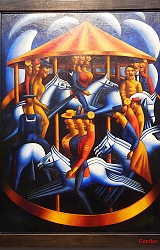
By Mark Gertler
It was the painter William Rothenstein (1872-1945), who found accommodation for, and looked after the great Indian literary genius Rabindranath Tagore, when he stayed in Hampstead briefly in 1912. The artist, who also lived in Hampstead for a while, is represented by at least two of his paintings in the Tate Britain: one was painted in 1891 and the other in 1899-1900.
It was during the first five decades of the 20th century that Hampstead became a mecca for artists, who are remembered today and whose works are displayed in Tate Britain. “The Merry-Go-Round”, a colourful painting created by Mark Gertler (1891-1939), who had a studio in Hampstead, depicts a fairground attraction on Hampstead Heath. It was painted in 1916. Gertler studied at the Slade School of Art at the same time as the painter Stanley Spencer (1891-1959), who had a studio in Hampstead’s Vale of Health for a while. It is therefore apt that Gertler’s painting hangs next to one by Spencer: “The Resurrection, Cookham”.
Another juxtaposition is a wooden sculpture by John Skeaping (1901-1980) and a painting by Ben Nicholson (1894-1982). Both worked in Hampstead in the 1930s and both were married to the sculptor Barbara Hepworth (1903-1975). She divorced Skeaping to marry Nicholson. One of her sculptures is on display close to another artwork by her second husband. I spotted one more work by Hepworth. That was a painting, a sketch for a sculpture she was planning in 1957. The three artists all worked at various times in the Mall Studios near Parkhill Road.
David Bomberg (1890-1957), who, like Gertler and Spencer, studied at the Slade, lived in West Hampstead between 1928 and 1934. There are several of his dazzling, colourful paintings hanging in the Tate Britain.
Henry Moore (1898-1986), who lived for a while in Hampstead, is the best represented of all the artists who lived or visited that locality. Tate Britain has many of his sculptures on display and some of the sketches he made during WW2. These images depict people sheltering in deep Underground stations to be safe from the bombs being dropped by the Luftwaffe. Moore lived for a while in the modernist and relatively bomb-resistant Lawn Road Flats (‘The Isokon’) near South End Green (and, incidentally, near the Mall Studios). I have read that it is likely that Moore made some of his dramatic wartime sketches in the nearby Belsize Park and Hampstead Underground stations.
It was fun visiting the Tate and seeing pictures by some of the artists, whom I have written about in my new book about Hampstead: “Beneath a Wide Sky: Hampstead and its Environs”. This work contains two chapters detailing Hampstead’s myriad artistic connections. If you wish to learn more about this and about other aspects of Hampstead and its surroundings, my book (and Kindle edition) can be obtained from Amazon (https://www.amazon.co.uk/dp/B09R2WRK92).
Primrose Hill is south of Hampstead village and southeast of Swiss Cottage. It is a delightful place to take exercise and has been home to several notable figures. From its summit at 210 feet above sea-level, it is possible to enjoy a superb panorama of London when weather permits. At its summit, a low concrete construction is inscribed with some words by the poet William Blake (1757-1827).
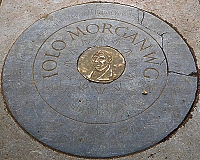
In the centre of the circular concrete platform at the summit of the hill, there is a round commemorative metal plaque surrounded with words in the Welsh language. It was placed to remember Iolo Morganwg (1747-1826), who was born in Wales as ‘Edward Williams’. He was a poet and antiquarian, who both wrote and collected poetry in the Welsh language. He had a great interest in preserving the literary and cultural heritage of his native land. His integrity as a scholar was somewhat undermined by the fact that he had forged several manuscripts that he claimed were of mediaeval origin. Nevertheless, he was involved in the early revival of Druidism. In 1792, he founded the ‘Gorsedd Beirdd Ynys Prydain’ (Gorsedd of Bards of the Island of Britain). The Gorsedd, which still meets today, is a society of poets, writers, musicians, artists, and other individuals, who have made notable contributions to the Welsh nation, language and culture. Every year, the Gorsedd assembles at a festival of Welsh culture, now known as the Eisteddfod. According to the website of the Royal Parks, Primrose Hill was the site of the first ever Gorsedd, which was held on midsummer’s day, 21 June, 1792, a long way from Wales.
I MUST CONFESS THAT I knew nothing about Leigh Hunt (1784-1859) until I became interested in the history of Hampstead in North London. What triggered my interest in Hunt was seeing a house named Vale Lodge in a part of Hampstead called The Vale of Health. Vale Lodge, a late Georgian (early 19th century, pre-1831) house modernised in the 20th century, is difficult to see from the lane by which it stands because it is surrounded by a high wall.
Vale Lodge
People, who have lived in Vale Lodge include the writer Edgar Wallace (1875-1932); the Russian-born industrialist Sir Leon Bagrit (1902-1979); and the banker Sir Paul Chambers (1904-1981). One source (https://historicengland.org.uk/listing/the-list/list-entry/1379083) mentions that Vale Lodge was:
“… home of Edgar Wallace, writer, and probably also the residence of Leigh Hunt, poet.”
Well, that got me interested because I had read that Leigh Hunt lived in the Vale of Health from 1816 onwards for a few years.
Hunt, a radical, was a critic, essayist, and poet. He was a co-founder and/or collaborator of several periodicals including “The Examiner”, “The Reflector”, “The Indicator”, and “The Companion”. In about 1812/13, Hunt and his two brothers, also involved with “The Examiner”, were imprisoned for libelling the Prince Regent (the future King George IV). Whilst incarcerated in the Surrey County Jail, Hunt was visited by his eminent friends including:
“…Lord Byron, Thomas Moore, Lord Henry Brougham, and Charles Lamb … When Jeremy Bentham called on him, he found Hunt playing battledore.” (https://en.wikipedia.org/wiki/Leigh_Hunt).
Hunt’s home in the Vale of Health not only inspired him to write some poetry extolling the virtues of Hampstead, but also attracted several of his contemporaries who were notable literary figures. These included the poets Percy Bysshe Shelley (1792-1822), Bryan Waller Procter (1787-1874) and John Keats (1795-1821) as well as the painter Benjamin Robert Haydon (1786-1846) and the essayist William Hazlitt (1778-1830). When I was studying at University College, I read some of Hazlitt’s essays. Some words he wrote about the fear of death made a great impression on me:
“Perhaps the best cure for the fear of death is to reflect that life has a beginning as well as an end. There was a time when we were not: this gives us no concern – why then should it trouble us that a time will come when we shall cease to be? I have no wish to have been alive a hundred years ago, or in the reign of Queen Anne: why should I regret and lay it so much to heart that I shall not be alive a hundred years hence, in the reign of I cannot tell whom?” (from “Table Talk”, published in 1821).
The poet Keats, who had slept in Leigh Hunt’s home in the Vale of Health, took a great liking to Hampstead and settled there in 1817. He lived in Wentworth House, which was later renamed ‘Keats House’. The house was built in about 1815 (https://keatsfoundation.com/keats-house-hampstead/) and divided in two as is common with modern semi-detached houses. One half was occupied by Charles Armitage Brown (1787-1842), a poet and friend of Leigh Hunt and the other half by Charles Wentworth Dilke (1789–1864), a literary associate of Hunt and a visitor to his home in the Vale of Health. Keats became Brown’s lodger. Keats had first visited the house when the poet and playwright John Hamilton Reynolds (1784-1852), who was part of Leigh Hunt’s circle of friends, introduced him to Dilke, Brown’s friend and neighbour.
While living in Hampstead, Keats wrote much poetry including “Ode to a Nightingale” (and other “Odes”), “Isabella”, Hyperion”, “St Agnes”, “La Belle dame sans Merci”, and began working on “Endymion”. It has been suggested that Keat’s poem “I Stood Tiptoe Upon a Little Hill” was inspired by his experience of Hampstead (www.hamhigh.co.uk/lifestyle/heritage/rare-keats-handwritten-poem-inspired-by-hampstead-heath-goes-up-3438636). Another of his works, “Dedication. To Leigh Hunt esq” relates directly to his friend Hunt (words: www.bartleby.com/126/1.html). His poem “Sleep and Poetry”, according to Leigh Hunt (http://spenserians.cath.vt.edu/TextRecord.php?textsid=36069):
“… originated in sleeping in a room adorned with busts and pictures … ‘On Sleep and Poetry,’ was occasioned by his sleeping in one of the cottages in the Vale of Health, the first one that fronts the valley, beginning from the same quarter.”
There is no doubt that many now famous literary and artistic people congregated around Leigh Hunt while he has living in the Vale of Health, but there appears to be some uncertainty as where exactly he resided. One suggestion, already mentioned, is Vale Lodge. However, a 19th century writer, William Howitt, wrote of Hunt’s residence in his “The Northern Heights of London” (published in 1869):
“The house, which he occupied … was pulled down to make way for the great hotel just mentioned.”
The site of the hotel, which has also been pulled down, is now occupied by a block of flats called Spencer House. If that is the case, then Vale Lodge can be remembered for at least one literary figure, Edgar Wallace, if not also Leigh Hunt.



 yamey
yamey 