RELIGIOUS DIVERSITY AT A SUFI SHRINE IN RAJASTHAN


IN MY BOOK “Coracles and Crocodiles: 101 Tales of India”, I have described how practices associated with Hinduism can sometimes be seen in Indian mosques. This is particularly true in the Sufi dargah (shrine) in Ajmer, where Khawaja Gharib Nawaz (1143 – 1236), also known as ‘Muʿīn al-Dīn Chishtī’, buried. According to Wikipedia, he was:

“… one of the first major Islamic mystics to formally allow his followers to incorporate the “use of music” in their devotions, liturgies, and hymns to God, which he did in order to make the ‘foreign’ Arab faith more relatable to the indigenous peoples who had recently entered the religion.”


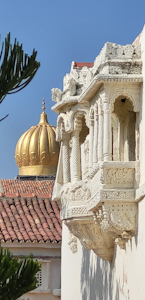
The shrine is in a large compound containing a mosque and other shrines in the heart of Ajmer.

 The dargah compound is much visited, not only by Muslims but also by adherents of other religions: Hindus, Sikhs, etc. Visiting the dargah is considered to be a very special auspicious event. Visitors of all religions buy baskets of red petals to place on the various shrines in the complex. In many places, there are Muslim clerics who bless you by tapping your head with what looks like a large peacock feather duster. In exchange for this benediction, the recipient is expected to leave a financial donation. If the donation is large enough, it and your name will be recorded in a ledger, and you will receive a receipt. If it is insufficient,  the cleric appears to pocket it.


Apart from the groups of musicians playing and singing qawwalis (قوّالی). surrounded by appreciative pilgrims seated around them, there were several other things that interested me. All of these can be found in Hindu places of worship. They include burning incense sticks (agarbatti); lighting diyas (oil lamps) and placing them in holders such as can be found in Hindu temples; and tying threads to parts of the shrines.  Another activity that I found unusual in a Muslim place of worship was blessing of pieces of cloth that were then tied around the pilgrim’s head.


The atmosphere in the dargah compound was lively and festive. People seemed happy to be there. And surprisingly for someone like me, who is not particularly religious, I  felt that the place seemed very holy. This might be because those around me were at the dargah not as an obligatory ritual but because they believed strongly in its holiness.

[ MY book is available from https://www.amazon.co.uk/CORACLES-CROCODILES-101-TALES-INDIA/dp/B0DJZ6DMYB

Feeding the faithful at a Hindu temple in Kutch (Gujarat)

THE DHRABUDI TRMPLE complex is near the sea about 5 miles east of the town of Mandvi (Kutch, Gujarat). It is located ated next a small Freshwater lake, where pilgrims can bathe. Our driver told us that baby boys are brought to be blessed at the temple when they reach their first birth anniversary. When we visited, we saw a group of people doing a puja in the open air. They were respecting the first death anniversary of one of their relatives.

While wandering around the temple compound, we saw a group of Rabari women seated in the shade, under a large banyan tree. The Rabari are nomadic cattle and camel herders, as well as shepherds. In India, they aremost frequently found in Gujarat, Punjab, and Rajasthan.

Worshippers come from far and wide to do pujas at the mandir. The temple offers free meals to pilgrims. These are served in a large dining hall. One wall of this is lined with numerous portraits of people who have died. We were told that diners pick up a thali and other eating utensils before lining up to be served food.

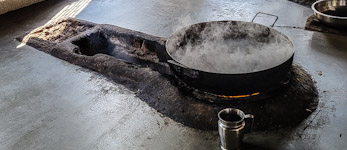
Pit containing glowing charcoal for cooking

The kitchen, which is next door to the dining hall is vast. It was spotlessly clean. I saw a few gas rings, but what really fascinated me was the other method by which food is heated up. I saw three or four pits sunk into the floor. Each one is shaped like a large spoon. Glowing charcoal is heaped in the bowl of the ‘spoon’, and can ve spread along the stem. Pots are placed above the charcoal. The arrangement reminded me of the Turkish ocakbaşı. I imagine that the cooking speed can be adjusted by varying the amounts of glowing charcoal beneath each of the enormous cooking pots.

We did not stay to join the pilgrims having lunch. Although the temple cooks kindly invited us, we had lunch awaiting us at my wife’s cousin’s home.

I always enjoy visiting place of worship. What made Dhrabudi special for me was being shown its wonderful kitchen.

Docked in Dartmouth

MOSES AND HIS followers crossed the Red Sea without difficulty. However, things were not so simple when a group of people were trying to cross the Atlantic to enjoy freedom to worship as they wished without persecution in North America in 1620 during the reign of England’s King James I. These travellers. the Pilgrim Fathers, were English Protestants, Puritans who had been living in the Low Countries in Leiden but felt that conditions there had become unfavourable for them. As they did not expect to live safely in England, they bravely set forth to sail to the New World.

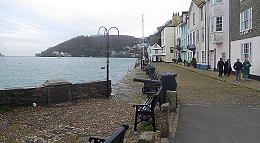
Bayards Cove

The Pilgrim Fathers and their families left Holland in the “Speedwell” (60 tons) and after crossing the North Sea, their ship was joined by the larger “Mayflower” (180 tons), which was carrying Puritans fleeing from London. While heading west, the boats headed into trouble. On about the 23rd of August 1620, the two ships slipped furtively into Dartmouth in Devon and lay at anchor near to the town’s Bayards Cove, close to where today a small ferry carries vehicles and pedestrians across the River Dart between Dartmouth and Kingswear. The secrecy was necessary because as Puritans, the passengers risked punishment in England.  They remained moored there until about the 31st of August while leaks on the “Speedwell” were being repaired.

After leaving Dartmouth to continue their voyage westwards, the “Speedwell” began leaking again. About 300 miles west-south-west of Lands’ End, the “Speedwell” had become almost unseaworthy. The boats returned to England, docking at Plymouth in Devon. There, the “Speedwell” was abandoned, and the “Mayflower” set sail for America with 102 passengers. The boat reached the harbour of Cape Cod in Massachusetts on the 21st of November 1620.

Although Plymouth is the place from which the Puritans finally left England, the point in the port from which they set off would now be unrecognisable to the Pilgrim Fathers were they able to see it. In contrast, although some of the buildings near Bayards Cove in Dartmouth have been built since the Pilgrim Fathers stopped there briefly, there remain sights that have not changed significantly since 1620.