
Do not expect to get your prescription honoured at this pharmacy

LOVE HIM OR HATE him, there is no denying that the artist Damien Hirst (born 1965) has plenty of imagination. Between 1997 and 2003, he created a restaurant in London’s Notting Hill Gate. It was called Pharmacy, but had to change its name after the Royal Pharmaceutical Society of Great Britain objected to it. Its new names were anagrams of the old: first Achy Ramp, and then Army Chap. Its decorative theme was pharmaceutical. For example, its walls were lined with cupboards containing (empty) drug and medicine packaging, as well as clinical equipment. It gave the visitor the impression of being in part of a busy hospital or clinic. From what I can remember of the place, its décor was vastly more exciting than the costly fare served to its customers. I was sad when it closed as it was a distinctive landmark in the area.

In 2016, Damien Hirst opened Pharmacy 2 on the first floor of his recently completed Newport Street Gallery (near Lambeth Palace). For a few years, this pharmacy themed restaurant offered a range of food and drinks, none of which were cheap. The interior of Pharmacy 2 follows on from the original art-installation-cum-restaurant design of the Notting Hill Gate version. An online article (www.dezeen.com/2016/02/18/damien-hirst-pharmacy-2-restaurant-mark-hix-newport-street-gallery-caruso-st-john-london/) describes the place well:

Similar to its predecessor, which was designed by Barber & Osgerby’s interiors company Universal Design Studio, the interior follows a clinical theme inspired by Hirst’s 1992 artwork Pharmacy. Images of tablets and brightly coloured pills have been embroidered onto leather banquettes and embedded into the marble floor. Bar stools are topped with pastel-coloured pill-shaped seats. Walls are covered with a silver-coloured wall chart of pills and pharmaceutical products first produced for the original Pharmacy restaurant … A neon prescriptions sign hangs above the bar, along with a series of sculptures based on molecular structures. Windows are covered with dark-coloured translucent vinyls. Stark lighting is used to reaffirm the restaurant’s pharmaceutical theme.”

These words give some idea about this fantastic place, but it must be seen to be believed. 

Pharmacy 2 has not been functioning as a restaurant for several years. When we visited Newport Street Gallery in May 2025, Pharmacy 2 was open to the public, and visitors can serve themselves with tea and coffee without charge. On each of the restaurant’s tables, there are art books for visitors to browse. The young man, an invigilator, who was keeping an eye on the place told us that occasionally the restaurant is revitalised for feeding visitors participating in special events. At these ‘pop-up’ events, meals are costly.

Pharmacy 2, like its predecessor in Notting Hill Gate, is an art installation. It is appropriate that the canteen of the Newport Street Gallery is not merely a restaurant but also an amazing work of art.
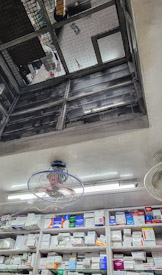
Perfect aim in a pharmacy shop in Calcutta

I HAVE BEEN TO many shoe shops in India. Some of these have the store room above the showroom. The ceiling of such showrooms has a hatch through which pairs of shoes can be thrown to the salesmen waiting below. The salesman asks for a particular shoe in a specific size, and someone in the store room drops the pair through the hatch. The shoes are caught by the salesman. Until yesterday, the 4th of January 2024, I had never seen such a system in shops other than those selling footwear.

The hatch in the ceiling of the pharmacy

Yesterday, we entered a chemist shop (a pharmacy) close to Calcutta’s New Market (SS Hogg Market). The walls were lined with shelves from floor to ceiling. These shelves were filled with boxes of medicines on what seemed like considerable disarray, although I feel sure that there must have been some organisation of the products. There were 5 or 6 men serving customers from behind the shop’s counters.

Like the shoe shops described above, the chemist shop had a hatch in the ceiling. The shop’s stock room was on the floor above the sale room. At frequent intervals, the salesmen yelled names of medicines, ointments, and so on. Somebody in the room above hurled the desired product through the small ceiling hatch. The product was aimed accurately at the salesman who asked for it. Different products kept dropping from the ceiling and being caught by the salesman who had shouted up for it. Whoever it was that was dropping the medications must have recognised the voice of the person who requested it. In addition, the person dropping the products must have had an extremely good aim. He (or she) would make a good cricket player. And the salesmen below never dropped a catch.

Having seen this amazing pharmacy, I have now poked my head into a few others, but none operated this remarkable aerial delivery system. For me, seeing things like that pharmacy near New Market is what makes India seem so wonderful.

Over the counter

The French philosopher Voltaire is believed to have written:

Doctors are men who prescribe medicines of which they know little, to cure diseases of which they know less, for human beings of which they know nothing.”

I was at a party in Athens, Greece, in the early 1980s when I suddenly became aware of bilateral back pain and nausea. Luckily, there was a medical doctor amongst the guests. He diagnosed a kidney or bladder infection and wrote a prescription for bactrim. The tablets were very effective and rapid acting.

A year or so later, I was flying to Greece via Rome in Italy when I experienced a recurrence of the symptoms. As I had quite a long stopover in Rome, I took the opportunity to visit a pharmacy, but this time without a prescription. To my great surprise and relief, the pharmacist sold me some bactrim without requiring a prescription.

In the UK, it is not possible to obtain antibiotics and most other medications without a prescription. There are also rules determining how much non prescription medication can be bought at any one time.

In India, which I visit often, I have never been asked for a prescription to obtain any kind of medication. One just asks for the medicine or tablets required, and then following payment they are handed over the counter. Quite a few of the medications I have needed in India have been clearly marked as prescription only medicines, but these words are ignored by the pharmacy salespeople.

Having been trained as a dentist I have some knowledge of pharmacology. So, I feel that I am unlikely to abuse the ease of obtaining medicines in India, but I worry about others with less knowledge than me.

The freedom of being able to obtain medications without having to first get a prescription has mixed blessings. On the one hand, if you are certain that you need a particular drug or simply need a repeat of what you have been taking, not needing a prescription can save you time and money that visiting a doctor entails. On the other hand, self diagnosis and self treatment is not without risk.

What Voltaire wrote many years ago is less true today than it was then. But, still, even after so many advances have been made in medical science , a great deal of ignorance about the human body remains.