
Seen on the wall
Vibrant and plenty of colour
It’s great graffiti

Seen on the wall
Vibrant and plenty of colour
It’s great graffiti
THE ARTIST LEONARDO Drew was born in 1961 at Tallahassee, Florida (USA), and now works in Brooklyn (New York City). Until 7 September 2025, an entire, large room at the South London Gallery in Peckham is occupied by a work by Drew, which has the name “Ubiquity II”.

At first sight, the viewer is confronted by what looks like the chaotic result of a big explosion. The room is filled with fragments of wood, some of which is piled in heaps leaning against the walls, and the rest scattered on the floor, on which visitors tread. On closer examination, it can be seen that there are fragments of mirrors amongst the debris, and almost every piece of wood has paint or some other modification on it.
Despite looking like disorganised chaos, it is not. The artist carefully selected each of the fragments, modified them (often with paint), and then carefully arranged them to produce what the viewer sees. He has created the depiction of chaos and destruction in a most careful orderly way. As the gallery’s website put it, Drew:
“… creates reflective abstract pieces that play on the tension between order and chaos. Transforming and eroding materials by hand in the studio, he explores the cyclical nature of life and decay.”
And given what is happening in the world today, this powerful depiction of order and chaos is particularly relevant.
GENERALLY, I AM NOT A FAN of food courts. Many of them in England are merely a collection of branches of well-known fast-food chains (such as KFC, McDonalds, Pizza Hut, Subway, and Burger King). A notable exception to this is a food court in Trinity Market in Hull, which visited in April 2025. On 9 May 2025, we visited Peckham in south London, having just viewed an exhibition in nearby Camberwell.

While strolling along Peckham’s busy Rye Lane, we came across the entrance to Rye Lane Market. After entering it and walking along an arcade lined with shops, we arrived in a large, covered area filled with food stalls: a food court. Unlike many other food courts, the food outlets were not branches of well-known chains. Instead, there were stalls catering to the multi-ethnic local population. We sat down at a table that was surrounded by stalls serving Mexican, Carribean, Colombian, and other many cuisines. We ordered the set lunch offered by a small Peruvian kitchen. As first courses, we ate cold boiled potatoes dressed in a red pepper flavoured mayonnaise and a delicately flavoured beef soup. These were followed by a fried rice dish containing chicken, pork, and smoked sausages, and another consisting of a whole fish beautifully fried, served with lentils, rice, and a salad containing onions, lime juice, coriander, and tomatoes. Freshly prepared and reasonably priced, everything was delicious.
There were more stalls serving food from other countries, mostly Latin American and African. One stall offered a range of vegetarian Indian dishes, including a snack, dabeli, that is popular in Kachchh (once an independent state, and now part of Gujarat). The lady working there told us that she is from Rajkot in Gujarat. When we mentioned to her that we have always thought that dabeli is a dish from Kachchh, she said it was Gujarati, but added that:
“It does not matter because the people of Kachchh are our brothers”.
Our first visit to Rye Lane Market’s food court has whet our appetites for further visits. There are so many enticing dishes on offer that I feel sure that we will venture across the Thames more often to sample the fare offered in that food court.
FIRELEI BÁEZ WAS born in the Dominican Republic in 1981. She studied art in the USA, where she now lives and works. The South London Gallery (‘SLG’) in South London’s Peckham district is hosting her first solo exhibition in the UK. The show continues until the 8th of September 2024. The exhibition is distributed between the main gallery building and a converted fire station, which is a few yards away.

The large exhibition space in the main building is occupied by a wonderful immersive installation. The viewer walks beneath a huge blue canopy with multiple small oval holes suspended from the ceiling. Light filters through the material of the canopy producing the effect of sunlight dappled by leaves of trees, creating the feeling that one is walking in a forest. Recordings of bird sounds enhance this illusion. On the walls of the room there are large, boldly coloured aluminium cut outs, representing silhouettes of Ciguapas – figures from the folklore of the Dominican Republic.
In the converted former fire station, there are yet more works by Firelei Baez. On the ground floor, there are huge floor-to-ceiling, extremely colourful abstract paintings. The artist’s idea is to immerse the viewer in an excitingly vibrant sea of colours. The first floor has two galleries. In one, there are large, richly coloured silhouettes depicting Ciguapas. In the other, there are many pages from books, which the artist has transformed by overlaying parts of each of them with paint or ink. In doing this, she provides the viewer with alternative versions of what was originally on the page before she added her artwork. Although libraries and book-collectors might well object to extracting pages from books and then painting over them, the effects Firelei produced are both witty and attractive. In addition, they make you think twice about what was originally on the page.
For a north Londoner like me, Peckham seems to be a distant part of the world, but actually it is not to difficult to reach it by public transport. And many of the exhibitions we have viewed at SLG, including the one described above, makes the trip to Peckham well worth making.
UNTIL I VISITED THE SOUTH LONDON GALLERY (‘SLG’) yesterday, the 11th of October 2023, I had no idea that Peckham in south London is home to one of the UK’s largest Nigerian diasporic communities. Some even call the district ‘Little Lagos’ after the capital city of Nigeria. Until the 29th of October 2023, the SLG is hosting an exhibition of artworks, called “Lagos Peckham Repeat: Pilgrimage to the Lakes”, by Nigerian and British Nigerian artists. Lagos means ‘lakes’ in Portuguese, and the Nigerian city of Lagos developed on an area with several lakes. Part of the show is housed in the same building as the Camberwell School of Art, and the other in a nearby repurposed, former fire station, which was purchased in 2010 and donated to the SLG by the artist Raqib Shaw (born in Calcutta in 1974). The two venues are a few paces from each other, and both are well worth visiting.
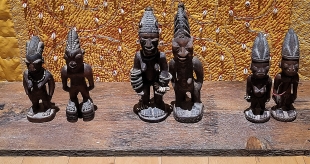
The exhibition consists of photographs, videos (including an excellent one showing a woman in Nigerian clothing riding through Peckham on a black horse), sculptural assemblages, and coloured drawings. Words are inadequate to describe the imaginative exhibits, but if you are unable to visit the show, there is a good verbal summary of the artworks on https://www.southlondongallery.org/exhibitions/lagos-peckham-repeat/ . To give you some idea of the ideas that link the various works on the display, I will quote from the gallery’s guide:
“This exhibition brings together thirteen contemporary Nigerian and British-Nigerian artists to explore links between Lagos, meaning ‘lakes’ in Portuguese, and Peckham as a channel through which to address wider issues of migration. It is framed around ideas of pilgrimage, meaning journeys to a sacred or special place and, in this case, migration motivated by a search for a better life. At the heart of the exhibition is an exploration of the complexities of shifting notions of home and identity as generations of Nigerians settle in London permanently, return to Lagos, or move elsewhere.”
And I feel that this summarises the show very well. All of the exhibits are visually engaging in an exciting way, and if you bother to read the guide carefully, all of them convey the artists’ concepts with great lucidity and originality.
After seeing the show, you can obtain good refreshments in the SLG’s simple but attractive South London Louie café. The SLG also has a bookshop with many intriguing titles on offer.
 yamey
yamey 