
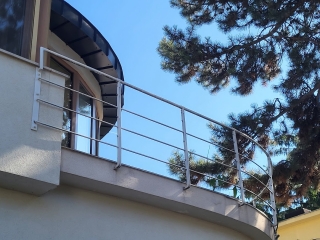
Budapest’s city bus number 5 goes from Blaha Lujza Square in central Pest to Pasareti Square in the suburb of Pasaret, which is northwest of the historic heart of Buda. The bus route terminates at a circular piazza – Pasareti Square – and parks next to a curved, single-storey bus station which occupies the northwest quadrant of this circular area. The elegantly simple, clean lined bus station looks as if it were built only a few years ago, but it was not. Designed by Gyula Rimanóczy (1903-1958), it was built in 1937, and it is one of several Modernist buildings that can be viewed in the leafy suburb of Pasaret.
Close to the bus station on the northeast quadrant of the circular piazza, there is another building designed by Gyula Rimanóczy. Constructed between 1931 and 1934, it is Pasaret’s parish church of St Anthony of Padua. When we were in Budapest, many churches were locked closed except on Sundays. Luckily for us, on the Saturday morning we visited Pasaret, the church was open, and we were able to enter. We were amazed by the beauty of its interior, which is kept in immaculate condition. Although it was constructed over 90 years ago, this church is one of the best twentieth century churches I have visited, comparing very favourably with the reconstructed Coventry Cathedral and Le Corbusier’s church at Ronchamp.
The spacious, tall, well-lit church is filled with details designed by Rimanóczy, and works of art created by his contemporaries. These are summarised in a Hungarian Wikipedia article (https://hu.wikipedia.org/wiki/Pasar%C3%A9ti_t%C3%A9ri_templom), which provides a good idea of the richness of the building’s decorative features, and is translated as follows:
“The stained glass windows are the work of Lili Árkayné Sztehlo (1934). The pulpit (with the symbols of the four evangelists) and the original altar reliefs are the work of Béla Ohmann (1934). The Heart of Jesus altar (1934), the Saint Joseph altar (1939) and the Stations of the Cross reliefs (1939 ) were created by Éva Lőte. The wood-carved reliefs of the Virgin Mary altar and the Saint Francis chapel, together with the marble altar, are the work of István Karle Bicskei (1935). The altar of St. Teresa dates from 1942 (created by Jenő Zoltán Hallgass), and was donated by Rimanóczy. Gyula Rimanóczy designed even the smallest details, such as all the light fixtures (the text of the eight beatitudes described in the New Testament can be read in the middle of the “wall sconces” on the eight columns, which are still visible today), the holy water tank, the candlesticks, and the communion chalices. The goldsmiths István Iván and Jenő Hadina made the goldsmiths ‘ works of art. The statue of Christ Falling to the Ground in front of the tower was donated to the Franciscan order in 1931 by the sculptor Sári Somló before the church was built . The four bells of the church date from 1935 (from the Budapest workshop of László Szlezák) …”
Despite the wealth of artwork and decorative detail, the church feels uncluttered and airy. It is a gentle modern structure, not a brutal one. It feels wonderfully peaceful and calming being within it. It is a church that unlike many gothic and baroque edifices does not feel oppressive; it is a place in which to contemplate peacefully.
Pasareti utca, the main road of the suburb, continues northwest from the church and the bus station, reaching a bifurcation after just over 500 yards. A small road, Napraforgo utca, begins at the bifurcation. All the 22 houses along this short thoroughfare were built between 1930 and 1931 in the Modernist style. This estate was inspired by those modern model housing estates already built in countries including Germany, Austria, Czechoslovakia, and Switzerland. When looking at the houses in Naproforgo utca, it is not difficult to detect the influence of leading design institutions such as the Bauhaus, which functioned in Germany from 1919 until 1933.
The history of the Naproforgo utca estate is concisely related in a website (https://www.offbeatbudapest.com/features/how-the-bauhaus-shaped-architecture-in-budapest/) from which I have extracted the following:
“The most interesting large-scale housing development of the early 1930s was in Napraforgó utca, a leafy suburb on the outskirts of Budapest. The private developers, Fejér & Dános, hired a motley crew of 18 leading architects that included both the radically modern Molnár and the notoriously conservative university professor, Gyula Wälder, to build 22 small houses for middle class families.
The project was a success and all houses were sold soon after its completion in 1931. The charming side street was flanked by two-story, flat-roofed family homes, each slightly different but fitting into a modern aesthetic. The houses were sun-filled and came with fully equipped kitchens and bathrooms. Unfortunately, some of them have since been neglected, parceled up, or unrecognizably rebuilt. In recent years, locals have started to appreciate the legacy of Napraforgó utca – there are many walking tours, for example – and made a conscious effort to protect its buildings.”
The architects of the buildings in the street are listed at https://modernism-in-architecture.org/buildings/napraforgo-street/, which also includes brief summaries of their biographies. One of those who oversaw the planning of the estate was Farkas Molnar (1897-1945), who had been a member of Germany’s Bauhaus in the 1920s. However, as an article (https://www.artmagazin.hu/articles/archivum/napraforgo_utca) translated from a Hungarian website revealed, though Modernist, some conventionality was retained in the design of the buildings on the estate:
“The model estate thus shows the diversity that is typical of Budapest’s modern architecture in general. The floor plans of the buildings corresponded to the basic type of European family houses of the time, with the service rooms and living room on the ground floor, the bathroom and several bedrooms on the first floor – in terms of spatial connections and spatial organization, the houses showed little of the functionalist character of modern architecture. Most of the facades were not strictly modern in style or inspired by Bauhaus, many used brick cladding, art deco or historicizing formal elements (such as house number 9 by Róbert K. Kertész, house number 16 by the Tauszig and Róth designers, or house number 22 by Béla Baráth and Ede Novák). At the same time, the construction created an opportunity to demonstrate new building materials, structures (sliding windows, built-in wardrobes), and less common mechanical solutions (such as air heating), since the houses of the model estate were opened to visitors – just like in the case of the Werkbundsiedlungs [experimental modernist housing estates built in Central Europe]. This form of communication with potential buyers and the idea of the “model estate” continued in practice in the 1960s, for example in the Óbuda Experimental Housing Estate. Despite the different perceptions of the architects, the image of the street consisting of nineteen buildings became harmonious; on the similar-sized plots (with one exception), single-storey, smaller-than-usual family houses were built, mostly with carefully matured proportions, consisting of cubist masses, mostly with flat roofs, and without traditional decoration. In addition to the uniform fence and street lamps, the sight of the geometric gardens consisting of square plant islands designed by the gardener László Solty also contributed to the uniform image of the street.”
Despite these observations, I felt that the edifices on Naproforgos utca have a distinctly Modernist appearance or ‘flavour’.
We walked along the street, viewing the buildings, each of which has a label outside it giving the name of its architect. Most of them seemed to be in good condition, but a couple looked as if they need considerable care and attention. Each of the two-storey dwellings still look contemporary although they were built more than 90 years ago, and I would be happy to live in any of them. Halfway along the street, there is a small, rectangular public garden. At one end of this, there is a memorial bearing the date ‘1932’ and a list of the architects involved in the designing of the buildings on the estate.
During visits made to Budapest prior to our latest in September 2026, I have often visited the Pasaret district, mainly to visit elderly friends, one of whom is now aged 104, who lived on the main road leading to Pasareti Square, and also once to view the house where the composer Bela Bartok lived between 1932 and 1940. However, it was only during our latest trip to Budapest that I spotted in a guidebook published in 2001 that Pasaret is the home of some interesting, attractive 1930s Modernist architecture.