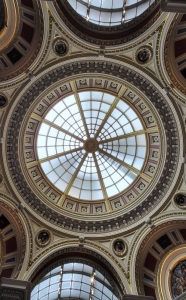
Pasaret is a suburb of Budapest on the left – Buda – bank of the Danube River. In September 2026, my wife and I revisited this leafy area for two reasons, one of which I will recount below. I will write about the other in a future essay.
In September 1974, a conference, The Nafplion Colloquium on Research Programmes in Physics and Economics, was held in Napflion, Greece. My father, an economist, was one of the organisers and participants of this conference that celebrated the works of the Hungarian philosopher Imre Lakatos (1922 – February 1974; see: https://en.wikipedia.org/wiki/Imre_Lakatos ). My mother, my sibling, and I were invited to join the delegates and their partners at the event. Imre’s recently widowed partner, Gillian, was present, as were his friend the historian of mathematics and philosopher Arpad Szabo (1913-2001) and his wife Klari, who lived in Budapest. Although much older than me, I enjoyed their company during the two weeks we spent together in Napflion.
In the early 1980s, I was about to make my second visit to Budapest. Before I went, I contacted Gillian, who had visited Hungary several times and gave me some contacts in the city, including those of Arpad and Klari. After arriving in Budapest, I got in touch with the Szabos, and they invited me for dinner at their flat in the Pasaret district of the city. We got on very well, and each time I visited Budapest, I used to visit them and enjoy their generous hospitality. They spoke superb English, and Klari was an excellent cook.
In 1985, when I was living in Gillingham, Kent, Klari sent me a letter. In it she wrote that she was teaching two young men, teenagers, English. Back then, Hungarians were able to travel outside to Soviet bloc but were only allowed to carry with them an extremely small amount of ‘hard currency’ – about 200 US dollars every five years, if I recall correctly. In view of this and the high cost of living in the UK, she wondered whether I would be able to accommodate the two lads at my home for a month. Although I did not know them from Adam – so to speak – I agreed because I trusted Klari’s judgement. It was quite a risk agreeing to host two people, whom I knew nothing about, but I am glad I did. A and K turned out to be delightful, appreciative guests.
After their stay, I used to visit them in Budapest, usually staying with A’s family and later in his own apartment. A has remained in Hungary, and K is now successfully established in the USA.
Between 1997 and 2026, we did not visit Budapest. I kept in touch with A and K, but lost contact with the Szabos in Pasaret.
In September 2026, we decided to visit the Pasaret district to view something of architectural interest, which I will write about in the near future. As our local bus sped along Pasareti Utca – the main thoroughfare that runs through Pasaret, we passed a house that looked familiar. It reminded me of the house where the Szabos lived, but I was not suren if it was that one. After seeing the architecture we had come to view, I rang our friend A to see if he remembered the Szabo’s address, which was where, many years earlier, he used to attend the private English tuition given by Klari. He supplied the address, and we walked there.
The house, which now bears a plaque commemorating Arpad Szabo, is a small apartment block surrounded by a garden. Two women were standing in it. We mentioned Klari, and one of them, who spoke English, pointed at the correct entrance, telling us that Klari, who was now 104 years old, lived there. I was delighted to discover that she was still alive.
We rang the doorbell several times, but there was no reply. An elderly lady, who lives in the flat below that of Klari, invited us into her flat. She only spoke Hungarian, but was keen to meet us. A retired violinist, we could not get her to understand that we would like to have Klari’s telephone number. We left, happy to know that Klari is still living, but sad not to have met her.
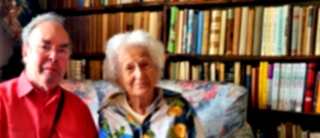
The following day, A came into Budapest to collect us in his car to have lunch with his family in the hills outside Buda. When we told him about our abortive attempt to meet his old teacher Klari, he suggested we drove there, and tried the bell again. This time, we were successful. One of Klari’s daughters let us in, and there in her immaculate flat whose walls are lined with shelves filled with books, stood Klari, looking much as she had sone when we last met her almost 30 years ago. She invited the three of us into a small room, which A remembered as being the one in which his English tuition used to take place.
Klari, who is about to celebrate her 104th birthday, is a little frail, but her memory and mind are in an excellent state. She recalled all kinds of small details about me, my parents, other people who had been at Napflion, and my wife, who visited her in 1997. It was a wonderful meeting – One which I had thought would have had the tiniest chance of occurring.
While we were chatting, one of her daughters mentioned that only the evening before, they had been talking about us. Our unannounced, spontaneous visit must have seemed unbelievable. One thing they recalled about our last visit made when our child still wore nappies – diapers – was that my wife changed her in front of the Szabos on their living room floor. Clearly, this had made a great impression on them at the time.
We spent 6 days in Budapest this September, and each one of them was highly enjoyable. Our best experience, which was one we were least expecting, was finding Klari again and spending time with her and her daughters.