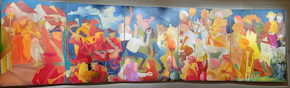
KRISHEN KHANNA CELEBRATED his one hundredth birthday in July 2025. The NGMA (National Gallery of Modern Art) in Bombay is currently holding a superb exhibition showcasing his paintings. The show is beautifully displayed and the artworks are skilfully illuminated.
Khanna was born in Lyallpur, now in Pakistan. After the Partition of India in 1947, he worked as an official in Grindlays Bank in Bombay. However, before Partition, he had already begun painting. The bank job was just to help keep him and his family going after they had left/fled what became the Pakistani part of Punjab.
Soon after arriving in India, Khanna began associating with members of Bombay’s Progressive Art Group that included notable creators such as FN Souza and MF Hussain. Thereafter, his painting career took off, and his reputation soared.
The exhibition at the NGMA surveys Khanna’s extraordinary range of paintings. Their subject matter ranges from political to historical to religious … and much more. The show, which demonstrates the artist’s amazing versatility and great artistic skill, continues until 12 December 2025, and should not be missed if you are in Bombay.
IN AUGUST 1947, India and Pakistan became independent sovereign nations. Following this, vast numbers of Sikhs and Hindus fled from Pakistan to India, and many Muslims fled in the opposite direction. This mass migration of people was accompanied by unbelievably horrific incidents of violence; many lost their lives on both sides of the frontier. Meanwhile, in much of India, daily life for many went on without incident. A yearly publication was published in Bombay from 1919 until 1979. It was called “Times of India Annual”, but between 1942 and 1948, it was called “Indian Annual”. The 1948 issue of “Indian Annual” was published by the Times of India soon after Independence was achieved in 1947. I have a copy of this beautifully illustrated issue. In common with many magazines, it is amply supplied with advertisements. Studying these was interesting because although some of them seem to have recognised that India was independent of both the British Empire and separate from Pakistan, others have not taken this into account.
I imagine that many of the readers of the 1948 Indian Annual were Indians. The magazine includes advertisements for many products used by Indians. Many of these commercials depict faces or people. Some of them show people with faces that look Indian. These include the adverts for Firestone tyres, the India Tea Marketing Expansion Board, Cyclax (beauty products), Tata Steel, Saba Radio Company, and Himanlal Manchand (jewellers). Others feature people with faces that are unmistakably (white) European, for example: Ovaltine, Terra Trading Corporation (modern Czechoslovak glassware), Argoflex (cameras), Rogers (soft drinks), Yardley (beauty products), Rendells products (feminine hygiene), and Virol (a health product). Either these companies that used European faces were recycling pre-existing company advertising material or not sensitive to the fact that India was then independent, or both. Another possibility is that these companies were appealing to the spending abilities of the many European people who were to continue living in India until well into the 1970s. For even after Independence, there were institutions (e.g., some clubs and schools) in India that for many years were only for Europeans, but excluded Indians.
Several of the advertisements in the 1948 publication listed the cities where they had branches. Some of these listings ignored the fact that India and Pakistan were no longer parts of one country. Ovaltine was distributed by a company that had branches in Bombay, Calcutta, Karachi (Pakistan), and Madras. The mechanical and construction engineers Garlic &Co had branches in Indian cities and also in Lahore. And Modern Trading Company listed offices in Bombay, New Delhi, Karachi (Pakistan), Calcutta, and Lahore (Pakistan). Another advertisement, that for the Chicago Telephone & Radio Co. Ltd, includes listings of offices both in India and Pakistan. The Rootes Group, which manufactured cars like the Humber, the Hillman, and the Sunbeam Talbot, list their (I quote) “Distributors in India” as being in towns such as Karachi, Lahore, Peshawar, and Rawalpindi. Had the advertiser not realised that these towns were now no longer in India, but in Pakistan? In all the cases I have mentioned in this paragraph, the advertising agencies seemed to have ignored the fact that what had once been (greater) India was now India and Pakistan. Given what was happening in the way of the misery caused by the partition of India at the time the Annual was published, it seems odd or even insensitive that the advertisements display no sign that the Subcontinent had been divided.
After Independence, Jawaharlal Nehru wanted to move India into what he perceived as the ‘modern era’. Some of the advertisements reflect this both in their design and the products they were promoting. The advert for Godrej shows some tubular household furniture of a design that many would have considered avant-garde in 1948. An advertisement for Indian-made Panama cigarettes is reminiscent of the Italian Futurist style. Likewise, for the Tata steel advertisement. This has futurist features but also veers towards the Soviet Socialist Realism style.
Finally, we come to a very interesting advert, that for the Bombay based Himanlal Manchand jewellers. It depicts Indian warriors on horses and is covered with crests of various rulers of Princely States and that of the Governor of Bombay, which is accompanied by the words:
“By appointment to H.E. Rt. Hon’ble Sir John Colville, Governor of Bombay”
Sir John Colville (1894-1954) was appointed Governor of Bombay in March 1943. He held this post even after India became independent, and was replaced by Raja Maharaj Singh in early January 1948. The jewellers were also by appointment to the princely rulers of Baroda, Jodhpur, Cooch-Behar, Jubbal, Jaipur, Indore, Palanpur, and Dewas. These maharajahs had been the rulers of ‘semi-autonomous’ (vassal) states within the British Empire. All of those listed became incorporated into the India which came into existence in August 1947. Their rulers were recognised officially by the Indian government until 1971. Between 1947 and 1971, these and other rulers of princely states received a privy purse from the Indian government. In 1971, Prime Minister Indira Gandhi put an end to the majority of these payments and de-recognised their titles and put an end to all of their royal privileges. So, in 1948 when Himanlal Manchand placed their full page coloured advertisement in 1948, they were entitled to show off their appointments to Indian royalty. The advertisements alone make the 1948 Indian Annual an interesting curiosity. The articles in the magazine along with many of its fine illustrations make it into a real treasure of great historical interest. While writing this piece, I discovered that the 1949 issue can be read online (https://archive.org/details/dli.venugopal.824/page/n91/mode/2up) . Skimming through this, I noticed that some companies still depicted European faces in their adverts and others included cities in Pakistan in the lists of their branches. This was despite the fact that since October 1947 Pakistan had been fighting a war over Kashmir. This only ended on the 1st of January 1949.
IN A SECONDHAND BOOKSHOP in Thame (Oxfordshire) I purchased a book called “Wonderful India”. It must have been published by 1943 because inside its front cover there is the name of its first owner, LW Morris, and next to that he added “Royal Air Force, Calcutta, July 1943”. The book is trilingual. Its text is written in Bengali (Bangla), English, and Urdu. It was published by The Statesman and Times of India Book Department. The Statesman is a newspaper that was founded in 1818, and published simultaneously in Calcutta, New Delhi, Siliguri and Bhubaneswar. The Times of India was founded 20 years later. The gloriously illustrated book, which covers pre-Partition India, as well as Sri Lanka, Burma, and Nepal, contains no text in Hindi. In British India, the official languages were English and Standard Urdu, and later Standard Hindi (https://en.wikipedia.org/wiki/Languages_with_legal_status_in_India#History). Oddly, for many years Bengalis were opposed to using their language as an officially recognised one, for a long time preferring to use Persian for formal (especially commercial) use (https://thespace.ink/bengali-and-persian-in-british-raj/). Yet despite this, the book I found favours Bengali and omits Hindi. I suspect that because the book might well have been published in Bengal, the Bengali script has been included. Hindi written in the Devanagari script only became the official language of India in September 1949, several years after “Wonderful India” was published.
Dhaka (now in Bangladesh)
The book covers all the regions of pre-Independence India as well as some of its neighbours. It is rich in black and white photographs, many of which are superb examples of photographic technique. Each picture is captioned in Bengali, English, and Urdu. The only pieces of prose are the general introduction (which includes a photograph of Mahatma Gandhi) and introductory paragraphs at the beginning of each section. The Urdu introduction is at the rear of the book, and is next to a picture of Jawaharlal Nehru. There is no picture of any member of the British Indian hierarchy.
Bangalore, a place which I have visited often, is given only one sentence at the beginning of the section on Mysore and Coorg:
“The British retain some territory at Bangalore, which is the administrative headquarters of the state, while Mysore is the capital.”
There are three photographs of the city, Sadly, not the most interesting in the book. To compensate for this, the book is filled with pictures of touristic sights and daily life of India as it was before WW2 had ended. The book provides a fascinating window on a part of the world that has in many aspects changed beyond recognition.
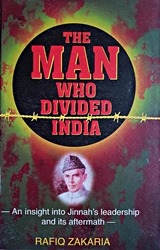
Mohammed Ali Jinnah (1876-1948) saw the realisation of his ambition, the formation of a sovereign nation for Indian Muslims: Pakistan, a year before he died as its supreme leader. Jinnah was a brilliant barrister and orator. His brilliance is described by Rafiq Zakaria in his book “The Man who divided India“. The author, clearly recognising his subject’s skills, does not rate him highly as an individual. His lucid, well-reasoned text makes this very clear.
At first, Jinnah, who was always attracted to politics, strove for Hindu-Muslim unity/harmony in pre-independence India. Various factors, including his disapproval of the anti-British Khilafat uprisings of India’s Muslims following WW1, led to him being sidelined by both the Indian National Congress and the main Indian Muslim political groupings. This led to him leaving India and establishing a legal practice in London and also attempting (in vain) to become involved in British parliamentary politics.
Returning to India after a few years in London, Jinnah recommenced his struggle to become prominent in the Indian polical scene. To do this, he abandoned the idea of working for Hindu-Muslim unity for the opposite – the alienation of India’s Muslims. This proved successful. Under his leadership of the Muslim League, he promoted the idea of a separate sovereign state for India’s Muslims by indoctrinating his followers to believe that as the Congress became more powerful and when the British left India, Muslims would be at the very least dominated by the Hindus. By 1947, when the British gave up their hold on India, the formation of Pakistan, a sovereign state for Indian Muslims, was guaranteed.
The formation of Pakistan was associated with mass movements of people: Muslims into Pakistan, Hindus and Sikhs out of the newly created country. During this ‘Partition’, there was massive loss of life and much irreversible misery both in Pakistan and India. Furthermore, Pakistan was not one contiguous territory, but two widely separated portions: West Pakistan and East Pakistan (now Bangladesh).
Zakaria describes how Jinnah, the great leader of the Muslims, was really a very unobservant Muslim. Throughout his life, Jinnah ate pork, enjoyed alcohol, hardly knew the Koran, and never learnt Urdu, the language of the Muslims of the Indian subcontinent. According to Zakaria, Jinnah did not hold his fellow Muslims in high regard, to put it mildly. It appeared to me while reading the book that Jinnah took advantage of Muslim fears of possible domination by the Hindus to further his ambitions of achieving political prominence, which were indeed successful.
Zakaria uses the last few chapters of his fascinating book to discuss the legacy of Jinnah’s creation, Pakistan. He paints a gloomy picture. Having espoused the idea of the separateness of the Muslims, and promoted the idea that the Indian Muslims were a ‘race’ or ‘nation’ separate from their non-Muslim Indian neighbours, Jinnah, like his hero the Turkish leader Kemal Ataturk in Turkey, decided that Pakistan should become a ‘modern’ secular state rather than some kind of Islamic entity. He wanted to govern Pakistan using the model of British imperialism, which the Indian subcontinent had just freed itself. This has not happened in Pakistan; it is now an Islamic state.
Zakaria emphasises that far from unifying India’s Muslims, Jinnah’s creation of Pakistan has achieved the very opposite. The Muslims of the subcontinent are now divided between Pakistan, India, and Bangladesh. Many families have members now separated by international borders. Many Muslims in India continue to live with the fear that they are somehow threatened by the Hindu majority in the country. In addition, within Pakistan itself, different factions of Muslims (Sunnis, Shias, and others) are in permanent conflict with each other. In Bangladesh, there are also problems. And, if that were not bad enough, the political situation in modern Pakistan is extremely unstable and life there is far from peaceful. From what I have read in Zakaria’s interesting and highly readable book, Jinnah’s dream of unifying India’s Muslims has turned into a nightmare.
To conclude, it should be mentioned that Zakaria, an Indian Muslim, has served the Indian Congress Party, which opposed Jinnah in the years before independence, as a high-ranking official. Despite that, I felt that his book attempts quite successfully to give a balanced view of Jinnah and his politics without concealing his own views.



 yamey
yamey 