An artist from Aberdeen in west London

SURROUNDED BY SOCIAL housing, the Frestonian Gallery is within a stone’s throw from the Westfield shopping mall in west London’s Shepherds Bush. This small but elegant commercial gallery hosts well-chosen artworks at temporary exhibitions. The artists whose works are displayed there are not as well-known as those shown in some of the larger and longer established galleries in Mayfair, but all of them deserve to be recognised as worthy exponents of their craft and creativity.

The current exhibition, which continues until 13 June 2025, is of paintings by Barry McGlashan, who was born in Aberdeen (Scotland) in 1974. Trained in painting at Gray’s School of Art in Aberdeen, he went on to teach in its painting department between 1998 and 2005. He now lives and works in Edinburgh.

At first glance, many of Barry’s paintings have a hazy or misty appearance. After a few moments, the mist seems to clear, and the viewer can enjoy beautifully painted scenes. The paintings have a dream-like quality, and as the gallery’s handout notes, some of his images are:

“… at once so vivid and yet close to slipping away entirely …”

Barry refers to a concept embraced by the Elizabethan John Dee (1527-1608). Namely, that the world around us is far more unseen than seen. Barry’s pictures do depict such an idea very well.

Rather than wasting time and money in the Westfield shopping mall, feed your eyes on the lovely paintings currently on show at the Frestonian. You will not regret visiting this gallery.

Address: 2 Olaf St, London W11 4BE

The brief but creative life of an artist from America

BORN IN SEATTLE (USA), the black American artist Noah Davis (1983-2015) led a brief but productive life. Son of a lawyer and an educator, Noah became addicted to painting during his early teenage years. By the age of 17, he had his own studio. He studied art at the Cooper Union School of Art in New York City between 2001 and 2004, and from 2004 onwards he lived and worked mainly in Los Angeles. Until 11 May 2025, there is an excellent exhibition of his works (mainly paintings) at the Barbican Centre Gallery in London. Until I visited this show, I had never heard of Noah Davis, but I am pleased that I have now ‘discovered’ him and his work.

Noah’s lifelong aim was (to quote what is recorded in Wikipedia as having been said by him):

“… to just show black people in normal scenarios, where drugs and guns are nothing to do with it …”

And to portray these scenarios in images created to illustrate:

“… where black aesthetics and modernist aesthetics collide …”

Although most of the paintings illustrate mundane or normal aspects of the lives of Black American people, Noah does so in ways that make the ordinary seem less ordinary and more magical.

In a documentary film that visitors to the exhibition can watch, Noah, who comes over as being a delightful person, made an interesting point. He said that in some forms of art like film, theatre, and literature, a story can gradually develop as the performance or novel proceeds. In painting, on the other hand, the artist must create an image that tells the whole story from start to finish, all on one canvas. This is something he does successfully.

In 2015, Noah was diagnosed with a rare but usually lethal carcinoma. Even while lying in bed in hospital, he continued to create images. In fact, he made 70 wonderful small works (many of them experiments in abstraction) while undergoing treatment for the disease that tragically ended his life. Many of these works are shown in the exhibition. During the month before his death, he made three large canvases, each one expressing his anticipation of his life’s imminent ending. One depicts two girls asleep on a sofa. This picture honours togetherness and restfulness. Another depicts a funeral. And the third shows a man walking in front of self-storage lockers. This image represents the loneliness in which each of us leaves the world of the living.

Having become acquainted with the creativity of Noah Davis, I feel that it is a great tragedy that this wonderfully poetic artist lived for such a brief time.

From rural Cornwall to the Royal Academy in London

ONE OF MY FAVOURITE National Trust properties in England is Trerice, which is about 2.3 miles south of the Cornish town of Newquay – not one of my favourite places in Cornwall.  We visit the house and gardens at Trerice every time we spend time in Cornwall, and always discover soothing there that we had not noticed before.

This tine (June 2024), one of the volunteers working in the house pointed out a painting by John Opie (1761-1807). I had not come across his name before. Our informant told us that he had been born in Cornwall, and thought that he had been involved with the establishment of the Royal Academy. He was born at Trevallas between St Agnes and Perranporth, both of which are not far from Trerice. At an early age, his artistic talents became evident, but his father, a carpenter, wanted John to become a carpenter. A physician, Dr Wolcot, met him at the place where he was an apprentice, and reecognising John’s artistic skills, paid for him to be released from his apprenticeship. Wolcot encouraged Opie, and by the start of the 1790s, he was a successful portraitist in Cornwall.

In 1781, Wolcot took Opie to London, where his works were admired by great artists of the time including Sir Joshua Reynolds, who compared John’s work to that of Caravaggio and Velasquez. A year later, Opie began working independently of Wolcot, who had been supporting him up until then. An acquaintance of Dr Wolcot introduced Opie to the court of King George III. This led to Opie being commissioned to paint portraits of people of high rank in English society and royalty. In 1886, he was elected a full member of the Royal Academy, and in 1805 he was appointed a professor in that esteemed institution.

There are three paintings by Opie hanging on the walls of Trerice house. One is a portrait, and another a self-portrait. The third, which depicts three people playing cards, is a copy of the same picture that can be seen at Petworth house. The version at Trerice is believed to have been painted by Opie and others in his studio. Each of the three people in it have smiles. It is thought that in this painting, Opie was experimenting with the depiction of smiling. Although attractive, this picture is not as attractive as his other two paintings in Trerice.

It is always pleasant to re-visit places, and always exciting to discover something one had missed on earlier trips to that same location. As well as the lovely interiors at Trerice, the gardens surrounding it are always a joy to behold.

An artist from Vienna who lived in Hampstead (north London)

HAMPSTEAD HAS BEEN home to many artists – both painters and sculptors. Some of these are well-known, such as John Constable, George Romney, Stanley Spencer, Henry Moore, and Barbara Hepworth – to name but a few. Others are less widely known. Amongst the lesser-known is the late Marie-Louise von Motesiczky (1906-1996), some of whose paintings are on display in a special exhibition in Hampstead’s Burgh House until the 15th of December 2024. In addition to the works in the temporary exhibition, Burgh House’s permanent collection includes a few of her paintings.

Marie-Louise was born in Vienna (see: www.motesiczky.org/biography/). Her mother’s family were well-connected with Vienna’s flourishing intellectual circles in the early 20th century. Her grandmother, Anna Von Lieben, was one of Freud’s first psychoanalytical patients. At the age of 13, Marie-Louise left school, and began studying art in Vienna, The Hague, Frankfurt, Paris, and Berlin. In 1927, she joined the master classes held by the artist Max Beckmann (1884-1950) in Frankfurt-am-Main. This painter became an important influence in her life and work.

After the Anschluss (the Nazi annexation of Austria) in March 1938, Marie-Louise and her mother, Henriette, left Vienna. They went to Holland, where, in 1939, Marie-Louise had her first solo exhibition. Soon after this, she and her mother left for England, and settled in Amersham. There, she met the Bulgarian writer Elias Canetti (1905-1994) and his wife. Canetti was to become an extremely close friend of Marie-Louise. At Burgh House, we saw her portrait of him on display.

When WW2 was over, Marie-Louise and her mother moved into a flat in West Hampstead, which they rented until 1960. Then, they purchased a large house in Hampstead, number 6 Chesterford Gardens (a short road linking Frognal and Redington Road). While living there, she painted many portraits of her ageing mother. Some of these were on display at Burgh House.

Marie-Louise is now highly acclaimed as a 20th century artist in the country where she was born. Although the paintings I saw today at Burgh House are often imaginative and pleasant enough, I began to understand why she has not become as well-known as some of the many other artists who lived in Hampstead. However, everyone has different tastes in art. So, a good way to judge this artist’s work would be to pay a visit to Hampstead’s lovely early 18th century Burgh House.

From the screens of Instagram onto the walls of commercial art galleries

DO NOT UNDERESTIMATE the power of Instagram.

Today (the 2nd of April 2024), we visited Beers Gallery in Little Britain, a street which is close to St Bartholomew the Great church and Smithfield meat market. Until the 13th of April 2024, they have an exhibition of delightful paintings by Florent Stosskopf, who was born in Rennes (France) in 1989. Based in Brittany, he has qualifications in web and graphic design, as well as holding an Advanced Technician diploma from L’école Multimedia. Yet, he is a self-taught painter. His current exhibition at Beers is called “The Mocking Bird”. The gallery’s press hand-out says:

“The title, he informs us, is a loose reference to elements of his own autobiography that he found mirrored in the song ‘Mockingbird’ by Eminem.”

Be that as it may, the paintings are full of bold colour and vibrancy. It was a joy to see them.

We had never heard of Florent Stosskopf. We asked a lady who worked in the gallery how her establishment had got to know of this artist. The answer astonished us. She told us that it was after he began posting pictures of his paintings on Instagram (see: www.instagram.com/stosskopf_florent/)  that he began to be recognised as being a painter worth exhibiting in commercial galleries.

Many people with artistic tendencies and varying degrees of skill post images of their creations on Instagram. Even I use Instagram to try to promote some of my books. However, just posting on Instagram is not enough. To become truly successful by using Instagram, you need real talent, and that is what Monsieur Stosskopf has in a large amount.

A twentieth century American artist who seemed to have lost his way

THE EARLY WORKS OF artists, who became famous for their successful experimentation in style and expression (such as Matisse, Picasso, Van Gogh, Miro, and Hockney), began by making quite conventional figurative pictures – always competently executed. Such was also the case with the artist Philip Guston (1913-1980), who was born in Canada, son of Jewish parents who had migrated from Czarist Russia. Born ‘Goldstein’, he later changed his surname to ‘Guston’. His family moved to Los Angeles (USA) in 1922. His childhood was filled with trauma: his father committed suicide, and soon after that his brother was killed in a motor accident. He began to be involved with art as a way of dealing with these sad events. In the 1930s, he engaged with political activity, fighting racism and anti-Semitism at a time when the Ku Klux Klan was enjoying some prominence. Several of his paintings depict hoods, such as were worn by the Klan.

There is a retrospective exhibition of Guston’s works at London’s Tate Modern until the 25th of February 2024. The paintings are exhibited chronologically on the walls of eleven interconnecting display areas. Like the artists listed at the beginning of this piece, Guston’s early works are figurative and very beautifully painted. Many of these powerful images reflect his concerns about the adverse political developments he observed during the 1930s. Later, in the 1940s, he became friends with artists like Mark Rothko and Willem de Kooning, and he moved successfully from figurative painting to abstraction. He became well-known as an abstract artist. After that, in the 1960s, his art seemed to my eyes to go downhill.

Guston’s later works, which are partly figurative and partly abstract, and created in and after the late 1960s, were undoubtedly created to send messages to the viewer. However, I found them to be crudely executed in comparison with his earlier abstract and much earlier figurative works. Whether this crudeness was deliberate or reflected a decline in the artist’s ability I cannot say. These later works express the artist’s personal crises and his reaction to injustices and other global catastrophes, but they did not do much for me from an aesthetic point of view. Had I left the exhibition without seeing them, my admiration for Guston would have been higher than it is having seen them.

Franco and Franco in Funchal

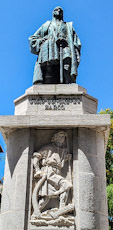
MOST VISITORS TO central Funchal in Madeira will pass, and probably notice, a bronze statue high up on a square based plinth outside the Bank of Portugal and the Golden Gate Grand Café. It depicts Joao Goncalves Zarco, who began the Portuguese settlement of Madeira in the 15th century. Very few people who pass this statue will know that it was created by a Madeiran sculptor, Francisco Franco (1885-1955). His older brother Henrique Franco (1883-1961) is one of Madeira’s most famous painters.

Both brothers studied at the Lisbon School of Fine Arts. They also spent time in Paris. Henrique returned to Madeira where he painted many of his pictures. Many of them are of Madeirans and scenes of the island. His paintings are beautifully executed and visually pleasing. Although the influence of Cezanne can be detected, Henrique did not seem to have affected by the innovative trends that were occurring in Western art during the 20th century.

Francisco visited Mussolini’s Italy in the 1920s and was impressed by the way that the state produced sculptures, which promoted the ethos and aims of the regime. He returned to Portugal, and began creating sculptural works that boosted the image of his country. Many of his important works were created for the Salazar government, which began in 1932.

Until our second visit to Funchal, I had never heard of the Franco brothers. Today, the 8th of May 2023, we visited a small museum in Funchal. It contains a fine collection of the works of both brothers. The museum contains many fine paintings by Henrique and sculptures by his brother, including a bust of Portugal’s former dictator Salazar. A video showing in the museum seems to suggest that far from being hostile to the Salazar dictatorship, Francisco was happy to create sculptures for it and its institutions.

Francisco attended an industrial school in Funchal. Its building is next to the museum. Over its main entrance is a carved stone sculptural frieze created by Francisco. The edifice now houses the Escola Secundaria de Francisco Franco, which opened in about 1976. Within its entrance lobby, we saw a bas-relief depicting the sculptor.

Although it is not one of Funchal’s main tourist attractions, the Museu Henrique e Francisco Franco deserves to be better-known.

Built during a time of war

FROM THE OUTSIDE, the church of St Barnabas in Pitshanger Lane (Ealing) is not particularly attractive. Even though we visited it on a Sunday, it was locked up. However, we were fortunate to meet a lady, who had been in the church hall and happened to have the key to the church with her. Kindly, she unlocked the edifice, and we were able to enter. The church’s interior, unlike its exterior, is wonderful.

The church stands close to Brentham Garden Suburb, which was built largely between 1901 and 1915. I will write about the Suburb at a later date, but now I will concentrate on the church. Although the Suburb was built with a magnificent club house, there had been no plans to include a church. In 1907, a temporary church made from corrugated iron sheets, and dedicated to St Barnabas was constructed at the junction of Pitshanger Lane and Castlebar Park. Eventually, it was too small to accommodate its congregation in an area where plenty of housing was being constructed. For legal reasons, it was not possible to build a larger church on the site. So, in 1911 a larger plot was acquired at the corner of Pitshanger Lane and Denison Road (one of the streets within the Garden Suburb).

Ernest Shearman (1859-1939) was the architect chosen to build the larger St Barnabas Church, which can be seen today. After working in Buenos Aires and later at Sandringham, he moved to Winchester in 1907. From that year onwards, his work was mainly concerned with designing churches. According to a book by Hugh Mather about the centenary of the church of St Barnabas, all of Shearman’s churches:

“…are tall imposing buildings without spires, and their austere, simple architecture was designed so that elaborate furnishings and other adornments could be added subsequently …”

His churches represent “… almost the final flowering of the last phase of the Gothic Revival.”

All except one of his churches demonstrate Shearman’s fascination with rose windows and elaborate tracery. St Barnabas is a fine example of this.

The construction of the church began just before the start of WW1, in June 1914. It was completed in the middle of the war by June 1916, when it was consecrated.

The church has a spacious nave, which has a lovely timber ceiling. Although it was designed to reflect the heritage of the gothic era, the inside of the church feels almost contemporary. There is an enormous organ at the west end of the church. Made in 1851, it was made by the company of William Hill and  originally housed in St Jude’s Church in Southsea. It was moved to St Barnabas in 2011. Some of the pipes on the south side of the central tall organ pipes do not make sounds. They were added to the organ for purely aesthetic reasons. The current organ replaced an older, less reliable instrument, which was removed in 2010.

The apse is adorned by a large painting by James Clark (1857-1943), who was living in Bedford Park not far from the church when he created it. He was one of many artists residing in Bedford Park, which was an ancestor of the Garden Suburb movement. His painting in the apse depicts the three hierarchies of angels praising and adoring the Holy Trinity. It is a magnificent addition to the church.

As we did not want to delay the lady who opened the church for us, we did not have sufficient time to examine its interior in great detail, but it did demonstrate how wrong it was to, to rephrase a well-known saying, to judge a church by its cover.

Drawn to remember: an exhibition by an Indian painter

THE PAINTER MAHESH BALIGA was born in the south Indian state of Karnataka in 1982. He studied painting at The Chamarajendra Academy of Visual Arts (CAVA) in Mysore, and then received a postgraduate qualification at the prestigious Faculty of Fine Arts, MSU, in Baroda (Vadodara in Gujarat). He has taught at various art schools in India and exhibited in several countries including India. Currently, he lives and works in Baroda. Between the 12th of April 2022 and the 28th of May 2022, some of his works are being exhibited in a solo exhibition, “Drawn to Remember”, at the David Zwirner Gallery in Grafton Street (in London’s West End).

The paintings on display were created using casein tempera. This kind of paint has a glue-like consistency, but it can be thinned with water. According to Wikipedia, artists like this kind of paint because:

“… unlike gouache, it dries to an even consistency, making it ideal for murals. Also, it can visually resemble oil painting more than most other water-based paints …”

At first glance, it is difficult to discern whether the Baliga’s paintings on display at Zwirner’s resemble water colours or oil paintings; some of them seem to look halfway between the two mediums. All of them, except one, are quite small canvases and without exception they are all attractive. The subject matter depicted in the works is varied, from studies of plants and animals to everyday scenes (often with depictions of Indian life) to the slightly unusual. An example of the latter is in the only large canvas of the show in which there is an image of a man with sticky plasters over his left eye. Another odd subject shows a man with flowers growing out of his shirt. This is appropriately named “Flowering Self”.

The small size of most of the paintings, which the artist described as ‘lap-sized’, has a reason. Many of them were executed on the journeys the artist made when commuting to and from Surat (in the south of Gujarat), where he held a teaching position for a while. Though they are not large paintings, each one of them provides a window on the artist’s experiences and and his take on them. Although the paintings are far from mundane, they are not over-dramatic or excessively visually challenging. The exhibition is well worth seeing.  I would be happy to hang any one of the works I saw at his exhibition on my walls at home.

Constable and the clouds

THE ARTIST JOHN Constable (1776-1837) loved Hampstead and eventually lived there. It was in that part of London, then a large village, that he became fascinated by the depiction of clouds. Here is an extract relating to this from a book about Hampstead, which I am in the process of writing:

In the last of a series lectures he gave to the Royal Institution in Albermarle Street in 1836, Constable emphasised his systematic approach to depicting nature, by saying:

“Painting is a science and should be pursued as an inquiry into the laws of nature. Why, may not landscape painting be considered a branch of natural philosophy, of which pictures are but the experiments?”

Clouds over Hampstead Heath by John Constable

One of Hampstead’s attractions for Constable was its wide expanse of sky, which, as the historian Thomas Barratt wrote, the artist:

“… regarded as the keynote of landscape art, and so assiduously did he study cloud, sky, and atmosphere in the Hampstead days that Leslie, his biographer, was able to become possessed of twenty of these special studies, each dated and described. Constable was a man of Wordsworthian simplicity of character, fond of all things rural, and devotedly attached to birds and animals.”

The website of Cambridge’s Fitzwilliam Museum reinforces what Barratt wrote:

“While living at Hampstead, Constable made a series of oil sketches of the sky alone, each one marked with the date, time and a short description of the conditions. His interest in clouds was influenced partly by the work of the scientist Luke Howard, who had in 1803 written a pioneering study, classifying different types of cloud …”

In “The Invention of Clouds” by Richard Hamblyn, a biography of the chemist and amateur meteorologist, who devised the modern classification of clouds (cumulus, nimbus, etc.), Luke Howard (1772-1864), it is noted that Constable, who was familiar with Howard’s work, focussed his concentration:

“… on the extension of his observational range and clouds were the means that he had chosen for the task. After years of searching for an isolated image, seeking a motif upon which to weigh his technical advancement as a painter, he had found it at last in the unending sequences of clouds that emerged and dissolved before his eyes like images on a photographic plate.”

During the summers of 1821 and 1822, Constable made over one hundred cloud studies on the higher ground of Hampstead and its heath.  Writing in 1964 in his “The Philosophy of Modern Art”, the art critic/historian Herbert Read (1893-1968), who lived in Hampstead, commented that Constable was:

“… rather a modest craftsman, interested in the efficiency of his tools, the chemistry of his materials, the technique of his craft. His preparatory ‘sketches’ are no more romantic than a weather report. But they are accurate, they are vividly expressed, they are truthful.”

Read next contrasted Constable with Turner, pointing out that the former was far more attentive to depicting nature accurately than the latter, who became increasingly extravagant in his portrayal of it, always moving towards what is now called ‘expressionist’. Barratt wrote that although Constable admired Turner, he had no desire to imitate him and:

“He knew his limits, and recognised that within those limits were to be found subjects worthy of the highest aspirations. “I was born to paint a happier land,” he wrote, “ my own dear England ; and when I cease to love her may I, as Wordsworth says, — ‘never more hear her green leaves rustle or her torrents roar..’”