
Pears ripening
Within a fine historic garden
Close to Greys Court
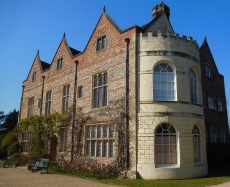
Greys Court is a house and garden in Oxfordshire, near to Henley-on-Thames. It is maintained by the National Trust.

Pears ripening
Within a fine historic garden
Close to Greys Court
Greys Court is a house and garden in Oxfordshire, near to Henley-on-Thames. It is maintained by the National Trust.
NOT FAR FROM Henley-on-Thames, lies the village of Bix. Its name might derive from either the Anglo-Saxon word for box, an evergreen shrub, or from a word, ‘behaeson’ meaning ‘to vow’. By 1085, when the Domesday Book was compiled, Bix was divided into two nearby settlements, each of which had its own church. One of these has disappeared, and the other, St James, is now in ruins.

Still consecrated but in a dilapidated state, St James is now known as Bix Old Church. Very little is known about the early history of this ruined church. It was in existence by 1274, when it and the other church were so poor that they had to share a vicar. In the late 1700s, the walls of St James began to collapse. So, brick buttresses were constructed to prevent further damage. These buttresses are still standing, but they failed to halt the collapse of the church. In 1874, the church was deemed unusable, and a new church, the present St James, was built.
We visited the new church, arriving just in time to meet someone who was about to unlock it. Constructed in 1874, it is a Victorian gothic edifice. Inside, the church is built with bricks of differing colours arranged in layers to produce an eye-catching appearance. What makes this church fascinating is that it contains various things that were rescued from Bix Old Church: the font; two fragments of Flemish stained glass dating from 1530; and the carved stone bowl of the piscina. These valuable remains were moved from the old church to the newer one in 1875.
Bix Old Church is reached by a long country lane that is only wide enough for one car. It and the church are in surprisingly a rural environment, considering how close it is to places like Henley, Reading and High Wycombe. We visited the church mainly because when I passed a sign for Bix, which I thought was a strange name, I looked it up on the Internet later while enjoying a picnic, and found out about the existence of the ruined church. Once again, a short visit into the English countryside has resulted in an unexpected, fascinating discovery.
ONE WRITER WHOM I had to study for a state examination in English literature in 1968 was Geoffrey Chaucer (c1343-1400). Although I struggled to make sense of his “Prologue” to the Canterbury Tales, I enjoyed doing so. Since then, I have hardly ever thought about Chaucer. This changed when we made our third visit to the attractive village of Ewelme in Oxfordshire. During this visit, the parish church (St Mary) was open, and we were able to enter. Inside, we met a churchwarden, who was getting the place ready for a funeral service. He pointed out a very elaborate tomb that separates the chancel from the Chapel of St John the Baptist, which occupies the southeast corner of the church. I could hardly believe my ears when he told me whose remains are buried beneath this tomb.

The tomb, which bears the carved stone effigy of a woman, and beneath it, a stone carving depicting her after death, is that of Alice, the Duchess of Suffolk (1404-1475). She had been married first to the Earl of Salisbury, who died in 1428. Her second husband was William de la Pole (1396-1450), 4th Earl and first Duke of Suffolk. Fascinating though this is, what really interested me was that her paternal grandfather was none other than Geoffrey Chaucer, whose writing I studied many years ago. Near to Alice’s tomb, there is a less elaborate tomb containing the remains of her parents, Thomas Chaucer and Maud (née Burghersh).
Once again, visiting places in the English countryside has led us to making an exciting discovery.
WALLINGFORD IN OXFORDSHIRE stands on a bank of the River Thames. There is a bridge across the river. If you stand on it, facing the town, you will notice a church with an unusual spire standing near the river. This is the church of St Peters. It was built between 1763 and 1769 on the site of an earlier church, which had been demolished by Parliamentary forces in 1646, when the town was being besieged by them.

Largely unaltered since it was constructed, the church contains the grave of the famous lawyer Sir William Blackstone (1723-1780), a judge who was the author of the still influential “Commentaries on the Laws of England”. He was elected as one of the first church wardens of St Peters. Sir William contributed generously to the construction of the steeple and the installation of a clock on the south face of the tower.
On the 29th of June 1969, the last service to be held in the church took place. St Peters became officially redundant in April 1971, and its care was taken over by the Redundant Churches Fund a year later. This organisation was founded in 1969. In 1994, the organisation was renamed The Churches Conservation Trust. This admirable group currently look after more than 350 redundant churches in England, and keep them open to the public and in an excellent state of preservation. We have visited many of their churches over the years, and found them to be interesting and usually very beautiful.

Autumn blooming
In an English country churchyard
Roses I believe
BITTER TASTING, WATERCRESS is a member of the cabbage family (Brassicaceae). It is rich in health-giving nutrients. In Britain, it is grown in fast flowing chalk streams. It used to be grown in streams on Hampstead Heath, and there is a row of cottages that formerly housed watercress workers on Hampstead’s Willow Road. Another place where it was once grown is the Oxfordshire village of Ewelme.
A trout stream runs past Ewelme. It was here in the late 19th century that the Smith family from the village of South Weston, not far from Ewelme and the larger town of Watlington, began cultivating watercress in the stream. The watercress beds stretch for about ¾ mile along the stream, and have now been preserved as a nature reserve. By the beginning of the 20th century, the watercress beds at Ewelme were flourishing, producing large crops. Hampers containing 56 lb of watercress were carried by wagon to Watlington railway station, and from there they were transported by train to the Midlands and Manchester. The cress from Ewelme was highly regarded all over the country.

The Smith family kept the watercress beds going until the mid-1960s, when they were sold to new owners. The beds were kept going but became increasingly less viable economically. They were closed in 1988. However, visitors to Ewelme can see the two rows of rectangular beds, each enclosed by low partitions. A boardwalk runs along the length of the beds, separating the two rows. The stream flows through the beds. What can be seen now was the result of much restoration work carried out by local volunteers. A small visitors’ centre stands next to the beds. Near the beds, there is a house called Watercress Cottages, where a member of the Smith family used to live.
Ewelme is an attractive village with many historic buildings. A visit to the watercress beds, now the home of waterfowl, is an unusual experience and well worth making.
THE NATIONAL TRUST looks after a house in Oxfordshire, which was once owned by William Morris. When I came across this property, Nuffield Place, I was surprised, because I believed that the artist and socialist William Morris (1834-1896) had lived in properties in Hammersmith, Walthamstow, Bexleyheath, and Gloucestershire, but not in Oxfordshire.
Nuffield Place was the home of another William Morris, who became Baron Nuffield in 1934, and later in 1938, Viscount Nuffield. He lived from 1877 until 1963. At the age of 15, he set up his own bicycle repair business. By 1901, he had a bicycle repair and sales shop on the High Street in Oxford. Two years later, he was manufacturing motorcycles. In 1903, he married Elizabeth Anstey (1884-1959), a seamstress whom he met when both were members of a cycling club. They never produced children.

By 1909, he had set up the Morris Garage in Oxford, and was selling and repairing cars. In 1913, he and his small team of workers had built the first car he had designed. By the time the First World War had begun he had acquired larger premises in Cowley on the edge of Oxford. He was already producing cars that were affordable to the popular market, but during the war, his factory switched to producing products needed for the war effort. While doing this, which was not very profitable, he developed much experience in the techniques of mass-production. One of the many models turned out by the Morris factory was the Morris Oxford. This car has made its mark in India because it was the prototype for the Hindustan Ambassador, which was made in India between 1957 and 2014.
After WW1, Morris began making huge numbers of affordable Morris cars, which sold well. William Morris became incredibly rich. However, he was a modest man and extremely generous. He spent most of his money on philanthropy, particularly in the medical field. Many of the institutions he paid for, which bear the Nuffield name, including Oxford’s Nuffield College, still exist. The number of ways in which he helped are far too numerous to be listed. As a child, he wanted to study medicine, but economic circumstances did not allow that to happen. However, because of all he did to promote healthcare and medical research, he was made a Fellow of the Royal College of Surgeons in 1948.
Nuffield Place, the house which William Morris purchased in 1933 and lived in for the rest of his life, was built for the shipping magnate Sir John Bowring Wimble, also chairman of an insurance company, in 1914. It was designed by Oswald Partridge Milne (1881-1968), who worked in the office of Edwin Lutyens between 1902 and 1904. When Sir John died in 1927, his widow sold the house, which was then called ‘Merrow Mount’, to Morris in 1933.
The house is spacious and must have been comfortable to live in, but it is remarkably modest to have been the sole residence of a man as wealthy as the automobile manufacturer William Morris. We were shown around it by a knowledgeable lady, who helped us to appreciate how modest were the lives led by William and Elizabeth Morris. Among the many things that interested me was William Morris’s bedroom. In one corner of it, there is what looks like a wardrobe. However, when the doors are open, it can be seen to be filled with tools and a workbench. Morris had his own workshop in his bedroom. His wife continued her seamstress skills, and many chairs were covered with textiles she had worked on. The house contains many books on a variety of subjects including history and politics. One bookshelf is filled with medical treatises. Morris, although he never became a doctor, was interested in reading about medicine.
Nuffield Place contains an iron lung machine, such as was used to help sufferers of poliomyelitis to breathe. On learning that there was a shortage of these machines in Britain, Morris used his factories to produce many of them to distribute to hospitals that needed them. The model he helped design, and his factories manufactured, has some curious details. The handles that were used to adjust the apparatus look just like car door handles. And some other components on the iron lung look very much like the hinges of car doors. These iron lungs were a valuable contribution to the treatment of diseases such as polio.
I could describe much more of what we saw at Nuffield Place, but it would be better if you visit the it. Lovers of gardens will also enjoy visiting this house owned by a William Morris, who did not design flowery wallpapers.

Ever circling upwards
Ascend the spiral steps
Till summit is reach’d
DURING THE LAST YEAR or longer, we have visited plenty of ‘stately homes’ in England. Many of them are very fine works of architecture.Today, we visited Blenheim Palace for the second time in 12 months., It was built for the first Duke of Marlborough and is still home to some of his descendants.

Of the many grand homes that we have seen during our travels, Blenheim impressed me far, far less than many of the others. It is impressive in its bulkiness but, for me, it lacks the finesse that characterises so many of the other aristocratic homes we have visited.
PS: To be fair, Blenheim was not completed as originally planned because at some stage the funds for its construction became dramatically reduced.
SHEEP WITH THEIR LAMBS were grazing or resting in the sunshine in a meadow beside the roadway leading to the entrance of Greys Court near Henley-on-Thames in Oxfordshire. Although the main house at Greys Court was closed (because of the covid19 pandemic) when we visited the estate in April 2021, there was plenty to enjoy in the gardens and fields that are contained in its extensive grounds. The highlight for me was the formal garden enclosed within ruined stone walls that extend from two sides of a tall tower topped with crenellations.
Greys Court has an interesting history, most of which I have summarised from what is contained in a good guidebook published by the National Trust, to which Greys Court and its grounds were donated in 1969. I have also consulted “Elizabeth’s Rivals” by Nicola Tallis. The tower and the attached ancient wall are the only remains of what was constructed by the De Grey family, who had been living on the estate since (or before) the Domesday book was compiled in the late 11th century. One of the family, Walter de Grey (died 1255), Archbishop of York, was a supporter of King John when he was forced into signing the Magna Carta in 1215.
In December 1346, the then owner of the estate Sir John, 1st Baron Grey of Rotherfield (1300-1359) was granted a licence to ‘crenellate’ Greys. What this means is that he was authorised to surround his home with a fortified curtain wall. It is the remains of this mediaeval wall that surrounds the walled garden that attracted me. After Robert, 4th Earl of Grey died in 1387, the estate passed to his daughter Joan, who was married to Lord John Deyncourt. Then, it was inherited by their daughter Alice, who married Lord William Lovell (died 1455). Through this marriage, the estate became owned by the Lovell family.
When Alice died in 1474, she left Greys to her grandson Francis Lovell (1456-c1487), who managed to ‘back the wrong horse’ by being a supporter of the Duke of Gloucester, who became King Richard III. After fighting alongsid the king, who was defeated at the Battle of Bosworth (1485), the Crown confiscated Greys and awarded it to Jasper Tudor (1431-1495), uncle of King Richard’s successor, King Henry VII. In 1514, Greys was leased to a member of Henry VII’s court, Robert Knollys (died 1521). His rent was a single red rose to be paid each Midsummer.
Sir Robert’s son Sir Francis Knollys (1511-1596), a devout Protestant, spent most of the Roman Catholic Queen Mary Tudor’s reign (1553-1558) abroad, returning following the accession of Queen Elizabeth I, who was a cousin of his wife Catherine (1524-1569), whose mother was Mary Boleyn (sister of Henry VIII’s wife Anne Boleyn). One of Francis’s many important jobs was guarding the imprisoned Mary Queen of Scots.
Sir Francis demolished much of the mediaeval Greys Court building and rebuilt it with three gables in the Elizabethan style. His renewed building is what we see today as Greys Court House. One of his reasons for this and other constructions was that he hoped that he would be able to host Queen Elizabeth there, but she never visited. The works were carried out between 1559 and 1596. Francis’s son Sir William Knollys (1544-1632) inherited the Greys estate. It is thought that Shakespeare’s character Malvolio in “Twelfth Night” was based on William. The Knollys family made several modifications and additions to the buildings on the estate but by the late 17th century they began to lose interest in maintaining it. Lettice Kennedy (died 1708), the last of the Knollys to live at Greys sold it to James (or William, according to one source: “Greys Court Volume 2 – Historic England Research Report”: research.historicengland.org.uk) Paul in 1688. Mr Paul and his wife Lady Catherine Fane had a daughter Catherine, who inherited Greys Court. The daughter, Catherine, married Sir William Stapleton (1698-1739) in 1724. Thus, the Stapleton family acquired the property.
Sir William was wealthy. Some of his money came, as the National Trust discreetly puts it:
“…also from sugar plantations in Antigua and Nevis, acquired in the 17th century.”
His son, Sir Thomas Stapleton (1727-1781) inherited Greys. He was a member of the infamous Hell-fire Club along with its principal member and founder, his cousin Sir Francis Dashwood (1708-1781) of nearby West Wycombe. Sir Thomas did not live at Greys Court but arranged for the transformation of the mediaeval remains into ‘Gothick’ follies including the addition of the crenellations that can still be seen on the Great Tower. He also added the two-storey bow windows to Knolly’s Elizabethan house after his marriage to Mary Fane in 1765. She was responsible for many more modifications of the house and its outhouses.
The Grey estate remained in the Stapleton family for several generations, but it was only in 1874 that another male member of the family, Sir Francis Stapleton (1833-1899) began living in it. With no heirs, he left it to his nephew Miles Stapleton, who showed no interest in the place, eventually selling it to a widow, Mrs Evelyn Fleming, in 1934. Both her sons became extremely well-known. Ian Fleming was the creator of the fictional character James Bond. Ian’s brother Peter was an adventurer, soldier, and travel writer, whose life was far more exciting than that led by James Bond. Mrs Fleming was hoping that Greys would be a place where her son Peter could write between his travels, but his marriage to the actress Celia Johnson in 1935 put an end to this idea. So, she sold the property in 1937. The buyers were Sir Felix Brunner (1897-1982) and his wife Elizabeth (1904-2003).
Sir Felix was grandson of the politician and industrialist Sir John Brunner (1842-1919), who was one of the founders of the Brunner Mond & Co chemical company, which became part of ICI in 1926. Sir John was also a supporter of Octavia Hill (1838-1912), the founder of the National Trust, which was formed in 1895. Incidentally, Octavia was also involved with saving London’s Hampstead Heath from disappearing by being built on. As well as serving in WW1, Sir Felix was a Liberal politician. He stood in various Parliamentary elections but was never elected to become an MP. In 1926, he married the actress Elizabeth Irving (1904-2003), a granddaughter of the famous actor Henry Irving (1838-1905).
In 1969, Sir Felix and Lady Elizabeth donated Greys Court to the National Trust and continued to live there. After she was widowed, Elizabeth continued to live at Greys Court, where she died in 2003. During their occupation of the Greys Court estate, the Brunners did much to improve and beautify it, rendering it one of the loveliest National Trust properties that I have visited so far.
I had never heard of Greys Court until a few weeks ago when we drove past a road sign pointing at a road leading to it. As we had never come across the name before and were curious about it, we returned a few weeks later and discovered what a gem of a place it is. While it is relatively simple to describe its history, the opposite is the case when it comes to describing its appearance. Photographs help to do justice to its attractiveness but the best way to appreciate it is to visit it yourself.
 yamey
yamey 