Somewhere snooty in Ooty (Ootacamund in south India)

ABOUT TWENTY-FIVE years ago, we spent a short holiday in the southern hill station at Ootacamund (Udhagamandalam) in India’s Tamil Nadu state. Often called ‘Ooty’, the town is the home of one of India’s most prestigious colonial-style clubs, the Ootacamund Club, which was founded in 1841. It was there that my in-laws arranged for us to stay for a few nights. Our bedroom with a working wood fireplace was comfortable enough. It reminded me of rooms in old-fashioned hotels in which I had stayed in with my parents in the English countryside in the late 1950s.

When we stayed at the club in 2000, it seemed to be quite a ‘snobby’ or ‘snooty’ place. We were travelling with our then five-year old daughter. Apart from our bedroom, there were only two parts of the club that she was permitted to enter. One was a lobby, and the other was a children’s dining room. The latter was depressing to say the least. Because we did not want to abandon our daughter, we saw little else of the inside of the club.  The rest of the club house could only be entered by adults wearing appropriate clothing. For men in 2000, this included a jacket, shirt, proper shoes (not trainers or sandals) and tie. It seemed crazy to enforce such rules as we were the only people staying in, or using, the club  during the off-season. I wonder if these rules have been relaxed at least a little since our visit.

It was not my first visit to Ooty. My wife and I had spent part of our honeymoon there after our marriage in Bangalore in January 1994. That time, my father-in-law had arranged for us to stay in the St Margarets guest house that belonged to the company in which he had worked, ITC. Our stay at St Margarets was not without small problems, but the place suited me much more than the hallowed Ooty Club.

Driving on roads on India

WHEN I FIRST visited India – that was in January 1994 – I carried my British and International driving licences with me. Boldly, I drove in the heavy traffic and densely crowded streets of the busy City Market area of Bangalore and also all the way to Ootacamund (‘Ooty’) – over 270 Km, and that was before the highway was constructed. You can share in these experiences by reading my book about travels in India, “The Hitler Lock & Other Tales of India”. This book/kindle is available from Amazon (https://www.amazon.co.uk/HITLER-LOCK-OTHER-TALES-INDIA/dp/B0CFM5JNX5/ ), and IF you live in India, from: https://store.pothi.com/book/adam-yamey-hitler-lock-and-other-tales-india/ .

A poorly placed direction signpost

I FIRST BECAME AWARE of fingerposts when I was in Ootacamund (‘Ooty’) in South India in 1994. One of the places in the spread out town is called Fingerpost because there is a fingerpost in the centre of the so named district.


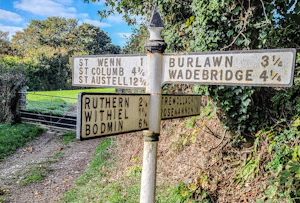
Where we are staying in Cornwall this October (2022) there is a finger post at a T-junction where one road meets another slightly larger one. The fingerpost at this junction ought to have three arms, one pointing along the road that ends here, and two for the larger road. However, the sign has four arms. One of them, pointing to Trewollack and Rosenannon appears to point where there is no road but the entrance to a farmer’s field without even a footpath crossing it.


This sign puzzled us for several days. Then, we spotted a small side road located about 100 yards downhill from the sign and the T-junction. This road leads to Trewollack and Rosenannon, but has no sign indicating this near where the lane begins. The four armed fingerpost is supposed to direct travellers along this road but is nowhere near enough to it to be helpful.

The kiss

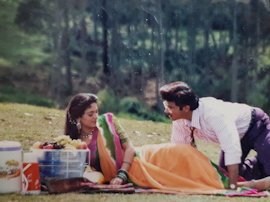
SHE LAY ON A RUG on the well-trimmed lawn of the Ootacamund (Ooty) Golf Club, propped up by one of her elbows. Dressed in a colourful sari, her long black hair was partly hidden by a picnic box filled to the brim with fruit. There was a thermos flask and a cylindrical container for warm food next to and in line with the fruit filled box.

Soon, a bespectacled young man with well coiffured hair and dressed in a white shirt with brown trousers began crawling towards the lady’s feet. Then, he manoeuvred his body over her knees and towards her face. Then, just as he was about to kiss her, both of these figures lowered themselves so that their heads were hidden from view by the picnic box, the hot food storage and the thermos flask.

This amorous couple were neither alone nor unobserved. Apart from my wife and me, local women carrying unwieldy bundles of wood on their heads passed by. Also, the couple were surrounded by a large film crew with lights and cameras.

Soon after their heads disappeared from sight, they reappeared as the film director came running towards them. He talked to them and they repeated what we had just watched after a man with a clapperboard bearing the film name “Andaz” had stood close to them for a few seconds.

“Andaz”, a Bollywood film, was released in April 1994. By chance we had stumbled on this outdoor film shooting in January 1994 during our honeymoon, part of which was spent in Ooty.

In 1994, and certainly until quite recently, intimate displays of affection were not included in Bollywood and other Indian films. What we saw in rehearsal was one of many ways from which film audiences would be saved from seeing an intimate moment. At the moment the audience would expect the male actor was about to plant a kiss on the young lady, they disappear from sight behind the picnic items. Nowadays, the audiences in India get to watch the intimate moment, often in surprising detail for someone, like me, used to watching the older more prudish Bollywood productions.

Although my love of Bollywood films began around 1994, seeing this scene being shot only increased my affection for them. My addiction to Bollywood films began in 1993 when in London some Maharashtrian friends of my wife-to-be insisted that watching the Bollywood film “Sholay” (1975) was important for acclimatising me to the Indian milieu I was about to marry into.

Although many of the latest Bollywood films are extremely good, my preferences is for the older ones. Though often with very complex plots, they have, I believe, an enjoyable innocence that transports the audience temporarily away from the harsh realities of the world beyond the walls of the cinema. Many of the more recent films do the opposite: they remind the audience of the problems they are facing.