A disused passageway in north London’s Golders Green

DURING MY CHILDHOOD and teenage years, there used to be two entrances to Golders Green’s tube (Underground) station, which is on the Edgware Branch of the Northern Line. One of these entrances, which is the only one in use today, is from the bus station (bus yard) next to the old Hippodrome Theatre and opposite the clock tower.

The other entrance, which has been closed for several decades, was beneath the bridge that carries the railway tracks over Finchley Road. The canopy at this entrance is still standing. Passengers used to walk beneath this canopy and then along a long walkway covered by a wooden canopy supported by timber pillars with simply ornamented capitals. . This passageway , which still exists, led to a ticket hall. Neither the ticket hall nor the passageway are accessible to the public.

You can discover much more about Golders Green, its past and present, in my book, which is available from Amazon, e.g.:

Water for the public

WE TAKE IT FOR GRANTED that when you turn on a tap in your bathroom or kitchen, fresh water will flow. And when, usually for maintenance purposes, the mains water supply is turned off temporarily, we can be truly inconvenienced. There are still many parts of the world where piped water is not available to domestic users, but the UK is no longer one of these.

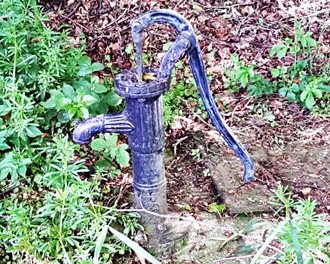
During a recent (May 2023) trip to Lavenham in Suffolk, my wife noticed something next to a pavement. It was a now obsolete bit of plumbing, which has been preserved to demonstrate that even as late as 1936, the small town did not have a public piped water supply for its dwellers. I suppose that before that date, the people had to rely on springs and wells.

The object that can be found on the east side of Church Street, south of Water Street, is a public standpipe. A notice near it explained that piped water came to Lavenham in 1936 to 1937. Several standpipes were erected to give the public access to the water. At that time, people had to collect water from the standpipes and take it to where they required it. However, they did not yet have the luxury of having taps that supplied water in their own homes. The standpipe, which we saw, is now non-functional, but is one of nine such items still to be found in Lavenham.

Lavenham is full of small reminders of how different life was many centuries ago. The standpipe is a small souvenir that makes us realise how different life was less than 100 years ago.

Press button A

A and B_240

When I  first became aware of public telephone boxes – that would have been in the early 1960s – they operated as follows. The caller first inserted a suitable number of coins, and then dialled. If the call was answered, the caller had to press a button marked ‘A’ in order to continue the call. By pressing this button, the inserted coins moved into the cash box. If, on the other hand, the recipient of the call did not answer or was busy on another call, the caller had to press button ‘B’. By doing so, the inserted coins were returned.

The A and B call boxes were later replaced by another system. The caller dialled the number. If it was answered, the caller heard a series of beeps. At this point, the caller had to insert money in order to remain connected. Many years after this newer system was installed, my father used to yell down the ‘phone:

“Press button ‘A'”

He did this despite the fact that button ‘A’ no longer existed.

Today, with the advent of mobile telephones, mastering the intricacies of operating public telephone boxes has become almost unneccessary.