
Unlock your data
With letters numbers and symbols
Use your password

Unlock your data
With letters numbers and symbols
Use your password
THERE ARE MORE people who make use of the English language in India (over 130 million) than in the UK (53 million). The language is a ‘lingua franca’ in India. However, like North American English, Indian English differs in some details from British English. For example, whereas an Indian says “I will do the needful”, a Brit says “I will carry out what is required ” or “I’ll do it”
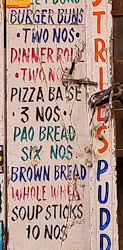
While strolling through the market area of Jaisalmer today, we passed a bakery that listed its wares in English on a board outside the shop. This notice employed a commonly occurring Indian use of the word ‘numbers’ (abbreviated as ‘nos’). Amongst the produce that was sold in the store were the following: “Burger buns two nos”, “pizza base 3 nos.”, and “soup sticks 10 nos” What this means is that the shop sells burger buns as a pair, pizza bases in threes, and packs of 10 soup sticks.
You can often find the same usage of the word ‘number’ in restaurant menus. For example, “pakoras (6 numbers)” means that the portion you will be served will include 6 pakoras.
This particular Indian English usage of the word ’number’ is widespread, as is the usage of ‘avail’ as a verb. In India to avail something means to take advantage of an opportunity or something offered, whereas in literary English it means to help or to assist, as in, for example, “no amount of struggle availed him”.
The English language is one of a few useful benefits of the centuries of British rule in India. Yet, it has undergone some interesting adaptations by its users on the Subcontinent. I have described a few of these, but there are plenty more.
TRERICE HOUSE IN Cornwall was built mainly between 1570 and 1573. It is one of the loveliest National Trust (‘NT’) properties in the county and one of my top ten. In one of the upper rooms there is an ornate bas-relief above the fireplace. The top of this bears the following:
“ANNO: DOMINI: M : CCCCC : LXX3”
It is clearly a date in mostly Roman numerals, (i.e., 1573). However, this date has several odd features.

‘CCCCC’ is 500, but usually abbreviated to ‘D’ in Roman numerals. There is a surplus of colons (‘:’) and instead of ending in a Roman numeral, there is the Arabic numeral ‘3’. Or is it the symbol for a serpent, rather than a ‘3’? It is a curiously shaped 3: it is widest at the top and tapers towards its lower end.
The NT volunteer offering information in the room with this curious date suggested three possible explanations for this peculiar form of the date above the fireplace. One is that the creator of this date miscalculated the amount of space, and instead of ending the date in ‘: III’, used the Arabic ‘3’ to fit in the last part of the date. Had he used ‘D’ instead of the unusual ‘CCCCC’, there would have been plenty of space to fit in the entire date using only Roman numerals. Another explanation offered is that the ‘3’ is really a stylised serpent, a symbol of wisdom often associated with Queen Elizabeth I, during whose reign the house was built.
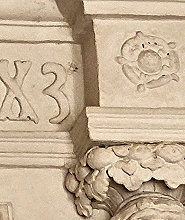
The last explanation was provided by a builder, who had visited Trerice some weeks before us. He suggested that the ‘3’ was added to indicate that the building works were supposed to have been completed in 1570, but had finished 3 years later than expected; the builders were running behind schedule.
Whatever the explanation of the curiously written date, and you might have another theory, Trerice is well worth a visit.

Some of my haikus
have, so I have been told,
wrong numbers of syllables
 yamey
yamey 