A Nigerian who created artworks for a British daily newspaper

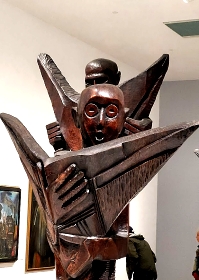
SEVEN CARVED WOODEN figures stand in a line at an exhibition in London’s Tate Modern gallery. Each of them is depicted holding something that looks like an book or a pair of wings. Their faces are all different, as are their expressions and heights. They were carved by the Nigerian artist Ben Enwonwu (1917-1994), and form part of a superb exhibition, “Nigerian Modernism”, which is showing until 10 May 2026.
Ben Enwonwu was born in Nigeria. His father was a traditional sculptor. Ben studied art first at Government College in Ibadan (Nigeria), and then at Government College Umuahia. At both places, he studied art under Kenneth Murray (1902-1972). In 1944, Ben was awarded a scholarship that allowed him to study both at The Slade School of Art in London and at The Ruskin School in Oxford. Also he undertook postgraduate studies in West African anthropology at the University of London. Thereafter, he taught art in Nigeria, where he created many of his sculptures and paintings. Since completing his education, Enwonwu has received international acclaim for his work.

In 1960, Ben proposed making a sculpture to commemorate Queen Elizabeth II’s visit to Nigeria in 1956. It was to be placed in the Nigerian House of Representatives in preparation for Nigeria’s independence in 1960. At the Tate’s exhibition, there is a photograph of Enwonwu working on this sculpture in the studio of his friend, the sculptor William Reid Dick (1878-1961), who was Sculptor in Ordinary for Scotland to Queen Elizabeth. At around this time, Ben received another commission in England.

The British newspaper, the Daily Mirror, commissioned Ben to create 7 sculptures for their headquarters. Carved in ebony, these are the works mentioned above. The diversity of their forms and expressions is supposed to represent the variety of people reading thepaper. According to a label in the exhibition, Enwonwu said:

“I tried … to represent the wings of the Daily Mirror, flying news all over the world.”

The statues were placed in the headquarters public courtyard in Holborn. Currently, they are in the Tate Modern, but after having been lost for several years, they were sold at public auction. They are now owned by Access Holdings PLC, a Nigerian company.

In addition to what I have already described, there are many more works by Enwonwu in the exhibition, both paintings and sculptures. Each one of them is wonderful. His works show the influence of European Modernism, but at the same time they reflect the artist’s African background and his involvement in the traditional art of his homeland. He was sympathetic to the Négritude movement, an anti-colonial cultural and political movement founded by African and Caribbean students in Paris in the 1930s, but was also affected by twentieth century artistic movements in Europe and the USA. It was fascinating to see how the modern art trends of the mid-twentieth century were successfully integrated with the artist’s desire to portray the life and traditions of Africa.

A Nigerian artist near London’s Edgware Road

OTOBONG NKANGA WAS born in Kano (Nigeria) in 1974. Her artistic training was carried out in Ile Ife (Nigeria), then in Paris (France). Now, she lives and works in Antwerp (Belgium). I doubt that I would have come across her work had we not visited the Lisson Gallery near London’s Edgware Road, where some of her artworks are on display until the 3rd of August 2024.

The exhibition contains sculptures, two attractive tapestries, and several framed works on paper. The sculptures, which are pleasant enough, are made with materials including clay, glass, and fibres. A leaflet with a text written by the artist describes how she is portraying her connections with nature. Without this text, I would have been hard pressed to realise what she described.

What impressed me most in the exhibition were Nkanga’s delicately executed framed works on paper. These, more than the other exhibits, convinced me that she is a highly talented artist. As I compared them to the sculptural works, I was remined of my thoughts about the artist Damien Hirst. At first, I thought that his works were interesting although often gimmicky, and did not display his deepest artistic feelings. I changed my mind about his inherent talents when, some years ago, I saw an exhibition of his paintings at the White Cube Gallery in Bermondsey. Great artists like Picasso and David Hockney, who are known for their experimental exploration of artistic expression, were, in their younger days, highly skilled exponents of what might be considered ‘traditional’ composition style. This was what I felt about the framed works on paper by Nkanga – although she clearly enjoys experimenting with a variety of media (including with recorded sounds – a soundscape, which is included in the exhibition), she is clearly able to express herself beautifully in the traditional art of sketching and painting.

Had we enough wall space and sufficient spare cash, I would have happily bought several of Nkanga’s lovely works on paper.

Wild silk beside the East Sussex sea shore

THERE IS A NIGERIAN woven fabric called ‘sanyan’. Made mostly by the Yoruba people, its principal ingredient is a type of wild silk. The fabric is thick and resembles denim or canvas in texture. Strips of sanyan are sewn together to make garments and other items. During a recent visit to the Hastings Contemporary Art Gallery, which stands close to the seashore, we saw an exhibition of paintings made on sanyan cloths.

The creator of these images is Nigerian born Nengi Omuku who was born in Lagos (Nigeria) in 1987. It is there that this artist, who trained at the Slade School of Fine Art in London, now works. Before becoming an artist, Nengi worked in her mother’s florist shop, eventually coming into contact with art when she began making preparatory drawings for customers’ garden planning.

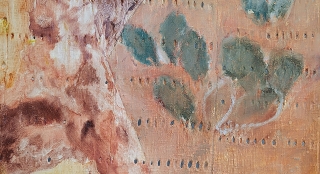
Nengi’s exhibition at Hastings is called “The Dance of People and the Natural World”and is on until the 3rd of March 2024. The artist took large sheets of sanyan fabric, consisting of strips of sanyan sewn tightly together, and then coated them with a gesso ground. When this was ready, she then used oil  paints to create images. Whether it was her painting technique or some property of the material upon which she applied the colours, the resulting images have a uniquely haunting, other-worldly quality that I have not seen in other artists’ works.  

The paintings are well displayed. They have been hung away from the walls so that one can look at their backs. By looking behind the paintings, you can see the stitching that holds the pieces of sanyan together as well as beads of the gesso ground that had oozed between the adjoining strips. By looking closely at the paintings, the joins between the constituent strips of sanyan can easily be detected (see photograph above). These create an interesting surface texture quite unlike the canvas usually used by painters.

I enjoyed the exhibition not only because the artwork was attractive but also because I became aware of an interesting fabric, which is in common use in Nigeria.

An artistic British Nigerian in Mayfair

WHEN WE ARE IN LONDON, we make regular visits to the commercial art galleries, many of which are to be found in and around Mayfair. Not only can one get to see some of the most recent works of contemporary artists, but also those that will eventually end up in private collections that are usually inaccessible to the general public. Today, the 12th of October 2023, we were walking along Cork Street, heading towards the Waddington Custot Gallery when we passed a gallery, the Stephen Friedman, which we had never entered before. Through its window, we saw works by an artist, whose oeuvre we enjoy, and entered.

Much of the exhibition at Stephen Friedman is dedicated to creations of the British Nigerian artist Yinka Shonibare. He was born in London in 1962. His Nigerian parents took him to Lagos in Nigeria when he was 3 years old, and he lived there until he was 17. A year later, he developed transverse myelitis, which left him paralysed on one side of his body. Despite this, he went on to study fine art at the Byam Shaw art school, and then later at Goldsmith College (part of the University of London). Because of his disability, Yinka directs a team of assistants to create his artworks (sculptures, photographs, fabrics, and much more). He has become a widely exhibited and highly acclaimed artist.

Yinka’s works are visually engaging and highly imaginative. They are also full of meaning. He uses his creations to:

“… question the validity of contemporary cultural and national identities within the context of globalisation. Through examining race, class and the construction of cultural identity, his works comment on the tangled interrelationship between Africa and Europe, and their respective economic and political histories.” (see https://yinkashonibare.com/biography/)

Although one can easily enjoy the aesthetics of his creations without understanding the artist’s messages contained within them, a good knowledge of colonial and post-colonial history will enhance the viewer’s experiences of them.

The exhibition is on until the 11th of November 2023. In addition to Yinka’s works, he has curated a small, but fascinating, collection of artworks by several artists from the African diaspora.

From Lagos in Nigeria to Peckham in London

UNTIL I VISITED THE SOUTH LONDON GALLERY (‘SLG’) yesterday, the 11th of October 2023, I had no idea that Peckham in south London is home to one of the UK’s largest Nigerian diasporic communities. Some even call the district ‘Little Lagos’ after the capital city of Nigeria. Until the 29th of October 2023, the SLG is hosting an exhibition of artworks, called “Lagos Peckham Repeat: Pilgrimage to the Lakes”, by Nigerian and British Nigerian artists. Lagos means ‘lakes’ in Portuguese, and the Nigerian city of Lagos developed on an area with several lakes. Part of the show is housed in the same building as the Camberwell School of Art, and the other in a nearby repurposed, former fire station, which was purchased in 2010 and donated to the SLG by the artist Raqib Shaw (born in Calcutta in 1974). The two venues are a few paces from each other, and both are well worth visiting.

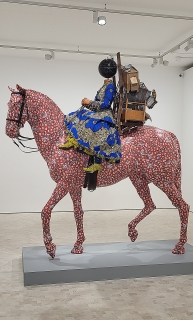
The exhibition consists of photographs, videos (including an excellent one showing a woman in Nigerian clothing riding through Peckham on a black horse), sculptural assemblages, and coloured drawings. Words are inadequate to describe the imaginative exhibits, but if you are unable to visit the show, there is a good verbal summary of the artworks on https://www.southlondongallery.org/exhibitions/lagos-peckham-repeat/ . To give you some idea of the ideas that link the various works on the display, I will quote from the gallery’s guide:

“This exhibition brings together thirteen contemporary Nigerian and British-Nigerian artists to explore links between Lagos, meaning ‘lakes’ in Portuguese, and Peckham as a channel through which to address wider issues of migration. It is framed around ideas of pilgrimage, meaning journeys to a sacred or special place and, in this case, migration motivated by a search for a better life. At the heart of the exhibition is an exploration of the complexities of shifting notions of home and identity as generations of Nigerians settle in London permanently, return to Lagos, or move elsewhere.”

And I feel that this summarises the show very well. All of the exhibits are visually engaging in an exciting way, and if you bother to read the guide carefully, all of them convey the artists’ concepts with great lucidity and originality.

After seeing the show, you can obtain good refreshments in the SLG’s simple but attractive South London Louie café. The SLG also has a bookshop with many intriguing titles on offer.

Islets on the island

MANY PEOPLE VISIT Madeira to improve their health or to retire. Some of these people die on the island and are buried there. Today (5th of May 2023), we took a look at the small English Cemetery in central Funchal. This well tended burial ground, founded in 1770, contains graves of British and some Portuguese people – Protestants mainly. In addition, there are graves of men and women born outside Portugal in places including Germany, Finland, Romania, USA, Holland, Sweden, and Poland.

One of the Americans buried in the cemetery is Harry C Stone “Late Captain Cavalry USA”. His simple yet moving gravestone bears the date 1972 and the words:
“He believed in God”

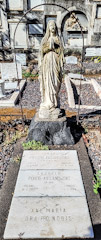
Three graves particularly intrigued me. One of them marks the burial place of Lady Sarah Bonetta Davies (née Forbes). She was born in Ogun State in 1843 and died in Funchal in 1880. The gravestone informs that she was: “Princess of the Egbada Omoba people, West Africa. God-daughter of HM Queen Victoria.”
She was born an aristocratic member of the Egbada clan of the Yoruba people and was enslaved by King Ghezo of Dahomey, who ‘gifted’ her to Captain Frederick Forbes of the British Royal Navy. She became a god-daughter of Queen Victoria, and later married the Nigerian businessman James Pinson Labulo Davies of Lagos in West Africa. She died of tuberculosis in Funchal.

Another black African, George Oruigbiji Pepple, also lies buried in the cemetery. Between 1866 and 1883, he was the King of Bonny which was a small state in the Niger River delta. He was deposed in 1883 and restored to the throne in 1887. Why he was buried in Funchal , I have not yet discovered.

The third grave that interested me greatly is that of Paul Langerhans (1847-1888). This German pathologist and physiologist is best known for his discovery of the cells in the pancreas that produce insulin. Although he was unaware of the function of these distinctive cells, they have been named in his honour as The Islets of Langerhans.

Langerhans came to Madeira in 1875, having contracted tuberculosis. He recovered a little, researched marine worms, and practised medicine. In 1885, he married the widow of one of his patients. They lived together until his death. According to his wishes, he was buried in the English Cemetery in Funchal.

The cemetery is a lovely place to visit. It has plenty of flowers and is peaceful. On a future visit to Madeira, I would like to spend more time investigating the biographies of those whose remains lie there.