THREE MILES NORTH of Basingstoke, there is a magnificent stately home, The Vyne, which is now owned by the National Trust. Set in fine grounds alongside a long, thin lake, this edifice is a wonderful mixture of architectural styles and features.
The present house began its life as a Tudor mansion built between 1500 and 1510 for William Sandys, 1st Baron Sandys, Lord Chamberlain to King Henry VIII. It remained a possession of the Sandys family for most of the time from when it was constructed until 1653, when it was sold to Chaloner Chute (died 1659), who was a lawyer and the Speaker of the House of Commons during the Commonwealth. Because he felt that the Vyne was too big for his requirements, he had much, but not all, of the Tudor mansion demolished. Fortunately, several of the beautiful rooms with elaborate wood panelling were saved, along with the Tudor chapel.
The rest of what remained of the original building was converted to a version of the Palladian Style. This included adding a neo-classical portico to the north side of the hose, facing the lake. In the eighteenth century, one of Chaloner’s descendants, John Chute, influenced by his friend Horace Walpole, redesigned the interior of the chapel, adding trompe l’oeil features and also installed a very spectacular staircase in the house. The staircase is in the neo-classical style. It must have impressed those who visited the Chutes, and it still dazzles the visitor today. Although there are many fine artefacts to be seen in the house, this staircase was, for me, the ‘star of the show’.
When John Chute died childless, The Vyne was inherited by his cousin Thomas Lobb, who then changed his surname to Chute. After that, few changes were made to the house. The house remained in the Chute family until 1958 when Charles Chute bequeathed the estate to the National Trust.
IN 1847 ISAAC D’Israeli (1766-1848) purchased Hughenden Manor in the Chiltern Hills west of London. When he died in 1848, the manor became the property of the Conservative politician Benjamin Disraeli (1804-1881), who was Prime Minister of the United Kingdom twice (1874-1880 and for a few months in 1868). Apart from Hughenden, Benjamin Disraeli also had a home in London, where he died. Both he and his wife are buried in the church near to his country home at Hughenden Manor. In addition to his many impressive political achievements, Benjamin wrote novels. I have read one of them, “The Rise of Iskander”, which is about the Albanian hero Skanderbeg. It is not a novel that I would recommend reading.
The mansion at Hughenden Manor was constructed near the end of the eighteenth century, and was heavily remodelled according to the tastes of the Disraeli family when they acquired it. The ground floor rooms are good examples of the gothic revival style. Some of the ceilings on this floor have fan-vaulted ceilings. We were lucky to have visited the place on a bright sunny day because even then, the rooms are pretty gloomy. On an overcast day, the place would seem quite melancholic. The dining room, which we saw at just before midday was depressingly dark, and made even worse by the presence of an enormous portrait of Queen Victoria that overlooks the round dining table. Disraeli (Benjamin) must have been a great ‘fan’ of Victoria because his bedroom on the first floor is filled with portraits of Victoria and her family, which the Royal Family gave him. The bedroom and other rooms on the first floor are far brighter, better illuminated through the windows, than those on the floor beneath, These first floor rooms are, luckily, not adorned with the ‘over-the-top’ gothic revival décor, which mars the ground floor’s appearance.
The mansion at Hughenden Manor is certainly not one of the most beautiful houses maintained by the National Trust, but the hilly grounds surrounding it are wonderful. When (if) we visit Hughenden again, we will miss out entering the house, and concentrate on enjoying the gardens and countryside around it.
BASILDON PARK IS an 18th century neo-classical mansion not far from Reading. From 1949, the house was owned and restored by the 2nd Baron and Lady Iliffe. They lived in it for 25 years. In one room on the ground floor, which contains the fascinating sketches made by the artist Graham Sutherland for his tapestry in Coventry Cathedral, there are four chairs. Two of them have the insignia of King George VI embroidered on their covers, and the other two are embroidered with the insignia of Queen Elizabeth II.
A National Trust volunteer guide working in the house explained that the 2nd Baron and his wife had attended the coronations of both King George VI and Queen Elizabeth II. The chairs were those they had sat on during these ceremonies. After the coronations, so the guide told us, the Iliffes bought the chairs they were sitting on to keep as souvenirs. The proceeds of sales such as this helped to pay for the coronation events.
Seeing these chairs reminded me of another chair, which I saw in a cousin’s house in Cape Town, South Africa. It was in this chair that Queen Mary (wife of King George V) had sat for a few minutes when she paid a brief visit to the Mayor’s house in King Williams Town (now called ‘Qonce’) in South Africa in 1946. The Mayor was my mother’s uncle. His grandson, my cousin, has kept this souvenir of the royal visit. I saw it when I visited him in Cape Town. Unlike the chairs at Basildon Park, there is no royal insignia on it.
THE NATIONAL TRUST looks after a house in Oxfordshire, which was once owned by William Morris. When I came across this property, Nuffield Place, I was surprised, because I believed that the artist and socialist William Morris (1834-1896) had lived in properties in Hammersmith, Walthamstow, Bexleyheath, and Gloucestershire, but not in Oxfordshire.
Nuffield Place was the home of another William Morris, who became Baron Nuffield in 1934, and later in 1938, Viscount Nuffield. He lived from 1877 until 1963. At the age of 15, he set up his own bicycle repair business. By 1901, he had a bicycle repair and sales shop on the High Street in Oxford. Two years later, he was manufacturing motorcycles. In 1903, he married Elizabeth Anstey (1884-1959), a seamstress whom he met when both were members of a cycling club. They never produced children.
By 1909, he had set up the Morris Garage in Oxford, and was selling and repairing cars. In 1913, he and his small team of workers had built the first car he had designed. By the time the First World War had begun he had acquired larger premises in Cowley on the edge of Oxford. He was already producing cars that were affordable to the popular market, but during the war, his factory switched to producing products needed for the war effort. While doing this, which was not very profitable, he developed much experience in the techniques of mass-production. One of the many models turned out by the Morris factory was the Morris Oxford. This car has made its mark in India because it was the prototype for the Hindustan Ambassador, which was made in India between 1957 and 2014.
After WW1, Morris began making huge numbers of affordable Morris cars, which sold well. William Morris became incredibly rich. However, he was a modest man and extremely generous. He spent most of his money on philanthropy, particularly in the medical field. Many of the institutions he paid for, which bear the Nuffield name, including Oxford’s Nuffield College, still exist. The number of ways in which he helped are far too numerous to be listed. As a child, he wanted to study medicine, but economic circumstances did not allow that to happen. However, because of all he did to promote healthcare and medical research, he was made a Fellow of the Royal College of Surgeons in 1948.
Nuffield Place, the house which William Morris purchased in 1933 and lived in for the rest of his life, was built for the shipping magnate Sir John Bowring Wimble, also chairman of an insurance company, in 1914. It was designed by Oswald Partridge Milne (1881-1968), who worked in the office of Edwin Lutyens between 1902 and 1904. When Sir John died in 1927, his widow sold the house, which was then called ‘Merrow Mount’, to Morris in 1933.
The house is spacious and must have been comfortable to live in, but it is remarkably modest to have been the sole residence of a man as wealthy as the automobile manufacturer William Morris. We were shown around it by a knowledgeable lady, who helped us to appreciate how modest were the lives led by William and Elizabeth Morris. Among the many things that interested me was William Morris’s bedroom. In one corner of it, there is what looks like a wardrobe. However, when the doors are open, it can be seen to be filled with tools and a workbench. Morris had his own workshop in his bedroom. His wife continued her seamstress skills, and many chairs were covered with textiles she had worked on. The house contains many books on a variety of subjects including history and politics. One bookshelf is filled with medical treatises. Morris, although he never became a doctor, was interested in reading about medicine.
Nuffield Place contains an iron lung machine, such as was used to help sufferers of poliomyelitis to breathe. On learning that there was a shortage of these machines in Britain, Morris used his factories to produce many of them to distribute to hospitals that needed them. The model he helped design, and his factories manufactured, has some curious details. The handles that were used to adjust the apparatus look just like car door handles. And some other components on the iron lung look very much like the hinges of car doors. These iron lungs were a valuable contribution to the treatment of diseases such as polio.
I could describe much more of what we saw at Nuffield Place, but it would be better if you visit the it. Lovers of gardens will also enjoy visiting this house owned by a William Morris, who did not design flowery wallpapers.
DUE TO BE DEMOLISHED in 1900, the newly established National Trust (founded in 1895) saved it from this terrible fate that year. The building is a long, narrow half-timbered, brick and wattle structure in the attractive village of Long Crendon in the west of Buckinghamshire. Built sometime between the 14th and 15th century, it served as the manorial courthouse.
Meetings of the manorial court of Long Crendon are believed to have begun before the 13th century. Until 1233, they were held in the lord of the manor’s house, which was demolished that year. In 1275, the manor was divided equally among three female heirs, and courts were held in the farmhouses of their families. By 1558, the courts of the three lords of the manors combined, and it must have been around this time that the courthouse began being used for judicial procedures. The building was not only used by the court but also as a facility for the poor. By the 19th century, it was used by one family to store wool. Some historians question this. In Victorian times the courtroom was used as a Sunday school and a place where occasional public lectures were given.
In 1900, the National Trust purchased the venerable edifice and began repairing it to keep it standing. The Arts and Crafts architect and designer Charles Robert Ashbee (1863-1942) and his wife lived in the courthouse. They used to invite groups of apprentices from London for arts-based holidays lasting a fortnight. In 1902, the Ashbees, whose bohemian activities disturbed the locals, left for Chipping Camden where they established the Guild of Handicrafts. In 1918, Ashbee was sent to Jerusalem as civic adviser to the British Administration for Palestine. In 1937, the courthouse became used as a clinic by the area’s District Nurse. This continued after the NHS was established in 1948. The courtroom then served as a Welfare Clinic.
Between 1985 and 1987, the building was intensively restored. Now, the long room, which occupies most of the upper floor, and was once the court room, is now a village museum. It is reached by a steep flight of wooden stairs. The upper rooms are the only part of the building open to the public. The long courtroom has a timber floor made with irregularly shaped planks. The arched ceiling is supported by massive timber crossbeams. Each one differs in shape from the others. Various exhibits and boards with historic photographs line the walls of this otherwise empty room, in which long ago trials were held.
We visited Long Crendon to see the courthouse. However, many other buildings in this village are incredibly picturesque and well-worth exploring.
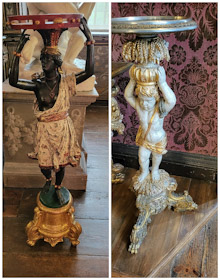
At some National Trust properties, figurines with dark skin pigmentation, such as the one on the left (first picture), are labelled with an apologetic warning that the figurine depicts a person of colour in a demeaning pose. Not so in Knole House, near Sevenoaks in Kent. In the same room, also without a label, there is a figurine depicting a person with pale skin in the same demeaning pose.
ONE OF MY FAVOURITE National Trust properties in England is Trerice, which is about 2.3 miles south of the Cornish town of Newquay – not one of my favourite places in Cornwall. We visit the house and gardens at Trerice every time we spend time in Cornwall, and always discover soothing there that we had not noticed before.
This tine (June 2024), one of the volunteers working in the house pointed out a painting by John Opie (1761-1807). I had not come across his name before. Our informant told us that he had been born in Cornwall, and thought that he had been involved with the establishment of the Royal Academy. He was born at Trevallas between St Agnes and Perranporth, both of which are not far from Trerice. At an early age, his artistic talents became evident, but his father, a carpenter, wanted John to become a carpenter. A physician, Dr Wolcot, met him at the place where he was an apprentice, and reecognising John’s artistic skills, paid for him to be released from his apprenticeship. Wolcot encouraged Opie, and by the start of the 1790s, he was a successful portraitist in Cornwall.
In 1781, Wolcot took Opie to London, where his works were admired by great artists of the time including Sir Joshua Reynolds, who compared John’s work to that of Caravaggio and Velasquez. A year later, Opie began working independently of Wolcot, who had been supporting him up until then. An acquaintance of Dr Wolcot introduced Opie to the court of King George III. This led to Opie being commissioned to paint portraits of people of high rank in English society and royalty. In 1886, he was elected a full member of the Royal Academy, and in 1805 he was appointed a professor in that esteemed institution.
There are three paintings by Opie hanging on the walls of Trerice house. One is a portrait, and another a self-portrait. The third, which depicts three people playing cards, is a copy of the same picture that can be seen at Petworth house. The version at Trerice is believed to have been painted by Opie and others in his studio. Each of the three people in it have smiles. It is thought that in this painting, Opie was experimenting with the depiction of smiling. Although attractive, this picture is not as attractive as his other two paintings in Trerice.
It is always pleasant to re-visit places, and always exciting to discover something one had missed on earlier trips to that same location. As well as the lovely interiors at Trerice, the gardens surrounding it are always a joy to behold.
ON THE FOURTEENTH of November 1940, Coventry’s cathedral was badly damaged by bombs dropped from aircraft of the German Luftwaffe. After WW2, a new, modernist cathedral was constructed next to the shell of the damaged one. Designed by Basil Spence, the new cathedral was built between 1956 and 1962. Visitors to this magnificent replacement cathedral can hardly miss seeing the enormous tapestry that hangs at the eastern end of the church. Depicting “Christ in Glory in the Tetramorph”, it was the creation of the artist Graham Sutherland (1903-1980). I have seen this work and admired it on several occasions, but little did I expect to find a connection with it when visiting a National Trust property not far from Reading – Basildon Park.
Set in lovely grounds surrounded by rolling hills that lead down to the rows of trees growing near the Thames, the house at Basildon Park was largely completed in the Palladian style by 1783. After a series of owners, including the military during the two World Wars, it was bought by Lord and Lady Iliffe (later known as ‘the 2nd Baron and Lady Iliffe’) in 1953. They restored the house, and filled it with artworks they collected. A great patron of the arts, Lord Iliffe was a friend of the artist Graham Sutherland. He and his wife were able to purchase many of the studies that Sutherland made when planning the great tapestry that hangs behind the high altar in Coventry Cathedral. Some of these were donated to the Herbert Museum in Coventry, and several of them are on display in a room on the ground floor of Basildon Park. The studies exhibited in Basildon Park demonstrate Sutherland’s great artistic talents. Each of them, although sketches of details to be included in the final tapestry, is itself a lovely work of art.
Sutherland’s studies are (for me) the highlights of the Iliffe’s artworks on show in their former home – they gave it to the National Trust in 1978. In addition to these fine works, a few others caught my attention. In one room on the first floor, there are four sketches of places in India by William Daniell (1769-1837). It is quite appropriate to find these in Basildon Park, which was originally built by Frances Sykes, who made his fortune in the British East India Company. Another, more recent, painting that interested me was a portrait of Lady Iliffe painted in the 1940s by Frank Salisbury (1874-1962). A society portrait painter, he interested me not because of his art, but because he owned a spectacular neo-Tudor mansion, Sarum Chase, on West Heath Road in London’s Hampstead. I came across him when I was doing research for my book about Hampstead.
For some reason, despite visiting many National Trust properties around it, today (the 19th of May 2024) was the first time we went to see Basildon Park. The house is worth seeing – its rooms are spacious and well-lit, and the artworks are, as I hope I have explained, of great interest. Also, it stands in beautiful grounds – an idyllic English countryside.
IN ABOUT 1380, Roger Ashburnam (died 1392) commenced building a castle surrounded by a moat about 6.7 miles southeast of what is now Royal Tunbridge Wells in Kent. During the centuries after the commencement of its construction, this edifice, Scotney Castle, was modified in various ways in different architectural styles.
In 1778, the cricketer and landowner Edward Hussey (1749-1816), who killed himself with a blunderbuss, purchased the estate in which the castle stands. In 1830s, Hussey’s grandson, also called Edward Hussey III, built a new and larger house on a hill overlooking the old castle. It was designed by the architect Anthony Salvin (1799-1881), who was an expert on mediaeval buildings. At the same time, the gardens surrounding the new house were landscaped. As part of the landscaping process, carefully selected parts of the old castle were demolished to create a picturesque ruin – an attractive garden feature.
In the 18th and 19th centuries, it was not uncommon for garden designers to build follies to add interest to gardens. Often, the follies look like classical or mediaeval structures – either constructed to look intact or ruined. At first sight, the old Scotney Castle looks like a grand and elaborate garden folly, but it cannot be so-described – it was not built as a folly. Although its degree of ruination was enhanced in the 19th century, it had been a real castle for several centuries, and had been built to be used as a fortification as well as a residence. Thus, what had once served to counter a possible invasion by the French ended up being an elaborate garden ornament. Maintained by the National Trust, Scotney Castle is well worth a visit. The ruined castle and its surrounding gardens make a magnificent sight. Salvin’s newer edifice, which is open to the public, does not deserve much of a visitor’s attention.
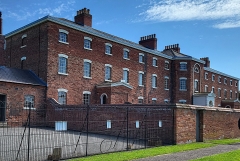
THE NATIONAL TRUST (‘NT’) maintains many buildings of great historic interest, and makes them accessible to the public. Most of the properties under the care of the NT are places where the well-off and the famous lived. Visitors to these homes and gardens can see finely decorated rooms. Often, the servant’s quarters are also displayed. This May (2023), we visited an unusual NT property in Nottinghamshire. Its distinctiveness lies in the fact that the buildings housed not the rich but the very poorest in society. Located at Southwell near Nottingham, it is the Southwell Workhouse.
The Workhouse was built in 1824 to house (usually temporarily) the poorest and most infirm people in the 49 parishes that made up Nottinghamshire’s Southwell Union, which financed the institution. Some of these people were impoverished during the advent of the Industrial Revolution in the early 19th century. For example, many households in the area made a living by making knitwear in their homes. When factories opened with industrial knitting machines, many of these artisans were left without work and income.
The Southwell Workhouse admitted people following assessment of their condition by a parish’s local Relieving Officer. The rather bleak Workhouse was divided into several separated sections: for women with children less than two years old; for women, both abled and disabled; for men, both able and disabled; boys aged 7 to 15; girls aged 7 to 15; and for other children, aged between 2 and 7 years. The children received elementary schooling in the Workhouse classroom; this improved their chances of obtaining employment. There was no mixing between men and women. Women worked mainly in the kitchens, which are in the cellars of the building. To avoid contact with men, who worked in the institution’s vegetable gardens, produce required for cooking was passed into the kitchens through hatches.
Except for the extremely infirm, the idea was to make the Workhouse as uncomfortable as possible so that the able-bodied inmates had an incentive to leave as soon as they felt able. Consequently, the food provided was dull and meagre. All able-bodied inmates had to work. Some of this work was either meaningless, like breaking stones, or physically difficult, like picking oakum. The maintenance of the institution was also carried out by the inmates. The Workhouse was designed to provide food and shelter for the most destitute, but not to make it so comfortable that they had no incentive to leave. By pooling their resources, the parishes in the Southwell Union saved money because without the workhouse each parish would have had to conform to legal requirements to set up their own facilities for looking after those at the bottom of the social pile. The Southwell Workhouse was an example of an economy of scale.
The Southwell Workhouse was the brainchild of the Reverend John Thomas Becher (1770-1848). A friend of Lord Byron, who wrote poems to him, Becher not only established the Workhouse, but four years later wrote a pamphlet, “The Antipauper System”. In this publication, he explained how successful the Workhouse was in reducing the “poor rates” by 75%. His work led to the establishment of other similar wirkhouses in the country following the passing of the Poor Law Amendment Act of 1834 (‘The New Poor Law’).
With the establishment of the NHS in 1948, the Workhouse became an institution run by a local authority and many things relating to the care of the poor changed in Britain. Until the 1970s, the Workhouse, re-named Greet House (after the River Greet), housed the poor, but ins slightly more comfortable conditions than were available to its earlier inmates. The NT has done a beautiful job of restoring the Southwell Workhouse. Arrows guide the visitor though the whole building. All along the route, NT volunteers greet you and explain what each room was used for and provide other fascinating background information. Although the Workhouse is a fairly grim looking place, a visit to it is extremely interesting and a dramatic contrast to the often-glittering, resplendent places that can be seen in the majority of NT properties.





 yamey
yamey 