
I hope that this piece will not sound ungrateful, dear reader.

When I was a child and in my early teens, my parents, who were art-lovers, took my sister and I to Florence every summer. As a child, I failed to appreciate what a treat these visits were. At the end of the summer when school recommenced, my friend N and I would compare notes about our holidays. N visited Llandudno in North Wales every summer with his parents. He would relate how they had climbed the Great Orme, travelled on a special tramway, and stayed at a marvellous hotel overlooking the sea. What was I able to tell N? Well, nothing that I believed would rival the exciting things that N had experienced. What, for example, was the Uffizi art gallery in Florence when compared with the Great Orme in Llandudno? I mention the Uffizi in particular, because our annual visits to this treasure house of art filled me with despair. I wrote of this place in my book “Charlie Chaplin Waved to Me” (available from Amazon and Bookdepository.com) as follows:
“The aforementioned Uffizi was another of the places that we often visited in the morning. I used to dread having to walk through its seemingly endless series of inter-connected galleries filled with masterpieces. The only thing that sustained me during this ordeal was the promise of an ice-cream afterwards or the promise of the opportunity to buy a paper cone filled with corn to feed the pigeons in the Piazza Signoria outside the gallery.
One of the first pictures that we always used to stop and admire was the Portinari Triptych painted by the Flemish painter Hugo Van der Goes in about 1475. That was during the time when the Florentine merchant Portinari, who commissioned it, was living in Bruges in the building which became the hotel in which we often stayed. My father, who is fascinated by the iconography of Renaissance art, explained to us the meanings of everything in this beautiful picture. My very young sister absorbed this information so well that year after year she could explain to us, and also to other tourists, who gathered around to listen to her, the reasons that particular things were depicted in it. For example, she could relate why there were a certain number of lilies in the vase near the bottom of the central picture; and why there was a barely visible devil’s horn at its top left, just above the horn of a cow grazing in the holy manger. This horn only became apparent after the picture was cleaned in the early 1960s.”
The museums and my late mother’s seemingly endless visits to the dress-maker and countless shoe shops added to my lack of enjoyment of Florence. However, it was not all gloom and doom. The food we ate was lovely and there were some cultural sights which I enjoyed. And, Florence did hold some mysteries, one of which was solved between two successive annual visits. Let me quote from my book again:
“The River Arno flows through Florence. It is traversed by a number of bridges, the most famous of which is the Ponte Vecchio. This is covered, like the mediaeval London Bridge used to be, with buildings and shops. The most interesting feature of this old bridge was the‘secret’ corridor that ran along its buildings just beneath their roofs. This, so my father often told us, linked the Uffizi on one side of the Arno with the Palazzo Pitti on the other side, the Oltrarno. Thispassageway, which must be about almost half a mile in length, allowed Florence’s rulers to move between these important buildingsunobserved by the public. It was closed to the public when we used to visit the city.
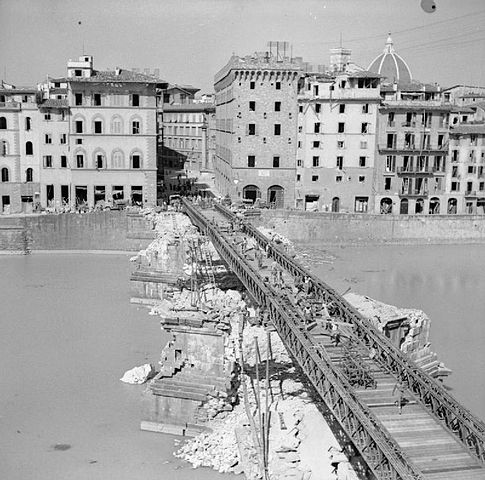
Ponte Trinita in 1944. [Source: https://commons.wikimedia.org/wiki/File:The_British_Army_in_Italy_1944_NA17848.jpg%5D
When the Germans retreated at the end of WW2, they demolished all of the bridges across the Arno except the Ponte Vecchio. They decided that as its carriage way was far too narrow to accommodate military vehicles and large troop movements, it could not have been used by the Allied armies chasing them. My father said it was a tragedy that this bridge was saved whereas its neighbour a few yards downstream was demolished. This bridge, the Ponte Santa Trìnita, was a masterpiece designed by the renaissance artist Bartolomeo Ammanati (1511-1592). His Fountain of Neptune is an important and much photographed landmark in the centre of Florence.
When we first visited Florence, the bridge, which was painstakingly reconstructed after the war from the fragments found scattered about under the waters of the Arno, had two statues at each of its ends. Three of these were complete, but one of them was missing its head. This was the only bit of the bridge that had not been recovered. One summer, when we were visiting the city, my father pointed at the bridge and asked us if we noticed anything different about it. We discovered that the missing head had been found, and was back in its rightful place; the bridge was complete again. This must have been in 1962, as the head was only recovered late in 1961.”
Most people reading this blog article, will probably think that I was so lucky to have visited Florence so often, and they would be justified. However, to a young boy as I was, I could not appreciate it properly. Now, many years later, I realise that my exposure to the arts at such a tender age was a great gift bestowed by my parents, even if it meant that I never saw the Great Orme.

 yamey
yamey 
