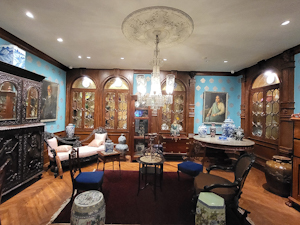
THE DR BHAU Daji Lad Museum in Bombay’s Byculla district is housed in a building with a neo-classical (Palladian) facade. However, within it there architecture is gloriously Victorian. Recently restored its interior competes with the exhibits for the viewer’s attention.
Prince Albert
The museum was opened in 1872 as ‘The Victoria and Albert Museum’. Like its namesake in London, its exhibits are form a display of applied arts, technology, and design. Some of them are replicas of objects that were sent from India to London as exhibits in the Great Exhibition of 1851.
In 1975, the museum was given its present name, which honours Dr Bhau Daji Lad (1822-1874). He was an eminent physician and surgeon, who researched cures for leprosy. With a keen interest in archaeology, he did much to raise funds to pay for the establishment of the museum.
One of the men who donated money towards the founding of the museum was the Jewish businessman David Sasoon. The museum contains a tall statue of Victoria’s Consort Prince Albert. The base of this includes the words “dedicated by David Sassoon”, and beneath them, there are some words in Hebrew. The base of the statue also has words in Hindi, Gujarati, and Urdu scripts. In front of the statue, there is a bust of Sassoon.
Like the much larger Victoria and Albert Museum in London, the Dr Bhau Daji Lad Museum contains a wide variety of beautifully crafted objects: too many to describe here. Some rooms of the museum are dedicated to housing temporary exhibitions. Behind the museum, there is a courtyard, lined by another exhibition space, a café, a small Hindu shrine, and a museum shop.
Of the many wonderful places that can be seen in Bombay, the Bhau Daji Lad Museum is one of my favourites.
BY TAKING A SHORT walk north of Kolkata’s 18th century Church of St John one reaches number 8 Council House Street, now home to the Reserve Bank of India (‘RBI’) Museum. In an interesting article published online, Sudabhip Mukherjee wrote that the museum is housed in what was originally the building constructed for the now non-existent Alliance Bank of Shimla, which flourished from 1874 until 1923. In 2019, the ground floor of this elegant Victorian building constructed in red brick with white stone facings was converted to become the RBI Museum.
The aim of the museum is to give visitors an understanding of all aspects of money and banking from the beginning of time until the present. It achieves this very well using imaginatively designed displays, which render the subject of interest to visitors of all ages. Rather than being a dull museum with conventional display cabinets, the designers of this place have produced displays that are both original and artistic. The visually exciting features begin as soon as you enter the building. For example, the pillars in the entrance hall are decorated with patterns made using out-of-date Indian currency coins, and in the centre of one of the larger display rooms, there is a dramatic sculpture that depicts the circulation of money across the globe. Had we not walked past the entrance to this museum after visiting St Johns Church on a Friday morning in late December 2024, I doubt we would have got to know about it. Many of our friends in Kolkata had never heard about the place.
PULICAT IS ABOUT FORTY miles north of the centre of Chennai. It is one of the very few natural harbours on the Coromandel Coast (east coast of India). As early as the third century BC, it was a thriving port. The unknown author of the “Periplus of the Erythraean Sea” wrote that Pulicat was one of only three ports on the east coast of India.
Today, it is a busy little village where freshly caught fish and other seafood are packed with ice before being transported elsewhere. In earlier times, it was an important trading centre.
Between 1502 and 1609, the Portuguese had a trading station (‘factory’) in Pulicat. They built a fort there. In 1609, the Dutch defeated the Portuguese, and took over Pulicat. They controlled it until 1825, when Dutch possessions on the Coromandel Coast were handed over to the British.
The Dutch built a fort, Fort Geldria, at Pulicat. This is in ruins today, and what is left is covered by seemingly impenetrable vegetation. I did not feel intrepid enough to enter the tangled plants that cover the site of the fort. The Dutch also built a gunpowder factory in the town.
Pulicat was a port from which the Dutch exported a wide variety of goods from India, including for example, textiles, coins, and gunpowder. They also exported Indians as slaves to work in some of the other Dutch colonies in places as far apart as Ceylon and the West Indies. It is said that between 1625 and 1665 alone, over 38000 slaves, procured mostly by brokers in Pulicat, were exported in Dutch boats. Many more were carried away from India after that.
Seeing Pulicat today, as we did in January 2025, it is difficult to imagine that this large village was once a thriving centre of international trade, and even more impossible to realise that it was an important market place for selling slaves. However, there is one very visible reminder of the erstwhile Dutch presence in the town: a small cemetery containing many well-preserved graves and mausoleums of Dutch people who died in the district.
Before describing the cemetery, I will mention the small museum near it, and next door to a school named ‘Dutch Academy Nursery and Primary School’. The very basic museum is housed in what must have once been a small shop. Its walls have some interesting informative panels attached to them. These outline the history of Pulicat. As for the exhibits, they are a rather shambolic assembly of unlabelled odds and ends. In one glass fronted cabinet, there were some fragments of ceramic vessels. I wondered whether these were bits of things left behind by the Dutch. On close examination, I noticed one of these broken pieces was labelled “made in Japan”.
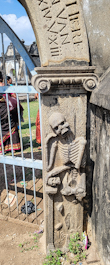
The Dutch cemetery is a fantastic sight. It is well worth making the 2 hour road trip from Chennai to see it. The entrance to the walled graveyard is made of carved stone. On each side, it is flanked by stone carvings of skeletons. One is resting its skull on its right hand and holding another in his left, and the other is balancing a double-sided drum or tabla on its skull. Although there are several obelisks and elaborate mausoleums in the cemetery, most of the graves are marked by horizontal stones upon which there are carved inscriptions. The inscriptions, which are all easy to read, are often framed with decorative floral carvings. Most of the inscriptions are in Dutch. A few are in Latin. The oldest of the deceased died in the mid to late 1650s. At the far end of the cemetery, we found two graves of British people. Although the British took over Pulicat in 1825, they used it more as a place for picnics than as a trading station.
The Dutch cemetery is a reminder that not every Dutch person who came to India to make a fortune returned home. What it does not recall is the vast numbers of Indians who were exported by the Dutch as slaves, and had no hope of ever seeing their homes again.
A JAIN BANIA (BUSINESS MAN) called Hiranand Shah travelled from Rajasthan to Patna in 1652. In 1707, he financed Prince Farrukhsiyar sufficiently for him to become the Mughal Emperor (he ruled from 1713 to 1719). Manik Chand, a later head of this Jain family was then rewarded with the title ‘Jagat Seth’, which means ‘banker or merchant of the world’. By the eighteenth century, the family or house of of Jagat Seth was the largest banking house in the Mughal Empire.
The Nawabs of Bengal used the banking services of the house of Jagat Seth to pay tribute to the Mughal emperors in Delhi. William Dalrymple wrote that the Jagat Seth family were able to:
“… make or break anyone in Bengal, including the ruler, and their political instincts were sharp as their financial ones.” (quote from Wikipedia)
When the young Siraj-ud-Daulah became Nawab of Bengal in 1756, he alienated many people including Jagat Seth Mehtab Chand. Siraj demanded 30 million rupees as a tribute from the banker. When the banker refused, Siraj-ud-Daulah slapped him. As a result, Jagat Seth took part in the conspiracy to defeat Siraj-ud-Daulah. He and others, including Mir Jafar, helped the British, led by Robert Clive, to defeat Siraj-ud-Daulah at the Battle of Palashi (Plassey) in 1757. Jagat Seth’s money funded the British to help them defeat Siraj-ud-Daulah.
The Jagat Seth family was at least as influential as tycoons such as the Rothschilds in Europe and figures such as Jeff Bezos and Donald Trump’s current ‘chum’ Elon Musk. Taking the story of Siraj-ud-Daulah as an example, one could say it is best not to upset your wealthy supporters. So, Donald, it would be best not to upset Elon!
Soon after the Battle of Palashi, the fortunes of the house of Jagat Seth began to decline. Today, this remarkable family is commemorated by an opulent mansion, which they built in Murshidabad, sometime after it became the capital of Bengal (for 70 years during the eighteenth century). In 1980, the house was opened up as a museum, which is privately owned and run. We visited this place before we knew about the family’s involvement with the downfall of Siraj-ud-Daulah and the following capture of Bengal by the British. Like many other places in Murshidabad, it is a fascinating reminder of Murshidabad‘s history during the era when Europeans, especially the British, were beginning to make their mark on Bengal.
IT IS NOT UNUSUAL to find a swing (‘hichko’ in Hindi) in an Indian home. Often, they consist of a seat suspended from a frame by ropes or chains. The museum in the fort at Jodhpur in Rajasthan has a fine collection of hichkos that were once used by the former royal family.
Hichko presented by the PWD
One of the swings in the collection caught my eye both because it was quite different in design from the others in the collection and because it bore an interesting label, which had been attached by its maker(s). The wording on the label reads:
“With profound loyalty of Jodhpur PWD Employees Union”
(PWD: Public Works Department)
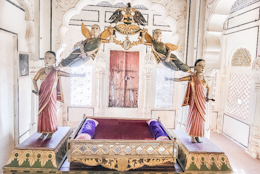
This hichko which is decorated with the royal crest of Jodhpur and almost lifesize models depicting two women in saris is not dated. The union still exists, but since 1947, the royal family has lost the power which it once possessed.
AFTER MANY FRUSTRATING months of waiting and much travelling to follow him from place to place, the English diplomat Thomas Roe (c 1581 – 1644) finally got an audience with the Mughal Emperor Jahangir. Roe had been sent to India by King James I to establish a formal trading relationship.
Roe meeting Jahangir
The meeting took place in the Mughal fort in Ajmer in 1618. At first, he had to communicate with the Emperor from outside the fort. Eventually, he was granted an audience with Jahangir within the fort. The meeting took place in the Diwan-i-Khas, the structure within the fort, where audiences were granted to important persons. The result of Roe’s meetings with Jahangir was an agreement that the British East India Company would have exclusive rights to establish factories (trading establishments) in Surat and other places.
Yesterday (30th November 2024), we visited the Diwan-i-Khas in which Roe had discussions with Jahangir. The fort is well-preserved and now serves as a museum. The rooms in the fort house collections of sculptures, coins paintings, inscriptions, weapons, and textiles. The museum is simply laid out, and the exhibits are lit well.
It was curiously moving to visit the place in which Roe met Jahangir. I am not sure why we felt that way, but maybe it was because we had previously read about Thomas Roe and his exploits in India.
DURING THE 1970s, Philip and Jeannie Millward began collecting folk art and other artefacts in the Swat Valley of Pakistan. Over the years, these intrepid travellers have been collecting folkloric and other objects from all over south Asia: from Pakistan, India, Indonesia, and so on. At first, they stored their growing collection in a warehouse in Norwich. The Millwards’ collection grew and grew and included things bought from auctions and dealers in the UK. Today, a part of what they have amassed is beautifully displayed in a building with an interesting history.
The Millwards’ South Asia Collection is housed in a huge building, which opened in 1876. It was designed to be an indoor roller-skating rink. However, by 1877, this enterprise failed, and the building became used for Vaudeville theatre. Five years later, it became a Salvation Army ‘citadel’, and then in 1898, it became a builders’ merchant’s storehouse. In 1993, the edifice was purchased by the Millwards, who converted it to become a museum to display items from their collection.
The museum’s exhibits are beautifully laid out, and clearly labelled. Many of the objects on display are very fine examples of their type. I have seen only few museums in India that come up to the high standard of this museum in Norwich. Many of the fine pieces that the Millwards have brought from the Indian subcontinent and elsewhere in the past might not now be allowed to leave their countries of origin. But luckily, they have come to Norwich where they are being expertly cared for. The museum is not simply a display place. It works with academic institutions such as CEPT University in Ahmedabad (Gujarat) to carry out research projects that help put objects in the collection into their true context.
Although the museum is the main attraction of the place, the former roller-skating rink also houses a shop where finely crafted, high quality folkloric goods, sourced in India and other places, can be bought. What is on sale has been purchased directly from the craftspeople who made them, rather than from middlemen. And the prices attached to them are very reasonable – not much greater than one would expect to pay in good handicraft shops in India.
Norwich is filled with attractions for the visitor. Less well-known than the castle, the cathedral, and the Sainsbury Centre for Visual Arts, the Millward’s South Asia Collection in Bethel Street should become one of the first places a visitor heads for.
TAVISTOCK IS A SMALL town just west of the Dartmoor National Park. Between the year 974 and 1539, when it was closed by King Henry VIII, there was a vast abbey in the centre of the town. A few remnants of the abbey buildings can be seen today, but most of the complex has disappeared. The Guildhall, built in 1848, stands upon land where the abbey once stood. Today, this edifice houses a well organised museum, which illustrates various aspects of the town’s history. Visitors can see the courtroom and the old prison cells beneath it.
Within the courtroom, there is an intriguing exhibit: a judge’s wig in a glass case. This wig was discovered recently when the Guildhall was being restored a few years ago. It is the kind of wig worn by judges in the 1840s. The wig contained its owner’s name: Mr JW de Longueville Giffard.
The researchers connected with the museum discovered that Mr Giffard attended court one day in October 1888. He had been presiding at Okehampton the week before, and had fallen ill. Unwilling to cancel his session at Tavistock, the conscientious judge attended the court on that October day, feeling extremely unwell. He died the following day. Because he was in such a bad state on the day before his death, he must have forgotten to take his wig back home with him.
130 years later, the unfortunate judge’s wig was found in a cupboard in what had once been the judges’ robing room.
MUCH HAS CHANGED IN Istanbul since we last visited it in October 2008. Many places we saw then have either been restored or are closed for restoration. One place that was not open to visitors in 2008 is the Tekfur Sarayi, a palace built next to the ancient city walls of Istanbul. We came across it in April 2024 after having made an abortive visit to the nearby Kariye Mosque (once a Byzantine church), which was closed for restoration.
The Tekfur Sarayi, which used to be known as ‘Palace of the Porphyrogenitus’, is one of three Byzantine palaces still surviving in Istanbul. This edifice was constructed either in the late 13th century or early in the 14th. According to Wikipedia, the palace was:
“… named after Constantine Palaiologos, a son of the Emperor Michael VIII Palaiologos. “Porphyrogenitus”, meaning literally “born to the purple”, indicated a child born to a reigning emperor. The emperor would show off the newborn heir from the balcony and have them proclaimed “Caesar Orbi”, or “ruler of the world””.
The palace was badly damaged during the Ottoman conquest of Constantinople in 1453, and was later used to house part of the Sultans’ menagerie. By the end of the 17th century, the animals were moved, and the building housed a brothel. In 1719, the building was repurposed to house a factory for making decorative tiles, and this is how it remained before going out of business during the first half of the 19th century. Next, it became a poorhouse for some of the Jewish people in Istanbul. Following this, it became a bottle factory for a few years before being abandoned. What makes the building of special interest is that it is a rare surviving example of secular Byzantine architecture.
In 2010, the building was extensively restored and 5 years later a new roof and glazed windows were added. After that, new wooden floors and ceilings and staircases were added. In addition, a stylish lift was installed close to the palace. This allows visitors to reach the high second floor with ease. From a terrace on the second floor, there is a superb panoramic view of the city. In 2021, the place became a museum, whose exhibits include displays of the kind of tiling that used to be made in the palace and informative explorations of the stages in the traditional methods of manufacturing tiling. On the ground floor, there are a couple of archaeological remains of the kilns in which the tiles were fired. Apart from the exhibits, the elegantly contemporary design of the museum and what can be seen of the palace itself add much to the enjoyment of a visit to the Tekfur Sarayi.
The ground floor opens out into a courtyard where more archaeological finds can be viewed. A short staircase from the yard leads to a small garden from which one gets a good view of both the palace and the city walls stretching away from it. Although we were hoping to see the Kariye Mosque, but were unable to do so, visiting the Tekfur Sarayi more than adequately compensated us.
THE FIRST TIME I visited Turkey was in about 1960. My father was participating in a conference organised by the Eczacibaşi Foundation. It was held in the then luxurious Çinar Hotel on the European shore of the Marmara Sea at a place called Yesilköy, which is about 9 miles west of old Istanbul. This April (2024), we visited Yesilköy both for old times sake and because we had read that the place has several interesting sights to be seen. Incidentally, it was in Yesilköy that I had my first piece of chewing gum.
After disembarking from the Marmaray train, which connects settlements on the coast of the Sea of Marmara, we enjoyed the best cheese börek we have eaten since arriving in Turkey. Then, despite constant rain, we walked along Istasyon Caddesi, admiring the many houses with decorative timber cladding that line the avenue.
We made a small detour to look at a Syriac Christian Church, which looked recently built. We could not enter because a service was in progress. Thence, we walked to the rainswept seafront, where we looked around a museum dedicated to the life of Ataturk. It was housed in a mansion once owned by Greeks. The ground floor is dedicated to the first decade of the Turkish Republic, which was founded in October 1923. The first floor has a display of ethnographic exhibits from Turkey. The second floor is a collection of photographs, items, and books relating to the life of Ataturk.
Greek Orthodox church in Yesilköy
Next, we came across a Greek Orthodox church. We could enter its covered porch in which candles were flickering. Through the windows of the porch we could see enough of the church’s interior to realise it is quite beautiful. Unfortunately, the church was locked.
Nearby, we found the huge Latin Catholic Church, which was open. Its interior was nothing special, apart from one religious painting which contained words in the Ottoman Turkish script. The size of the church suggests that there might once have been a large Roman Catholic community in Yesilköy.
Yet another church is a few yards away from the Latin church. It is an Armenian church, enclosed in a compound surrounded by high walls. The entrance was open, and after looking at the church, we joined the congregation (at least 40 people), who invited us to have tea and cakes. A couple of gentlemen began speaking with us in English. They told us that the Çinar Hotel was no longer in business, but it was still standing. They also told us that they are in the textile business. They are waiting for Indian visas because they are planning to visit Bangalore and Tiripur soon because they are looking to buy textile machinery there.
Several people told us that the Çinar Hotel is about a mile from the centre of Yesilköy. As it was cold and raining we decided against looking for it. Despite not revisiting the place I first stayed in Turkey more than 60 years ago, we saw Yesilköy and some of its fascinating sights. It is close to the railway tracks and not on most tourists’ beaten tracks.