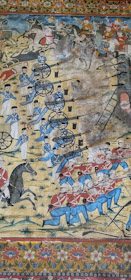
British soldiers on the wall in a house in Baroda

BY THE VERY EARLY 19th century, the armies of the Marathas had been beaten by the armed forces of the British East India Company. After this, from 1805 onwards until 1947, the State of Baroda was ruled by a Hindu Maratha dynasty – the Gaekwads of Baroda. Put simply, the Gaekwads controlled the internal affairs of the state in such a way that British interests were not damaged, and the British controlled the external affairs of the state.

Between 1849 and 1854, Bhau Tambekar (Vithal Khanderao) was the Diwan (prime minister) of Baroda. He lived in a large building, which was probably constructed in the early to mid 19th century. Known as Tambekar Wada, this typical Maratha-style mansion has three storeys and surrounds a courtyard. Currently, the first floor of the front (eastern part) of the building is the only part open to the public.

The part of the building that can be visited is a long rectangular hall with a wooden jaali (perforated screen) near one end of it. The walls of this room are covered with beautiful detailed paintings from floor to ceiling. Many of them depict scenes from the Mahabharata, Ramayana, and Hindu religious images. However, the north wall of the hall is even more fascinating.

Most of the north wall is covered with a mural depicting a battle between the British East India Company and the Marathas. Most of the picture shows features of the British forces in great detail. There are even several flags that resemble Union Jacks. Some British soldiers, dressed in red uniforms, can be seen riding elephants. Whoever painted this wall had a good eye for both detail and representation of battles.

On the same wall as the battle scene, there are several smaller paintings depicting European men and women. On one of these, a woman in European garb seems to be consoling another woman. In another, a man wearing a red jacket is looking at a European lady affectionately.

The purpose of the painted hall is not known for sure. It has been suggested that it was for entertaining guests. The small part enclosed by the screen might have been reserved for ladies. In its heyday, purdah would have been observed in the house. The hall has a set of windows through which one can access a narrow balcony that extends along the entire length of the eastern side of the house. This terrace has a perforated screen through which people on the balcony could look out onto the street without fear of being seen by passers-by.

Although this December (2023), we are enjoying our fourth visit to Baroda, we would not have known about the Tambekar Wada had our friend Nandita A not told us about it. I am very pleased that she introduced us to this gem hidden within the narrow backstreets of Baroda’s Dandia Bazaar district.

Vincent Van Gogh on a wall in India

YOU CAN SEE MURALS painted on walls throughout the Indian city of Bangalore (and in many other places in India). These paintings transform otherwise boring walls into something worth looking at.

Today, the 12th of November 2023 – Diwali, I visited Airlines Hotel in Bangalore. This place has an alfresco café and a large parking area. I saw some young people painting a mural. The design they were creating was a copy of a picture on the screen of a tablet or ipad. The building on which they were painting faces a long wall that marks the boundary of both the car park and the Airlines compound.

Since we last visited Airlines in February 2023, the boundary wall has been covered with a long painted mural. At first sight, this colourful painting brings to mind the work of the Dutch artist Vincent Van Gogh, who died long before it was made.

Though it resembles the style of the Dutch artist, on closer examination you can easily tell it is not by him. But its creator has certainly done a good job capturing the essence of Van Gogh’s style, and has livened up a hitherto unsightly, high breeze block wall. The other murals adorning the compound are visually engaging, but not as much as the Airlines “Van Gogh “

A quirky little open space in North Kensington

OVERLOOKED BY GOLDFINGER’S brutalist block of flats and hemmed in by Elkstone Road, Golborne Road, and the tracks of the Great Western Railway, there is a small patch of ground that serves as a little haven. Usually occupied by a few local characters, this space measures about 40 by 13 yards. It is The Elkstone Road Garden Oasis.

A curved wall at its northern end is covered with well painted murals depicting musicians and other figures, who I guess might be portraits of people well-known to those who use the garden. There are plenty of plants in this little oasis. Some of them are plastic artificial flowers picturesquely positioned. Others are real. Some of them have little notices next to them, identifying and explaining something about them. There are also printed notices that contain worthy thoughts about life. Amongst the rather tatty chairs, tables, and a small bookshelf, there is a wooden bench with a label stating that it was donated to a parochial organisation by the Chelsea Physic Garden. An online article published in 2018 (https://communityreporter.net/story/oasis-north-kensington-4-jun-2018-1249) revealed:


“The Elkstone Road Garden Oasis in fact, a small strip of land with a history of being neglected and abused. Originally rescued by the work of MIND volunteers the Oasis is now being managed by the Chelsea Physic Garden, which enjoys a somewhat longer history being created in 1683. Building on the work completed by MIND the Physic Garden, with grants from the Royal Borough of Kensington and Chelsea, Band Trust, City Bridge Trust and Turning Point, seeks to provide the local community with a beautiful space, in which the people who live in this area, adults and children, can enjoy being involved in the world of plants and wildlife. Colville Primary school are already participating in developing the garden, with visits every Thursday by Year three pupils. This is a popular activity and always provides a healthy injection of enthusiasm into the Garden.”

Long before Trellick Tower was constructed in the early 1970s and when Elkstone Road was named ‘Southam Street’, the area now occupied by the open space and that where Trellick Tower now stands was covered with rows of small, terraced houses. Unlike the nearby Meanwhile Garden (running alongside the Grand Union Canal), which is well-documented, the small, rather quirky open space I have described above seems to be slightly ‘off the radar’.

Two colourful churches

THE SUNDAY MORNING SERVICE at the parish church, St Mary the Virgin, in Haverhill in Suffolk had just ended when we entered the building. My wife chatted with a priest, who said he knew little about this church’s history. She asked him if there were any other churches in the district worth a visit. He mentioned two across the county border in Cambridgeshire, at the villages of Bartlow and at Hildersham. The two churches have something of interest in common: unusual colourful paintings.

Bartlow’s St Mary’s church has a distinctive round bell tower. But this is not the only thing that is remarkable about it. It was built in the 11th or 12th century and modified gradually during the following centuries. A real treat greets the visitor on entering the building: some colourful 15th century wall paintings, two on the south wall and one on the north. They depict St George’s dragon (north wall), and opposite this on the south wall: St Michael weighing the souls on The Day of Judgement, and east of it another shows a portrait of St Christopher carrying the Christ Child. The paintings existed long before the Civil War. On the 20th of March 1644, they were covered up with paint by Oliver Cromwell’s men under the command of William Dowsing (1596-1668), a fanatic iconoclast, also known as ‘Smasher Dowsing’. The frescos began to become uncovered in the 19th century, but it was only in 2014 that serious conservation work was undertaken on them.

St Christopher painting at Bartlow

The artists who created the wall paintings at Bartlow have been long forgotten, but this is not the case for the creators of the colourful chancel at Holy Trinity Church in nearby Hildersham. In 1806, the Reverend Charles Goodwin was appointed Rector of Hildersham. Ten years later, his son Robert was born. He studied at Clare College in Cambridge and whilst a student he joined The Cambridge Camden Society, whose aims were to promote the study of Gothic architecture and ‘ecclesiastical antiques’. This society grew to be a great influence on the design of Victorian churches.

In 1847, following the death of his father, Robert became Rector of Hildersham’s church. Soon, he began to consider how to ‘restore’ his church in accordance with gothic revival ideals. Amongst these ‘improvements’ was the painting of frescos on the walls of the chancel. These were executed using a novel technique known as ‘spirit fresco’, which made use of a complex mixture of beeswax, oil of spike lavender, spirits of turpentine, elemi resin, and copal varnish. This technique, invented by Thomas Gambier Parry (1816-1888), produced durable images that were easier to produce than the traditional fresco technique used, for example, in renaissance Italy. The chancel at Hildersham was painted using the new technique by Alfred Bell, John Clayton, and Stacy Marks. They and many assistants produced a magnificent display of saints and religious scenes, all from The New Testament. They were painted in 1890 and are in wonderful condition. The two churches are just under 4 miles apart and both are well worth visiting. And, when you do go to these buildings, you will find light switches near their entrance doors. We might never have seen them had it not been for my wife engaging in friendly conversation with the priest at Haverhill.