
KINGSTON UPON HULL (‘Hull’) did not exist as a significant settlement until several centuries after the Romans left Britain. However, the Romans built a road that ran north through Brough, which is west of Hull, to Malton (northwest of Hull), and beyond towards York. Along this road, at Horkstow and Brantingham, and at Rudston and Harpham, along a side road northeast of Hull, remains of buildings constructed by the Romans have been found and excavated by archaeologists. At each of these sites, large areas of Roman mosaics have been found.

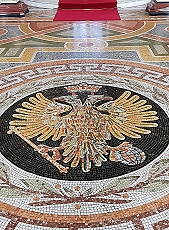
The mosaics have been carefully moved to Hull and can be seen at the city’s Hull and East Riding Museum. There, they have been beautifully displayed. I do not think I have ever seen such a large collection of Roman mosaics as can be found in the museum. It is worth visiting Hull to view this remarkable set of mosaics. Although, in my view, the mosaics alone make the museum unmissable, there is much more to be seen in this superbly curated place.
Visitors to the museum, which specialises in archaeology, follow a route that leads from exhibits relating to prehistory to just after the English Civil War. Each room or area along the way is designed to ignite interest in archaeology in the minds of everyone, from small children to adults. Every exhibit is labelled in language that is easy to understand, yet does not ‘dumb down’. Even if you enter the museum with little interest in archaeology and early history, you are bound to leave having become interested in these subjects.
Apart from the Roman mosaics, the museum contains several timber boats, the Ferriby vessels, that were built on the bank of the Humber in the Bronze Age. One of these is preserved in a special tank called the Boatlab, which contains equipment to preserve the ancient timber. It is believed the Ferriby boats are the earliest known form of seacraft made in Europe.
I have highlighted two aspects of this museum in Hull. They are the ‘icing on the cake’, but the rest of the cake is richly interesting. Many people disdain the idea of visiting Hull, but they are mistaken. The museum with its Roman mosaics is just one of many of the city’s relatively unknown but worthwhile attractions.


 yamey
yamey 