Do not throw it away because it might become valuable one day

AFTER MY DAD’S father died, his mother remarried Isaac, a merchant, who lived and worked in Port Elizabeth (South Africa).

In his holidays, both school and then later university, Dad, whose father had owned a general store (in Tulbagh, South Africa), helped his stepfather in his shop in Port Elizabeth. Once again, he was in an environment where he was acquiring first-hand experience of the workings of commerce, one of the foundations on which the study of economics is based. By all accounts, including the fact that Isaac could afford regular holidays in Europe, the business prospered. Dad told me that during his vacations, he used to help Isaac compile annual inventories of his stock.

The shop owned by my father’s father in Tulbagh

One day, Dad came across many large glass bottles filled with boiled sweets that had become unsaleable because the candies had fused together to form huge masses. My father asked Isaac whether these bottles should be thrown out. He was told that they were to be retained. A few years later, WW2 broke out and there was a shortage of glass. Isaac sold the bottles filled with inedible sweets because the glass, now valuable, could be sold (for recycling) during the glass ‘famine’.

Was it experiences in his father’s and stepfather’s shops that might have led him to eventually become a professor of economics, and helped him to understand the concept of futures markets? I wonder.

Buried behind Berry Brothers

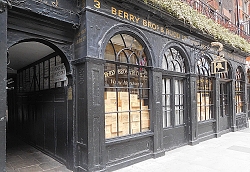
LONDON’S NOOKS AND crannies are often worth exploring. One, which I must have passed often but of whose existence I only became aware in April 2022, is Pickering Place, a narrow, covered passageway between numbers 5 and 3 St James Street, close to St James Palace.  Immediately on entering this timber lined alleyway, I noticed a metal plaque, which commemorates the short-lived Legation of the Republic of Texas to The Court of St James. The legation existed from 1842 to 1845, whilst the Republic existed from 1836 to 1846. It rented the premises from the property’s owner, Berry Brothers.

Pickering Place was in existence by 1690, when it was then known as ‘Stroud’s Court’.  Prior to that date, the site was:

“… once home to the medieval maidens’ leper colony of St James, before playing host to King Henry VIII’s royal tennis court.” (https://blog.bbr.com/2015/04/10/the-other-no-3/)

 The alleyway leads into a small open space, a courtyard that is believed to be Britain’s smallest square. The name Pickering relates to the company of Berry Brothers and Rudd (‘Berry’s’) that occupy most, if not all of the buildings around the courtyard and on the south side of the alleyway. In 1698, a widow with the surname Bourne began the business, at first a grocery shop, now known as Berry Brothers & Rudd. Her daughter, Elizabeth, married William Pickering (died 1734). They continued the business, supplying the coffee houses of St James with coffee. The company adopted the coffee mill as their symbol. The shop at number 3 St James Street and Stroud’s Court were then rebuilt by the family. William and Elizabeth’s sons, John and William Junior, continued the running of the firm. After John died in 1754, William Junior brought a relative, John Clarke, to be a partner in the business.

George Berry, John Clarke’s grandson, joined the business in 1803 and by 1810, his name became the firm’s name. George moved the firm’s activities into focussing on wine and spirits. In 1845, his sons, George Junior and Henry, took over the firm, hence the ‘Brothers’ in the company’s name. Hugh Rudd, a wine merchant with a keen interest in the wines of Bordeaux, joined the firm as a partner in 1920. His arrival in the company greatly increased its expertise in the wine trade. In 1923, the company created a new whisky which they called Cutty Sark Scotch. Its label was designed by the artist James McBey, whose studio was at the top end of Holland Park Avenue. The firm is still run by the Berry and Rudd families and flourishes.

Immediately after leaving the covered alleyway, you will see an orrery and beyond it, a carved stone portrait of a man with his head facing towards his left. Nobody we asked seemed to know whom it portrays. Various websites suggest it depicts the politician and former Prime Minister Lord Palmerston (1784-1865), who lived in Pickering Place for some time. The author Graham Greene also lived in Pickering Place for a while.

Doorways in the courtyard lead to various underground rooms including the Pickering and Suffolk Cellars. Once used to store wine and other products sold by Berry’s, parts of them are now also used as a wine school, as well as for banquets and similar gatherings. One of the cellars is named The Napoleon Cellar, after the exiled Napoleon III (1808-1873), a friend of George Berry Junior. In 1846, fearing assassination, the exiled Frenchman hid in the Berry Brother’s cellar, now named in his memory. Number 3 Pickering Place, built in the 1690s, is a well-preserved example of a William and Mary era townhouse.

Part of the tiny courtyard has outdoor tables and chairs. These can be used by patrons of the St Jacques restaurant, which occupies number 5 St James Street whose southern wall forms the northern wall of the alleyway. The southern wall of the passage is part of the wall of number 3, which houses the original Berry’s shop. This well-preserved historical shop is lined with wood-panelling and contains much of the old shop fittings.  These include old desks, shelving with old bottles, and a large hand-operated coffee grinder. Suspended from the ceiling, there is a large grocer’s weighing scales. According to Berry’s detailed company history (www.bbr.com/about/history):

“It was in the time of William Jr. and John Clarke that the famous grocer’s weighing scales began to be used to weigh the shop’s many notable customers, a fashionable pastime that continues to this day.”

Had it not been for noticing the alleyway which I have passed often without noticing it, and then spotting the portrait in the courtyard, I doubt we would have ever entered the old shop at number 3. Incidentally, if you wish to purchase wines or spirits from Berry’s, you will need to walk around the corner into Pall Mall, where the company has a newer shop … or, less interestingly, you can make purchases online.

NATION OF SHOP KEEPERS

It is popularly believed that Napoleon Bonaparte described the British as a nation of shopkeepers but in reality he might not have said so. More likely, the early economist Adam Smith, author of The Wealth of Nations, might have coined this phrase. He wrote: “… the sole purpose of raising up a people of customers may at first sight appear a project fit only for a nation of shopkeepers…”

Well, Great Britain still contains many shop keepers, but most of them are hopeless. Few shop keepers or their assistants, who are employed to make sales, put much effort into encouraging customers to buy. In general, they are an unhelpful bunch. Often when one asks for something, one is told by a typical British shop keeper: “If we’ve got it, it will be out on the shelves”, and then the customer is left to hunt for it somewhere in the shop.

Occasionally, you can find a helpful salesperson. Once, I was in London’s Oxford Street looking for a winter coat with certain features. I described in detail what I was seeking to a salesman. He replied cheerfully: “I know exactly what you need, Sir. I know just the job. You need a Danimac.” He paused before continuing: ” there’s only one problem: Danimacs are not made anymore.” And, that was it.

Had I been looking for that coat in India, the salesman would not have stopped at that point. Instead, he would have shown me a range of other types of coat in the hope that I might see the benefits of modifying my requirements and buying something else.

Unlike their British counterparts, Indian shop keepers and their sales people take a professional pride in both satisfying the customer and making sales.

Take clothes shopping for example. You enter a shop without much idea which shirt or skirt you want and are bewildered by the variety on display. You will be welcomed by a sales person, who will begin by showing you a garment that may not be to your taste. Then, you will be shown a series of other items. The salesperson will gradually show you merchandise that really appeals to you because he or she has been watching your reactions to what is being shown to you, and from these, your taste in clothes can be accurately ascertained. When you have selected whatever you were looking for as well as much that you never knew you wanted, alterations that might be needed to ensure a good fit will be carried rapidly out at no extra charge.

Some Indian shopkeepers are brilliant salesmen, especially the Kashmiris who run handicraft shops. You might enter one of these shops without any intention of making a purchase, but so expert are the sales people that I doubt that you will leave empty handed!

I could go on and on about the excellence of sales people in India, but I will not. However, before signing off, let me tell you about a simple vegetable seller in Bandra (Maharashtra). Formerly, he used to lay out a cloth blanket by the roadside. At about 1 pm, a truck would stop next to his cloth and various vegetables would be delivered. From day to day, the vendor had no idea which vegetables would arrive, but whatever arrived was, and still is, of a very high quality. His customers, mostly regulars, would turn up and buy what they needed.

After some years, the veg seller acquired a mobile phone. He collected the phone numbers of his customers. Now, every day the veg seller takes pictures of whatever he has received for sale, and then sends the pictures, the prices of his goods, and a description of them, to his customers via WhatsApp. His customers reply with their orders, which they come and collect from him. Thus, from humble beginnings a street vendor has brought his age old business into the 21st century.

Had Napoleon Bonaparte reached India, he would have had good reason to say, as I do, that Indians are truly a nation of first class shopkeepers.

Reflecting on the Lehman Brothers

I have just seen a performance of the much-hyped, sold-out, “Lehman Trilogy” at London’s National Theatre. It is written by Italian playwright Stefano Massini and ‘adapted’ into English by Ben Power. Starring Simon Russell Beale and two other actors, the three-and-a-half-hour drama charts the rise and fall of the Lehman brothers and the financial establishments they created. It is in three parts separated from each other by intervals. The first part and the beginning of the second narrate the Lehman’s family saga clearly, entertainingly, and quite interestingly. Then, the latter part of the play seems to ‘lose the plot’.

LEH 0

Seligmann store in Barkly East, South Africa

The Lehman bank’s operations literally collapsed in 2008. Although I am the son of an eminent economist, I do not understand the subject at all. I was hoping that the collapse of the Lehman Bank might be explained in relatively simple terms as the “Lehman Trilogy” drew towards its finale, but it was not. Rather than explore the dramatic possibilities of what was surely a very dramatic demise of a great financial establishment, the playwright and his ‘adaptor’ merely hinted at the disaster but made no obvious attempt to depict the momentous events that led to a frightful ending that greatly impacted on worldwide news and financial affairs. So, as you can gather, I was not altogether satisfied by the play itself. However, it got me thinking about my own ancestors, who, like the Lehman brothers, left Bavaria in the mid-19th century to seek their fortunes away from Europe across the oceans.

The Lehman brothers, who migrated to the USA in the mid-19th century, were born in Rimpar (Bavaria), near Würzburg. Heinrich (later’ Henry’) Bergmann, my great-grand uncle, was born 50 kilometres south-east of Rimpar in Ditenheim (Bavaria). He was only a few years younger than the Lehmans. In 1849, aged 18, he sailed to Cape Town in South Africa. Soon after arriving, he became the manager of a general store opened in the newly-established town of Aliwal North in the same year. Like the Lehman brothers, Heinrich became very successful as a middle-man. Like the Lehmans, during bad times he gave the farmers (his customers) credit, which they repaid when the wool harvests were brought to his shop (to be sold on to wool merchants). By the early 1860s, soon after marrying the daughter of a Jewish banker in Frankfurt-am-Main, he became the manager of one of the Aliwal’s three banks. Eventually Heinrich’s bank took over its two rivals. For reasons that are not at all clear, young Henrich shot himself in 1866.

LEH 1

The grave of Heinrich (‘Henry’) Bergmann in Aliwal North, South Africa

Heinrich’s death was not the end of the story. During his time in the Cape, Heinrich was joined in South Africa by his brother and some of his cousins. The cousins in question came mainly from Ichenhausen in Bavaria, 163 kilometres south of Rimpar. Heinrich’s brother married Klara, a daughter of Jakob Seligmann, a successful merchant in Ichenhausen.  Klara’s only brother Isak Rafael Seligmann and his wife had 18 children, of whom 15 lived to adulthood. One of the sons, Sigmund, Heinrich’s nephew, migrated to South Africa from Ichenhausen. He did not join his uncle, but began working for another German, a merchant in Lady Grey, which is not far from Aliwal North. Other young men from Ichenhausen including Sigmund’s brother Jakob and the Reichenberg brothers, one of whom joined Heinrich Bergmann, migrated to South Africa.

Sigmund Seligmann was offered a partnership in the business in Lady Grey but turned it down. He left Lady Grey to open his own shop in Dordrecht, a small place in the Cape. Soon after this, he opened a branch in Barkly East in the heart of a sheep grazing district. Like the Lehman brothers who bought cotton and sold it on, and also acted as bankers for the cotton-growers, Sigmund bought wool from his farmer customers and sold it on as well as lending money to the farmers when times were lean.

The Lehman brothers set their sights high. They moved from being merchants to becoming brokers, and then bankers. Their descendants continued the progression until, finally, others took over the running, and eventual ruining, of the business. Sigmund and many others like him, who went from what was to become ‘Germany’ to South Africa, more often than not retired to Germany when they had made their fortunes. In the late 19th and early 20th centuries, life in South Africa was a lot less comfortable than in civilised Germany or the USA, parts of which were becoming very sophisticated. Those who returned to end their lives in Germany had to face WW1 and then later the advent of Hitler’s regime. Sigmund and his children left Bavaria for Palestine, thereby escaping the fate of many Jews who remained in Germany.

Before Sigmund left to retire in Germany, he left the running of his by now very successful business in the hands of some of his very numerous nephews. One of these, who arrived in South Africa in about 1903, was my grandfather Iwan Bloch. Hardworking Iwan, like his father-in-law the future Senator, Franz Ginsberg (an industrialist in the Cape, who had migrated there from Prussia), maintained the successful running of his business as well as entering politics. Iwan became the first and only Jewish Mayor of Barkly East. His life was cut short by ill-health, but had he lived longer I feel sure that he would have entered national politics following in the footsteps of his father-in-law Franz.

With the exception of Iwan’s ill-fated uncle Heinrich Bergmann, this extended Bavarian Jewish family did not take the same road toward high finance as the Lehmans did, but they started at the same point.

Furthermore, the Lehman fortune began to be built from the labour of black slaves in Alabama. This is skirted around casually in the play. Although formally, there were no black slaves in South Africa when my ancestors arrived there, much of the dirty work required to make their fortunes was performed by black Africans, whose treatment by the white Europeans was very far from admirable.

LEH 2

Adam Yamey’s grandfather, Iwan Bloch, brought the railway to Barkly East in South Africa

I am glad I saw the “Lehman Trilogy” because it is engaging and, although there is little acting, what acting there is was good. Also, it got me thinking about my own history. However, like the doomed bank, the quality of the plot declines gradually as the three and a half hours pass by. Would I recommend it? The answer is “no”.