I FIRST CAME ACROSS the critic, writer, and poet Leigh Hunt (1784-1859) when I was collecting information for my book about Hampstead. For some years, Hunt lived in a house in Hampstead’s Vale of Health. Amongst the many noteworthy people who visited him there regularly were the poets Shelley and Keats. Later, when I was writing my book about west London, I found out that Hunt had resided in Edward’s Square, Kensington. He had also lived in Chelsea. Until today (the 7th of August 2023), I had never seen a memorial to Hunt. Today, I spotted one, a carved stone plaque, high up on the wall of the Bush Theatre that faces Pennard Road (in Shepherds Bush).
The theatre is housed in what was formerly one of several libraries established by the newspaper entrepreneur and philanthropist John Passmore-Edwards (1823-1911). The library building was built in 1895 and its external features are well-preserved. The theatre moved into it in 2011.
Hunt is not the only person commemorated on the plaque. Below his name is that of the artist Charles Keene (1823-1891). In his book “A Few Footprints”, Passmore-Edwards wrote (in 1906) that he placed memorials of illustrious people in places near where they died:
“I have placed medallions of Charles Lamb and John Keats in the Public Library, Edmonton; of Sir Henry Austin Layard and Sir William Molesworth in the Public Library, Borough Road ; and of Leigh Hunt in the Public Library, Shepherd’s Bush…
… Mr. A. E. Fletcher, who unveiled the memorial medallion of Leigh Hunt at the Shepherd’s Bush Public Library, said: ” Let us remember Shelley’s fine description of Leigh Hunt as one of the happy souls who are the salt of the earth.’ We have learnt enough to admire him for his genius and his marvellous industry, to honour him for his fearless outspokenness and courageous sacrifice for principle, and to love him for his splendid faith in humanity and his buoyant optimism””
However, Passmore-Edwards makes no mention of Keene.
The plaque was probably affixed to the library when it was built. But why the two names are on the same plaque is a bit of a mystery to me. The only possible connection, which makes sense in the light of what Passmore-Edwards wrote, is that both men died reasonably close to Shepherds Bush.
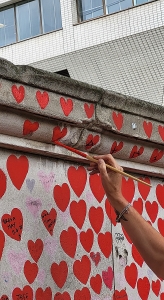
A LONG WALL on the south bank of the River Thames faces the Houses of Parliament. It is literally covered with hearts painted in red. Each heart is supposed to commemorate one of the more than 220,000 people who died of covid19 in Britain. Families and friends of the victims can write the names of their lost ones on the hearts on this wall – the National Covid Memorial Wall. For those who work in the Houses of Parliament and those who walk past it, this heart covered wall is a chilling and moving reminder of a terrible period during the recent history of Britain as well as the rest of the world.
A group of volunteers:
“… repaint faded hearts, re-write dedications that are being absorbed into the Wall, remove graffiti, and look after the Wall to ensure that those lost to Covid19 in the UK are remembered as people, not as a statistics.” (www.nationalcovidmemorialwall.org/)
Recently, we watched some of these generous people, some of them mounted on ladders, working with their paint brushes. As we walked alongside the wall, reading some of the names of people who were killed by the covid virus, we noted that not all of the inscriptions were dedicated to remembering the dead. Some of them, it is sad to relate, were tasteless graffiti and statements such as “X loves Y”. It is these thoughtless additions to a wall of sorrow that the dedicated volunteers work to eradicate. Seeing these irreverent and irrelevant ‘blots’ on the wall made me think “is nothing sacred?”
Some of the WW1 names and the Falklands victim below
IN THE HEART of Sandwich in Kent, near to the deconsecrated Church of St Peter, there is a war memorial that was erected to commemorate those from the town who died in the ‘War to End All Wars’ – the First World War (1914 – 1918). Roughly 100 names are recorded on the lists of people who died during WW1. However, they are not the only people listed on this monument because ‘The War to End All Wars’ did not live up to its name.’
The memorial lists about 15 people who were killed in WW2 (1939-1945). In addition, three of Sandwich’s population perished in the Korean War (1951), and more recently, one of the townsfolk was killed in the Falklands Conflict (1982).
I sincerely hope that no more names need to be added to this war memorial as a result of the conflict in Ukraine, or any future wars.
I STUDIED AT University College London (‘UCL’) between 1970 and 1982. I was not there for so long because I kept failing examinations. Instead, I was a student there while I completed three different degree courses. Today (and during the years I attended UCL), the Students Union building is still located in a not particularly attractive building on the southwest corner of Gower Place and Gordon Street. Whereas it was a popular haunt of many of my fellow students, I hardly ever entered it except for a very brief period in the mid-1970s, when I was a PhD student in the Physiology Department.
During that short period, an Italian man opened a small restaurant on one of the floors of the Union building. His menu was limited to beautifully prepared beefsteaks that were accompanied by salad. This wonderful steak was priced no more than the often mediocre (or sometimes even poor) food that was available in the various subsidised student canteens in UCL. The reason for the Italian’s low priced, superb fare became obvious when after a few weeks, his eatery closed – or was closed. It turned out (so I was led to believe) that he was using the Union’s premises, but not paying the rent that he owed.
Winding the clock forward to the 26th of June 2023, we walked past the Union building, and I noticed something that I had never seen before. The building has a commemorative plaque that reads:
“This building housed the London School of Tropical Medicine and the Hospital for Tropical Diseases. 1920-1939.”
The plaque was placed by the Seamen’s Hospital Society, based in Greenwich. I do not know when the memorial was affixed to the Union, but I feel sure that it was not there when I was a student. It is interesting that what was once a hospital has become a centre for hospitality.
AT THE WESTERN END of Chiswick’s Turnham Green, there is a striking church, which was designed in the Arts and Crafts style by the architect Richard Norman Shaw (1831-1912) and consecrated in 1880. It served the community that was beginning to settle in the recently established Bedford Park, which I described as follows in my book “Beyond Marylebone and Mayfair: Exploring West London”:
“Bedford Park near Turnham Green is probably the first example of what has become known as a ‘Garden Suburb’ development, although originally it was not known as such. Pevsner noted:
‘Its reputation as the earliest garden suburb needs some qualification. Trees and green spaces … are found in many earlier suburbs; the novelty of Bedford Park is their combination with ‘artistically designed’ houses … inspired not by classical or Gothic pattern books but by the red brick and tiled idiom derived chiefly from the home counties vernacular of the c17 and c18…’
He added that the idea was to recreate the:
‘… relaxed informal mood of a market town or village…’, in ‘… a completely speculatively built suburb.’
And, in the case of Bedford Park this ideal has been almost but not quite fully achieved, because the suburb, attractive though it is, has a somewhat staid, bourgeois feel about it. Created by Jonathan Thomas Carr (1845-1915), its development began in 1875 …”
If you want to know more, you can find it in my book.
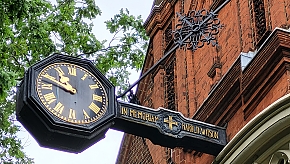
Returning to the church, which we re-visited today (20th of June 2023), I showed my wife the interesting clock on one of its exterior walls. It is held away from the building by a sturdy beam on which there are some words. On one side, you can read: “Spion Kop Africa 1900”, and on the other, you will see: “In memoriam Harold Wilson”.
In case you are wondering, the clock has nothing to do with the former Prime Minister Harold Wilson (1916-1995). Instead, it commemorates 2nd Lieutenant Harold AC Wilson, who fell at the battle of Spion Kop in January 1900 during the 2nd Anglo-Boer War (1899-1902).
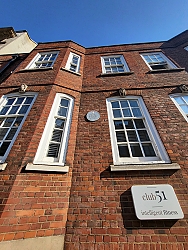
IT ALMOST GOES WITHOUT saying that wherever you are in central London, you are never more than a few footsteps away from a spot that has played a role in significant historical events. Most of these historical spots have been recorded, and therefore are not unknown to at least a few people. However, when walking around London, I often come across a memorial which I had not noticed before despite having passed it several times. Such is the case with number 51 New Cavendish Street – a brick building in Marylebone, which we have walked past several times recently.
Number 51 bears a commemorative plaque which has the following information:
“This building housed the headquarters of the Polish navy during 1939-1945”.
Poland became an independent country at the end of WW1. By 1920, then with only 90 miles of coastline, Poland began to construct a navy. This was based in Gdynia, near to the ‘free port’ of Gdansk (Danzig), which was not under Polish control. In 1939, with little chance of withstanding attack by the Germans, Polish naval vessels began leaving the Baltic, and heading for British waters. In late 1939, Polish Naval Headquarters were established at 51 New Cavendish Street. Although the Poles had administrative control over their vessels, operational control was dictated by British military requirements. Between 1939 and 1945, the number of men working in the exiled Polish Navy increased from 1000 to 4000.
After the end of WW2, in September 1946, the Polish Naval Detachment in the UK was disbanded. One of its warships was handed back to the new Communist government of Poland. Only a few of the naval personnel felt able to return to their native land now that it was under Communist rule.
Well, I knew a little about the exiled Polish Air Force and have visited Audley End House, where Polish Special Operations Executive personnel trained before being dropped behind the lines in German-occupied Poland. I have even eaten dinner at a Polish Airman’s Club in South Kensington, but this place’s restaurant might well have closed since then. However, until my most recent visit to New Cavendish, I did not know anything about Poland’s navy and its role in WW2.
GEORGE FREDERIC WATTS (1817-1904) was a sculptor and a painter. I first became acquainted with him and his work when I was writing my book about west London (“Beyond Marylebone and Mayfair: Exploring West London”). My interest in him increased when I was writing a book about the Victorian photographer Julia Margaret Cameron (1815-1879). Between about 1850 and 1870, he lived with Thoby and Sara Prinsep’s family, about whom I have written in another book, in the now-demolished Little Holland House in Kensington. Not far from where he lived, there are two bronze statues by Watts: a portrait of Lord Holland in Holland Park, and the equestrian sculpture “Physical Energy” in Kensington Gardens. While living with the Prinseps, Watts met Julia Cameron, who was Sara’s sister. Cameron lived at Freshwater on the Isle of Wight in a house that neighboured the property where the poet Alfred Lord Tennyson lived. Watts, who had helped the Prinseps rent Little Holland House, was a frequent visitor to Freshwater, where he met and socialised with both Tennyson and Cameron. Watts, who was briefly married to the actress Ellen Terry, painted Tennyson several times and was himself photographed by Cameron. And Watts painted at least one portrait of Cameron – now in the National Portrait Gallery.
Apart from the numerous paintings and sculptures created by Watts, one of his most unusual works is neither a sculpture nor a painting – it is what one might describe as a precursor of Conceptual Art. Although attractive, the concept that it conveys – self-sacrifice – is more important than its appearance. Located in Postman’s Park, which extends from Aldersgate Street to King Edward Street, it is a memorial to ordinary people who lost their lives during peacetime whilst trying to save those of others. Created in 1898 but conceived by Watts in 1887, the work of art is called “Memorial to Heroic Self-Sacrifice”. It consists of a stretch of wall protected from the elements by a wooden loggia, which was designed by Ernest George who helped design the buildings at the Golders Green Crematorium. On the wall there are memorials to those who sacrificed their lives whilst rescuing others. Each memorial is made of ceramic tiles and records the name of the hero and a brief account of how he or she met their deaths. The first four memorials were designed and made by William de Morgan. Later, others were made by the Royal Doulton pottery. There is room for 120 memorials but by 1931, only 53 had been placed. In 2009, the Diocese of London permitted another memorial to be added.
Watts supervised this project. When he died, his widow, his second wife Mary, took over its supervision, but after a while she lost interest in it as she began concentrating on the management of the Watts Mortuary Chapel and the Watts Gallery – both near Compton in Surrey. The memorial is in Postman’s Park, which was formerly the graveyard of the nearby St Botolphs Aldersgate Church and is, I am guessing, maintained by the Church of England or a local authority.
The memorials are both fascinating and moving. Here are a few examples:
“Mary Rogers. Stewardess of the Stella. Mar 30 1899.Self sacrificed by giving up her life belt and voluntarily going down in the sinking ship.”
“Herbert Peter Cazaly. Stationer’s clerk. Who was drowned at Kew in endeavouring to save a man from drowning. April 21, 1889”
“Herbert Maconoghu. School boy from Wimbledon aged 13. His parents absent in India, lost his life in vainly trying to rescue his two school fellows who were drowned at Glovers Pool, Croyde, North Devon. August 28, 1882”
According to Wikipedia:
“Maconoghu was actually Herbert Moore McConaghey, the son of Matthew and Martha McConaghey, and he was born in Mynpoorie in India where Matthew was working as a settlement officer for the Imperial Civil Service,”
Standing amidst these memorials is a small sculpture depicting Watts. Its inscription reads:
“The Utmost for the Highest. In memoriam George Frederic Watts, who desiring to honour heroic self-sacrifice placed these records here.”
Luckily for us, Watts’s unusual creation has been kept in good condition. Since 1972, it has been a protected structure. Unlike most of the art made by Watts, the memorial in Postman’s Park was an idea created by him, rather than something he made with his own hands. I had seen the memorial several times in the past, but today, the 17th of May 2023, I took my wife to see it for the first time. A few weeks earlier, while visiting the Tate Britain, we had seen an art installation by Susan Hiller. It incorporated photographs of 41 of the memorials on Watts’s wall of memory in Postman’s Park. Having seen this, we wanted to see the original, and were not disappointed.
You can discover more about Julia Margaret Cameron, Tennyson, the Prinsep family, and Watts in my book “Between Two Islands: Julia Margaret Cameron and her Circle”, which is available from Amazon:
CONSTRUCTED IN 1974, it was 221 feet tall. It overshadowed the homes of many people including many of the wealthier inhabitants of West London’s Kensington. And I imagine that the wealthy inhabitants of the elegant crescents and other thoroughfares near it did not appreciate the views from their windows being spoiled by this Brutalist block of flats containing less well-off people, about whom they would rather not think. Between 2015 and 2016, the block was refurbished and made less of an eyesore by the addition of cladding – ostensibly to improve insulation – to its exterior.
On the afternoon of the 13th of June 2017, I was walking around North Kensington, taking photographs as usual. I stopped to take pictures of the recently built Kensington Leisure Centre and its near neighbour the Kensington Aldridge Academy – both are interesting examples of contemporary architecture. While I was taking these photos, I had my back to the tower block I have just described. Had I looked at it then, I would have thought that it would have been of little interest to me. How wrong I was.
Just after midnight on the following day, a fire broke out in that tall block – Grenfell Tower – that edifice which overlooked the homes of the wealthy residents of Kensington. The fire spread rapidly because of the highly inflammable nature of the cladding used to make the tower more attractive to its neighbours. Seventy-two people died in the conflagration; many were injured; and all the surviving residents were not only badly scarred psychologically, but also lost their homes and possessions.
From wherever you looked in a large area around Grenfell, including from the homes of the prosperous residents of Holland Park and Notting Hill, one could see the horrifically charred tower block – a fear-inspiring eyesore – the result of local government officialdom ignoring repeated warnings about the already known potential fire hazards that the cladding presented and inadequate planning for escape during a fire. I felt – and I am not alone in thinking this – that the local council hardly cared for a few impecunious residents in a tower block. What was more important was to save money so as not to impose high local taxes on people who could have easily afforded to pay them.
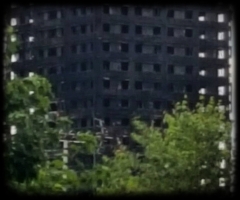
Soon after the fire, the charred tower was covered with protective wrapping to assist forensic investigations and to contain debris, which might otherwise have flown away and dropped in the neighbourhood. It also removed from sight the scarred, charred remains of the building – a 24 hour a day reminder of the avoidable, tragic loss of life, which was not altogether disconnected with civic and possibly criminal negligence. The remains of the tower are still covered up. Before the heart-rending remains of the conflagration were covered up, filmmaker Steve McQueen (born 1969 not far from Grenfell Tower) made a short film about the tower. It is currently on show at the Serpentine South Gallery in Hyde Park until the 10th of May.
The film is without words in its soundtrack and without any captions. It looks as if it might have been filmed with a drone or a camera held within a helicopter. It begins with a flight over beautiful countryside far beyond the edge of London. The camera moves above the scenes of rural serenity and slowly the city of London comes into view. We pass over London’s sprawling suburbs, and then the charred Grenfell Tower begins to be seen in the centre of the screen. The camera moves closer and closer to the blackened building, and then slowly circles around it many times. Each time the tower is slowly encircled, and the camera moves closer to it, more and more details of the destruction entered my consciousness, and my understanding of the horror of what had befallen Grenfell and its inhabitants gradually increased. As the camera moved around the wreck, you could catch glimpses of the parts of London surrounding it – the houses and flats of those who must have witnessed the fire, but were not affected by it, at least not physically. As the camera moved, one could see trains moving on nearby tracks and vehicles travelling along roads. I felt that I was witnessing life going on as usual at the same time as witnessing the horrors of a disaster. The absence of commentary added to the powerful impact that seeing these images of a lethal incineration simultaneously with scenes of normality made on me. There was a soundtrack, which consisted of recordings of everyday sounds – both natural and man-made. However, while the camera encircled the tower of death, there was no sound at all. I wondered whether this signified the fact that the victims, who had died, will no longer be able to enjoy the sounds of everyday life.
McQueen’s film is a sophisticated and solemn memorial to an event that could easily have been avoided. Without a soundtrack or explanations, the viewer is left to ponder the tragedy in his or her own way.
LONDON IS RICH in memorials. Some of them commemorate well-known figures and events and others make the observer aware of lesser-known aspects of history. One of these obscurer memorials is on number 218 Sussex Gardens, next to St James Church and not far from Paddington Station. It was placed on the building, which was rented by the Ukrainian Canadian Servicemen’s Association (UCSA) [Союз Українських Канадійських Вояків] in 1943.
According to an informative website (www.ukrainiansintheuk.info/eng/03/ucsa-e.htm), the UCSA was: “…formed on 7 January 1943 in Manchester, to cater for the social and cultural needs of Ukrainian Canadians serving overseas. Initially the association had 37 members. By the end of the war there were 1,500 active members and over 3,000 additional names on the association’s mailing list.” That is clear enough, but I wondered about the story of the Ukrainian Canadians. In 2016, there were more than 1.4 million Canadians with Ukrainian ancestry. Canada has the third largest population of Ukrainians after Russia and Ukraine. Almost certainly, 1891 marked the start of the migration of significant numbers of Ukrainians to Canada. Back in those days, the territory, which is now the republic of Ukraine was divided between the Austro-Hungarian and Russian Empires. They were welcomed in Canada as the country needed workers to populate and cultivate the prairies.
The UCSA occupied the house in Sussex Gardens from late 1943 until early 1946. The website quoted above revealed that the UCSA: “… organised social gatherings, or “get-togethers”, for its members, initially in Manchester and later also in London. A choir and a dance orchestra were organised at the London club, and a library and reading room were maintained there. The association’s activities also included visiting sick and wounded Ukrainian Canadians, compiling lists of those who had died or were taken prisoner, and looking after the graves of the dead (at various cemeteries in the UK, including Brookwood Military Cemetery near Woking, Surrey). From September 1943 the association published an UCSA Newsletter.” As WW2 drew to a close, the UCSA also provided assistance to Ukrainian displaced persons and refugees from mainland Europe.
The memorial plaque on 218 Sussex Gardens was placed in September 1995, long before Russia began its current conflict with Ukraine. Unlike the statue of the Ukrainian Saint Volodmyr, which stands in Holland Park Avenue, the building near Paddington did not have any pro-Ukraine flags or other patriotic items affixed to it. The plaque is a discrete memorial to an aspect of the history of WW2, about which I knew nothing until today.
SAWBRIDGEWORTH IS AN ATTRACTIVE small town with many picturesque old buildings and a parish church, St Mary’s, whose construction began in the 13th century. It is an unusual edifice, being about as wide as its length, rather than longer than its width as is the case for most English churches. It contains a fine selection of elaborate funerary sculptures.
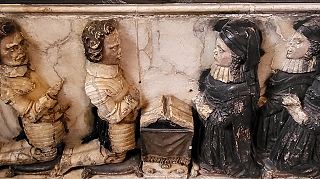
The most impressive funerary monument is the memorial to John Leventhorpe and his wife Joan, who died in 1625 and 1627 respectively. Within a multi-coloured marble frame, both of the deceased are depicted reclining on their left sides with their heads propped up by their left hands. John holds a sword in his right hand and Joan a small book in hers, Beneath the two statues, the couple’s six sons (one of whom, Arthur, died as a baby) and eight daughters are depicted in bas-relief, all kneeling in prayer. Baby Arthur is also present on the memorial but has been sculpted much smaller than his brothers. The whole sculptural ensemble is magnificent, and if you had time to see only one thing in Sawbridgeworth, this should not be missed.
High on the wall facing the Leventhorpe memorial, there is a smaller one, commemorating Jeremiah Milles (died 1797) and his wife Rose, who died in 1835. It is typical of early 19th century memorial art. It shows a female mourner in Hellenic dress kneeling in front of a sarcophagus. It was sculpted by John Termouth (1795-1849) of Pimlico (London).
The sculptor of the Leventhorpe memorial has been forgotten, but Termouth, who sculpted the Milles memorial, has not been consigned to obscurity. A notice in St Mary’s revealed that Termouth was:
“… an uninteresting artist whose symbolism was always obvious, hackneyed, and uninspired.”






 yamey
yamey 