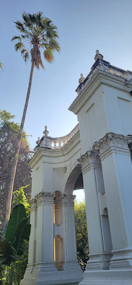
A LARGE WHITE MANSION stands in lovely grounds not far from the Sidi Saiyed mosque in central Ahmedabad. If you look carefully, you will see that in various places the outside of the building has cartouches consisting of an A intertwined with an S.
This edifice was a home of the textile magnate and philanthropist Ambalal Sarabhai (1890-1967).
Ambalal’s sister was Anasuya Sarabhai (1885-1972). She became a pioneer and founder of the women’s labour movement in India. Also, she helped Gandhi set up his Sabarmati Ashram in Ahmedabad.
Initially, Anasuya studied medicine, but gave it up. She was a Jain and dissecting corpses was abhorrent to her. She gave it up, and went to London where, in 1912, she studied at the London School of Economics, where many years later my father became a professor.
In 1914, she organised a textile workers strike in Ahmedabad. No doubt, her brother’s factories would have been affected. In 1917, the Ahmedabad Textile Labour Association (Majdoor Mahajan Sangh) was formed and Anasuya was made its lifelong president by Gandhi.
I do not know where Anasuya lived in Ahmedabad, but seeing her brother’s house made me think of her. [It is possible that she resided in Ambalal’s mansion.]
The villa is now the home of the Shanti Sadan institute.
ONE OF THE REASONS for our visit to Rajasthan in 2024 is connected with one of my wife’s ancestors: Laxmidas Sapat (also written as ‘Sampath’). He was my wife’s great great grandfather on her mother’s side. Trained as a barrister in London’s Middle Temple he was Dewan (Chief Minister) of Jaisalmer between from 1903 for about six years. After that, he became Chief Justice of Jodhpur.
As yet, we have not discovered where Laxmidas resided in Jaisalmer. But today (8th of December 2024), we have just visited the spectacular haveli (mansion) that was constructed for one of Laxmidas’s predecessors: Mohata Nathmal, who was Dewan between 1885 and 1891. The haveli is called Nathmalji ki Haveli and it was built in 1895.
“One of one of the most fascinating aspects of the façade is the addition of contemporary aspects, such as bikes and also a European-style heavy steam engine, which were unheard of in Rajasthan at the time. These makings mirror the interested and forward-thinking minds of the craftsmens who created the haveli, mixing conventional themes with contemporary motifs that were brand-new to Jaisalmer in the 19th century.”
Whatever the reason for the presence of these carvings, the facade is a showpiece of the skill of the two brothers who were commissioned to erect the building. Today, visitors can enter the haveli to view and purchase the goods in the shops that occupy the building. The rooms within the mansion have wall paintings that were created in the 19th century, and there are also a few framed historical portraits, including one of King Edward VII of England.
I am pleased that I have seen the home of one of the Dewans of Jaisalmer. I would be even happier if I could discover where Laxmidas Sapat resided during his time as Dewan of Jaisalmer.
BY THE VERY EARLY 19th century, the armies of the Marathas had been beaten by the armed forces of the British East India Company. After this, from 1805 onwards until 1947, the State of Baroda was ruled by a Hindu Maratha dynasty – the Gaekwads of Baroda. Put simply, the Gaekwads controlled the internal affairs of the state in such a way that British interests were not damaged, and the British controlled the external affairs of the state.
Between 1849 and 1854, Bhau Tambekar (Vithal Khanderao) was the Diwan (prime minister) of Baroda. He lived in a large building, which was probably constructed in the early to mid 19th century. Known as Tambekar Wada, this typical Maratha-style mansion has three storeys and surrounds a courtyard. Currently, the first floor of the front (eastern part) of the building is the only part open to the public.
The part of the building that can be visited is a long rectangular hall with a wooden jaali (perforated screen) near one end of it. The walls of this room are covered with beautiful detailed paintings from floor to ceiling. Many of them depict scenes from the Mahabharata, Ramayana, and Hindu religious images. However, the north wall of the hall is even more fascinating.
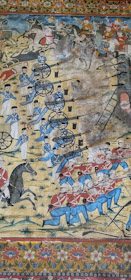
Most of the north wall is covered with a mural depicting a battle between the British East India Company and the Marathas. Most of the picture shows features of the British forces in great detail. There are even several flags that resemble Union Jacks. Some British soldiers, dressed in red uniforms, can be seen riding elephants. Whoever painted this wall had a good eye for both detail and representation of battles.
On the same wall as the battle scene, there are several smaller paintings depicting European men and women. On one of these, a woman in European garb seems to be consoling another woman. In another, a man wearing a red jacket is looking at a European lady affectionately.
The purpose of the painted hall is not known for sure. It has been suggested that it was for entertaining guests. The small part enclosed by the screen might have been reserved for ladies. In its heyday, purdah would have been observed in the house. The hall has a set of windows through which one can access a narrow balcony that extends along the entire length of the eastern side of the house. This terrace has a perforated screen through which people on the balcony could look out onto the street without fear of being seen by passers-by.
Although this December (2023), we are enjoying our fourth visit to Baroda, we would not have known about the Tambekar Wada had our friend Nandita A not told us about it. I am very pleased that she introduced us to this gem hidden within the narrow backstreets of Baroda’s Dandia Bazaar district.
WIMPOLE HALL IN Cambridgeshire is according to the architectural historian Nikolaus Pevsner:
“Without doubt the most spectacular country mansion in Cambridgeshire…”
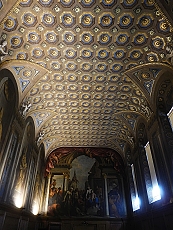
Chapel at Wimpole Hall, Cambridgeshire
Much of the mainly red brick building dates from the 17th century, although more was built in the 1740s. It contains many splendid rooms including a large library; a chapel decorated in 1724 by the painter James Thornhill (c1675-1734), who decorated the Painted Hall in Greenwich; and a large ‘salon’ created by Sir John Soane. These are a few of the wonders that can be viewed within the house, now maintained by the National Trust. The grounds of Wimpole are also superb and include a magnificent walled garden and a ‘Gothick’ folly.
Despite the visual attractions of Wimpole Hall, I was fascinated by its last owners: George and Elsie Bambridge. George Louis St Clair Bambridge (1892-1943) was a British diplomat and a soldier. In October 1924, he married Elsie Kipling (1896-1976), the second daughter of the famous writer Rudyard Kipling (1865-1936).
After living in several places outside the UK, George and Elsie came to London. Between 1933 and 1937, they lived in Hampstead. Their home in that lovely district of north London was the elegant Burgh House, which was built in 1704. In an epilogue to a biography of her father by Charles Carrington, Elsie wrote of Burgh House:
“In 1933 we returned to England, and our life in the delightful old house which we rented in Hampstead was a source of happiness to him to the end of his life.”
The person to which she was referring (i.e,, “him”) was her father, Rudyard Kipling.
On the 12th of January 1936, Rudyard and his wife (Carrie) visited George Bambridge, who was in bed at Burgh House, suffering from bronchitis. It was to be Rudyard’s last outing because on the following day he was admitted to Middlesex Hospital where he underwent hazardous surgery for a haemorrhage. He died in hospital on the 18th of January.
The Bambridges moved from Hampstead to Cambridgeshire in 1937. They rented Wimpole Hall between 1937 and 1942, when they purchased to property. George died in 1943, and his widow, Elsie, continued living in Wimpole Hall until her death. When they moved in, the place was empty of contents. They bought pictures and furniture, much of which can be seen today. After her husband’s death, Elsie used the substantial royalties from her father’s books to refurbish the house. On her death, she bequeathed the house and its vast estate to the National Trust. It is well worth visiting if you are anywhere near Royston or Cambridge and it is no more than one hour’s drive from central London.
ISAAC BASHEVIS SINGER, the author, should not be confused with Isaac Merritt Singer (1811-1875), the American born inventor of a successful version of the sewing machine. By 1862, he had fathered 18 children with several different women. In 1862, Isaac and his second wife, Isabella Eugénie (née Boyer), shifted from the USA to Europe because of his scandalous reputation in the States. They lived in Paris until the outbreak of the Franco-Prussian War in 1870. Then, they moved to England with their six children. For reasons connected with its mild climate, the family moved to the Torbay area in early 1872. By then, he had already purchased the Fernham Estate in Paignton, next to Torquay.
Oldway Mansion, (Paignton) Torquay
Singer and his family squeezed into Little Oldway, a villa on the estate, which had been built in about 1850. Next, he commissioned the architect George Soudon Bridgman (1839-1925) to help him design his ‘dream house’, the basis for the present grandiose Oldway Mansion, and the neighbouring circular building, the Rotunda. The latter was designed for stabling and as an exercise pavilion. The house was completed by the end of 1875.
What we see today is not what Isaac would have seen when the edifice was completed. Between 1904 and 1907, Paris Singer (1867-1932), one of Isaac and Isabella’s sons, who had bought the mansion from the Singer Trustees in 1893, made major changes to its appearance. He engaged two French men, the garden designer Achille Duchêne (1866 — 1947) and his father Henri, to design his new home, the present Oldway Mansion. His aim was to create an edifice inspired by the Palace of Versailles. The reconstructed (remodelled) mansion is a magnificent imitation of a French palace in the style of that which can be seen at Versailles. It incorporates decorative features copied from notable buildings in France. Its interior, which I was unable to see, is grandiose and includes fine paintings and a reproduction of the Hall of Mirrors.
In 1917, after having had an affair with the dancer Isadora Duncan (1877-1927) in 1917, Paris moved to the USA for tax reasons. After having been used for various purposes, Paignton Urban District Council bought the property from the Singer family. Currently, the building is mostly disused apart from a small, but pleasant café. Its formal gardens are well-maintained, but the mansion and the Rotunda are in need of maintenance. Oldway Mansion looks rather like an abandoned Russian aristocrat’s palace many years after the Revolution.



 yamey
yamey 