
When the letters V and R did not refer to England’s Queen Victoria

THE SETUPARVARTIPURAM DAM, also known as the Kundala Dam, is a popular spot for tourists. This curved dam, built with masonry blocks, lies near the beautiful road that runs between Munnar and Top Station, a high mountain view point.
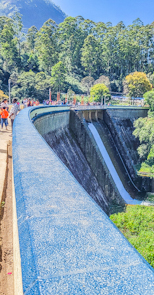
Kundala Dam

At the entrance to the narrow roadway that runs along the top of the dam, there are two commemorative plaques. Both of them bear the coat of arms if the former Kingdom of Travancore and the letters V and R intertwined.

One of the plaques informs the viewer that the dam was opened during the twenty-fifth year of the reign of “His Highness Sri Chitra Thirumal Sir Balaramvarma … Maharajah of Travancore”. Born in 1912, he died in 1991. He came to the throne in 1924. Therefore, the twenty-fifth year of his reign was 1948/49.

It was in 1949, that the Maharajah agreed to unite Travancore with Cochin (and the rest of India). Between Indian independence in August 1947 and 1949, Travancore resisted unification with the new republic of India. Between 1949 and 1956 Sri Chitra Thirumal served as the first and only Governor of the newly formed Travancore-Cochin Union. In 1956, this territory was incorporated into the state of Kerala.

As for the intertwined R and V, this has nothing to do with Queen Victoria (VR). Instead, it refers to Rama Varma, a set of rulers of Travancore, Cochin, and other parts of Southern India.

Having established the significance of the letters R and V, I must add that a visit to the dam is a delightful experience.

A palace by the sea

IN OCTOBER 2022, we visited the Isle of Wight and went around Osborne House, which Queen Victoria and her consort Prince Albert had constructed as a holiday home near the seaside on the north coast of the island. A largely unattractive Victorian pile, its saving grace is the Durbar Hall, which is a near perfect example of the Indo-Saracenic style of architecture that can be found in many places in India. Recently (in February 2023), we visited another royal summer palace located close to the sea. It is the Vijaya Vilas Palace close to Mandvi in the former Kingdom of Kutch, now a part of the Indian State of Gujarat.

The Vijaya Vilas was completed in 1927. It was built by Kutch’s ruler Maharao Kengarji III as a summer resort for his son and heir, the Yuvraj Shri Jayarajii.

Architecturally, it resembles older Rajput palaces, and is a fine example of the Indo-Saracenic style. It and its various oriental decorative and structural features were made by craftsmen from Bengal, Jaipur and other places in Rajasthan, Saurashtra, and Kutch. The predominant material used is sandstone , of which there is no shortage in Kutch. It seems that the palace suffered little damage during the 2001 earthquake, which badly affected the Maharao’s palaces in nearby Bhuj (the capital of Kutch).

Inside the palace there are rooms with furniture that would not look out of place in many English stately homes. There are many framed photographs of the royal family, their guests, and the many wild animals that were shot. One of these was a leopard that was shot by someone inside the palace. One of the window panes has a bullet hole that is said to have been made by the bullet that killed the creature. There are also photographs that record the many times that scenes in Bollywood movies were shot in the Palace.

One photograph shows the US General Dwight Eisenhower seated in a jeep. This picture was taken in Europe during WW2. I have yet to discover what, if any, connection existed between Eisenhower and the royal family of Kutch.

Visitors can visit the rooms on the ground floor, and can ascend to the roof from which there are superb views of the sea and the flat countryside around the palace. The first floor, which is private, is the residence of members of the former royal family.

Although not as old as it looks, Vijaya Vilas, is a superb example of the kind of palace typical of those older ones that can be seen in Rajasthan. To my taste, Vijaya Vilas is a much more lovely and harmonious edifice than Victoria and Albert’s seaside home on the Isle of Wight.