In search of WC on Madeira

IN JANUARY 1950, the famous writer, painter, and politician, Winston Spencer Churchill (‘WC’) paid a short visit to the island of Madeira with his wife and his eldest daughter. They were accompanied by various British officials.

WC arrived on the island by sea, and stayed in the luxurious Reid’s Hotel in Funchal, which continues to flourish today. He left by seaplane a few days later to attend to affairs connected with an upcoming election in the UK.

While we were visiting the excellent photographic museum in central Funchal, we saw some photographs of Churchill, which were taken during his excursion to the picturesque fishing port of Camara de Lobos, which is a few miles west of Funchal. The photographs show WC painting a picture of the lovely bay surrounded by serried rows of houses. I have yet to see the picture, which I hope still exists.

We took a local bus to Camara de Lobos and disembarked close to a small bar named after WC. This is located close to a terrace overlooking the bay and its fishing boats. It was from here that he painted. A monument records this episode.

In 2019, a new hotel opened, the Churchill Bay. Outside its entrance, there is a sculpture depicting WC with cigar held between his lips. He is shown seated at an easel. Within the hotel’s lounge and bar, there is a fascinating collection of Churchilliana – photographs; letters signed by WC; a portrait by Felix Topolski; and contemporary artworks relating to WC.

Whether or not you are a fan of the Great WC, Camara de Lobos deserves a visit. Although there are plenty of tourists there, it manages to retain the feeling of a traditional fishing village.
Water from on high

WHEN THE PORTUGUESE first landed in Madeira in the 15th century, the area that they settled – the southeast corner of the island – it was not well watered. Using slave labour, they constructed a series of irrigation channels to bring water from the mountains to the drier area, where they later planted valuable crops such as sugar cane. These channels that snake their way gradually downhill along the mountainsides are called ‘levadas’. The construction of these channels continued into the early 20th century, when they were built by Salazar’s political prisoners.

Today, the levadas continue to carry water and are well maintained. Paths run alongside each levada. Walking along them is a popular pursuit for tourist. Some of the paths are quite hazardous, and there are guided tours to shepherd groups of walkers safely along these waterside pathways.

We do not enjoy group tours. So, we had to find a levada that is not too hazardous and was easily accessible from Funchal. I homed in on the Levada dos Tornos, which passes under the hilltop village of Curral dos Romeiros – the terminal of bus number 29.

When we reached Curral, we asked the bus driver about the levada. He suggested where we proposed to walk was not good for us. We returned downhill in his bus, and he dropped us off at a staircase that led up toa section of the Levada dos Tornos, which he told us was not too narrow and led to a tea house.

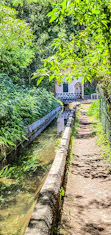
We had a pleasant 3 mile walk along the levada, which wound its way gently downhill. All along the rout, lizards darted across the footpath as we approached them. Our way was lined with flowers and trees, many of them eucalyptus. Short stretches of the levada were shaded by bushes and trees. Other stretches provided views down wooded valleys. Sometimes, the port of Funchal could be seen far away and far below us. Most of the pathway was without hazards, but short lengths of it ran alongside sheer drops. Eventually, we reached the compound of the Jasmine Tea House, which caters for British tastes (cakes, scones, etc.) We did not have time to sample its wares because we did not want to miss the next bus (route 47) back to central Funchal.

Although we walked along a tame stretch of levada, we were able to gain an impression of Madeira’s remarkable network of irrigation channels.

Standing on a bench in Funchal, Madeira

ON THE FLIGHT FROM Stansted to Funchal, I sat next to a young man who was born in Madeira and now lives in the UK. He told me that we were just in time for the grand parade of the island’s annual flower festival. It would be happening on the afternoon of Sunday, the 30th of April (2023) at 430 pm, and that it always attracts large crowds.

At about 2.50 pm on the Sunday, we found an empty bench on the Avenida do Mar. This is a wide dual-carriageway that runs close to the seafront. Our bench was beside one of the carriageways. The parade was due to proceed along the other carriageway. By as early as 3 pm, people were gathering on the grassy divider that separates the two carriageways. They were between us and the route to be taken by the parade. More and more people assembled there, and we wondered how we would be able to see the proceedings.

At about 3.30, an elderly English couple joined us on the bench. We did not speak with them until a few minutes before 4.30. Then, the rather frail looking old lady said to us:
“We’re going to stand on the bench to watch the floats pass by.”
I had thought about doing this but had been concerned about the stability of both the bench and me. But when this older lady and her even older husband climbed on the bench we joined them.

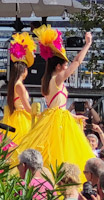
The colourful floats covered with floral decorations and lively girls and ladies moved a little faster than snail’s pace. They were separated by crowds of girls in folk costumes, who were singing and dancing as they proceeded. From our vantage point, we could see the floats easily, but the dancing girls were mostly hidden by the crowds on the grassy divider; only their headdresses could be seen.

After three floats had passed, the lady hopped off the bench, and said to me:
“We’ve got to go now. We don’t want to miss our team, Liverpool, playing.”

All this goes to show that one should never judge people by how old they look. Even some the oldest members of our species can be surprisingly full of life.

Places called London

MANY YEARS AGO, I used to visit Yugoslavia frequently. I stayed with friends in both Sarajevo and Belgrade. During almost every stay in Belgrade, several friends and I used to travel to the town of Novi Sad to eat good Chinese food in a restaurant called Szećuan. We used to order, and consume everything on its menu. This food was washed down with copious amounts of alcohol.

After one if these boozy lunches, we began walking to the railway station and as we passed a pub called Bar London, my friend Miša said to me:
“It would be surrealist if you take us for a drink in this bar”.
We had one or more ‘for the road’, and then staggered towards the station.

This memory was aroused by coming across the Restaurante Londres in central Funchal (Madeira). We ate dinner there. The food was excellent. For the first time in my life, I ate limpets. These aquatic snails were grilled in their shells with butter and garlic – they tasted wonderful. The other dishes we tried were so good that we have booked there again.

Returning to the past, if I recall correctly, there was also a restaurant or bar called London in central Belgrade, but oddly I never entered it.

Looking familiar in Funchal

THEY STAND SIDE by side on a pavement outside a post office on the sloping Avenida Zarco in central Funchal. There are two sets of them. In each pair, one is painted red, the other is blue. They are postboxes (letter boxes). These cylindrical mailing boxes have a familiar look about them, especially if you live in England.

Having seen several old British style post boxes in various places in India, seeing these boxes in Funchal aroused my curiosity. I looked at their bases. The two red boxes had no manufacturer’s marks. However, both the blue ones had the following on them in English: “Cooperative Industrial Society”. This suggests that at least these two boxes were made in the UK. It appears that many Cooperative Industrial Societies have existed. So just by looking at them, it cannot be said exactly where these boxes were made. In any case, it seems that these items were imported from the UK.

As for the two colours – red and blue – there are two postal methods/speeds in Portugal. Red boxes are for normal mail, and blue for priority or express mail.

Where the Portuguese landed

A GUIDE BOOK to Madeira suggested that before the Portuguese set foot on Madeira, there had been others from different places. Some of these earlier settlers are said to have been travelling on an English ship from England to Portugal. However, the boat was blown off course and ran aground on the shore of Madeira, near where the town of Machico stands today. Two of the passengers on the ship were the English lovers Robert Machim and Anne d’Arfet, who were fleeing England where their relationship was not approved of. They are supposed to have died on the island. Later, their (?) graves were discovered. Fascinating as this is, the veracity of the story is questionable.

18th century fort in Machico

What is most certain is that the Portuguese Joao Goncalves Zarco and Tristao vaz Teixeira landed on the beach at what is now Machico in July 1419, and in so doing helped initiate the erstwhile worldwide Portuguese empire.

In 1440, Teixiera and his descendants were awarded the Captaincy of Machico – the first on the island of Madeira. In the middle of the 15th century, the settlers on Madeira began growing sugar cane. In those days, sugar was a valuable commodity, much desired in Europe. The prosperity of Machico increased.

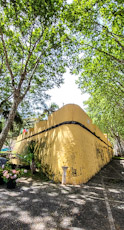
Today, Machico is a pleasant town with a promenade running along the seafront. Three churches survive from earlier times. We visited the Igreja de Nossa Senhora da Conceição, whose construction was completed by the end of the 15th century. Between it and the sea front, there is a small fortress – Forte de Nossa Senhora do Amparo, which was constructed in about 1706. We saw a few market stalls next it. One if them, a florist, was selling gorgeous pink proteas.

Machico is a 50 minute bus ride from Central Funchal, the city that replaced it as Madeira’s capital by the early 16th century . The journey is spectacular with great views of the sea and the mountains, but because of the incredible windiness of the roads, it is not ideal for those prone to motion sickness.

An amazing bookshop in Madeira

I AM ADDICTED to visiting bookshops. In the heart of Madeira’s capital, Funchal, not far from the cathedral in a steep narrow street stands the Livraria Esperança. Founded in 1886, this bookshop is the largest in Portugal, and maybe one of the largest in Europe. It is housed on three storeys of an 18th century Palace. On each floor, there is a veritable warren of rooms, each filled with books and magazines.

The unique feature of this well stocked bookshop is that each book is displayed so that its whole front cover can be seen. This differs from many other bookshops in which most books are shelved so that only their spines can be seen. Many of the books in the Livraria are held between the jaws of clips hanging from pegs on the bookshelves.

Although books are arranged according to subject matter in different rooms, within each of these rooms the books seem to be randomly arranged. For example, a book about Salazar might be hanging between one about Roman archaeology and another about East Timor. I am not sure how the salespeople lay their hands on a particular volume that a customer requires.

More than 99% of the books are in Portuguese. There is a small collection of books in other languages. I do not understand Portuguese sufficiently well to read a serious text in that language. So, sadly I left the wonderful shop without having made a purchase.

Flying with Ryan

THE FIRST TIME I flew with Ryanair was to and from Friedrichshafen in Bavaria. On the return journey, I asked a lady at an information desk whether our flight was on time or running late. She replied:
“Ryanair never runs on time.”

Since November 2022, we have made 13 flights – some domestic and others international. Of these, the majority did not run on time and many of them had aspects worthy of criticism.

Today, the 27th of April 2023, we flew yet again. We flew from London’s Stanstead Airport to Funchal in Madeira. Both the ground staff and the crew on board were both friendly and efficient. The flight departed two minutes early and arrived at exactly the scheduled time. And the airline was … Ryanair!

Dwarfed by a cruise ship

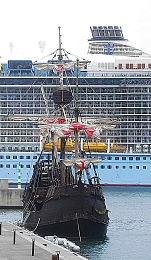
DURING THE ELEVEN days we spent in Funchal, the capital of Madeira, the city was visited by two enormous cruise ships. Resembling huge blocks of flats (apartments, my North American friends!) floating on water, they arrived in the port at night, remained a whole day, and then departed the next evening.

When these vessels disgorge their cargos of tourists, the centre of Funchal becomes crowded; the queue t the cable-car grows longer; and the frequency at which toboggans slide down from the Monte increases.

The port at Funchal is designed to accommodate these ‘humungous’ people carriers, so their arrival does not have the same damaging effect (on buildings and the shoreline) as is created by them in Venice (Italy). Cruising in vessels of this size appeals to many but not to me.

Amongst the agapanthus

We visited Funchal in Madeira in early June 2022. Although we were recommended to visit some of the numerous botanical gardens in and around the city, it was hardly necessary. I do not think that I have ever visited a place filled with such a profusion of flowers as is the case for Funchal. The whole city seems to be one great garden.

During our visit, we were in time to see a vast number of blue flowered agapanthus plants. Although they are commonly known as ‘lily of the Nile’ or ‘African lily, they are not of the lily family. They are members of the Asparagales order of plants, a part of the Asparagus genus. Had I not seen so many of these flowers in Funchal, I might never have bothered to find out anything about them. As the saying goes, travel broadens the mind.