The hole truth

AFTER AN INTERESTING visit to the Bank of England’s museum, we headed north east to Brick Lane. Our destination was Beigel Bake at number 159. Not to be confused with its near neighbour, Beigel Shop, the far superior Beigel Bake, which is open 24 hours a day, was established in 1974. Although now a separate business from the Beigel Shop, the two places were originally the same business, as is recorded in an online article (https://londonist.com/london/food/things-you-probably-didn-t-know-about-beigel-bake):
“Although widely seen as rivals, the two shops were originally owned by the same family. Brothers Asher and Sammy Cohen started off working for another brother at The Beigel Shop next door, but eventually branched out to 159 Brick Lane in 1976. When the brothers aren’t putting in a shift, Nathan Cohen, one of two sons can be seen overseeing the sale and production of the 2,000-3,000 beigels baked in-house every day.”
I am uncertain whether the brothers are still with us or whether Nathan still oversees the place. In any case, Beigel Bake is well worth a visit. We did so today, the 4th of April 2023.

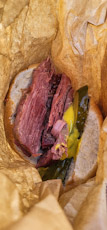
A few weeks earlier, we ate salt beef (Reuben)sandwiches at Selfridge’s Brass Rail eatery, which I have described elsewhere (https://adam-yamey-writes.com/2023/03/25/the-brass-rail/). We went to Brick Lane both because we were hungry and, also because we wanted to compare the salt beef on offer there with that we ate at Selfridges. After waiting in a long, but fast-moving queue, we were served our beigels, stuffed full of warm salt beef, some mustard, and slices of pickled gherkin.

Beigel Bake salt beef in a beigel (bagel)

As the Beigel Bake does not offer any seating, one has to eat the generously filled beigels elsewhere. At the Brass Rail, you can sit at a comfortable table, where a waiter brings the salt beef sandwich to you. The salt beef served at Beigel Bake is much tastier than that at the Brass Rail. Unlike the latter, Beigel Bake does not put sauerkraut and cheese into the sandwich. Without those ingredients, the salt beef tastes far superior to when they are present. In addition, the beigel suits the salt beef much better than the rather soft bread used at the Brass Rail. In brief, to my taste the Beigel Bake offering is far superior in all respects to that of the Brass Rail.

As mentioned, at the Brass Rail you can sit and eat your sandwich comfortably. However, currently the sandwich costs £14.95 to take-away (more if you eat-in). In contrast, a salt beef beigel with pickle and mustard, currently costs £6.00 at Beigel Bake. What you get at the Brass Rail is definitely not worth £8.95 more that at the less pretentious Beigel Bake, and it seemed like there was more beef in the latter’s offering than in the former.

A word of advice: do not bother with the nearby Beigel Shop even if there is a long queue at Beigel Bake – it is well worth the wait.

Freshly painted frescos at Tate Britain

FRESHLY PAINTED FRESCOS

UNTIL I WAS SIXTEEN, my parents took me to Florence (Italy) every year, except in 1967 – the year after the city had been devastated by a flood. My parents were crazy about Italy, the Italians, and Italian art. In Florence, we used to view many frescos in churches and palaces and even those removed from their original locations and placed in museums.

Traditional fresco painting was a laborious process, which produced durable images on walls and ceilings. To create a fresco, first a couple of layers of plaster are applied to a surface (wall or ceiling) and allowed to dry. Then, the artist(s) sketch the image that will eventually be created. Next, a part of the sketch is covered with fresh plaster. The extent of this is the area which the artist can paint during one day. While the plaster is damp, the artist paints that section of the picture with water-based coloured paints. As the plaster dries, the paint becomes incorporated within it, producing a surface more durable than if the paint had been painted onto dry plaster. Day by day, section by section, the process is continued until the whole image has been finished.

I mentioned that some frescoes have been moved into museums. The Italians developed a method for doing this. The fresco to be moved is covered with a cloth sheet coated with adhesive, Then the cloth is pulled away from the wall or ceiling. As it is peeled away, it takes with it that layer of the fresco that contains the paint-absorbed layer of plaster. When this layer has been removed, the artist’s sketch becomes revealed. This is of great interest to historians of art, who can learn how the artist developed his final product from his original sketch. This whole process fascinated me when I was a child, and still amazes me.

Most of the great Italian frescos were created many centuries ago, and the process has fallen out of fashion. Well, at least that is what I believed until I visited a lovely exhibition at Tate Britain. On show until the 7th of May 2023, it is a display of works created by Hannah Quinlan (born 1991) and Rosie Hastings (born 1991). They have created six large, colourful images depicting, to quote the Tate’s website:


“…street scenes showing groups of people portraying various power dynamics, class and social relations and positions of authority.”


Attractive and fascinating as these works are, what really intrigued me is the way that they were made. The paintings, which have been created during the last few years, have been executed using traditional fresco technique such as I described above. In an interview recorded on the Tate website, they were asked why they used this archaic technique, and they replied:


“Fresco painting is often found in places of political, legal and educational importance and is executed at a monumental scale. Traditionally, frescos depict scenes loaded with ideology and symbolism while presenting themselves as neutral or universal. A fresco often represents the moral code of the time within which it is painted, intended as an instructional and educational medium that reinforces dominant perceptions.”


I can understand this, and like their reasoning. I enjoyed the exhibition, and encourage others to take a look. Enjoy the frescos, but do not omit to examine the lovely drawing the artists created using graphite.

ART AND ARCHITECTURE IN A MAYFAIR GALLERY

ONE OF THE MANY JOYS of visiting London’s commercial art galleries is, apart from seeing the works of art on display, viewing the architecture of the galleries. Today, the 1st of Aoril 2023, we made a brief visit to the Bernard Jacobson Gallery in Mayfair’s Duke Street St James. Most of the exhibition space is in the basement. However, who ever designed the place has done something both spectacular and intelligent. Part of the ceiling of the basement has been removed to reveal above it a two or three storey high lightwell,which admits ample daylight to augment the artificial illumination in the rest of the basement.

The exhibition we viewed, which continues until the 28th of April 2023, is of paintings by the German artist Bernd Koberling (born 1938). His large works, executed in a variety of materials, are colorful abstracts. Even though they are abstracts, they bring to mind plants and other natural phenomena including reflections in watery surfaces.

I liked the pictures, but could not help being distracted by the gallery’s eye-catching design.

Pioneers of making selfies?

THE LONDON-BASED ARTISTS Gilbert Prousch (born 1943) and George Passmore (born 1942) first met whilst they were studying sculpture at the St Martins School of Art, where, incidentally, my mother created sculptures in the 1950s and early 1960s. From the late 1960s onwards, most of their creations have portrayed themselves, usually together, in an incredible variety of poses and situations. One might say that they were pioneers of selfie-making.

On the 1st of April, Gilbert and George (‘G+G’) opened their new establishment, The Gilbert & George Centre, in London’s Heneage Street near Spitalfields and Brick Lane (see https://gilbertandgeorgecentre.org/). I have yet to visit this new gallery, and look forward to doings so soon. To coincide with this new venture, the White Cube Gallery in Mayfair’s Masons Yard is holding an exhibition of works by G+G until the 20th of May 2023.

Called “The Corpsing Pictures”, this exhibition at White Cube consists of G+G posing as corpses in a range of different settings. In each picture, the two artists are portrayed lying as if dead but fully dressed in their characteristic smart suits. In many pictures, images of bones have been included in the compositions. At first sight, these pictures, which look like stained glass windows, appear somewhat macabre, but soon the viewer becomes aware of the playful and often punning nature of the images. Each composition is compelling visually and together the collection is a stunningly beautiful sight.

I suspect that the crowds at the Heneage Street Centre will be great for the first few weeks after its opening. So, if you want to see some good examples of the works of G+G without being bothered by too many other viewers, I recommend that you head for the White Cube in Masons Yard.

Morandi or bore-andi

CALL ME A PHILISTINE if you wish but I was underwhelmed by the much-hyped temporary exhibition of the works of the Italian artist Giorgio Morandi (1890-1964), which is being shown until the 28th of May 2023 at the Estorick Collection of Modern Italian Art in London’s Canonbury district. Morandi, who was born in Bologna (Italy), where he lived most of his life and died, was primarily a still-life and landscape artist. Without doubt, his works are both carefully and extremely well executed. However, his numerous still life works depicting bottles, jars, and other containers, did little to excite my interest in them. His landscape images appealed to me more, but not much more. For me, almost the best work in the show is a self-portrait, showing Morandi seated.

Compared with the other works in the Estorick’s permanent collection (e.g., Balla, De Chirico, Modigliani, Boccioni, Music, Greco, Manzu, and Russolo), all of which are highly creative and visually exciting, poor old Morandi’s work pales into insignificance. Having expressed my opinion about the temporary exhibition, I must admit that many of the other viewers I saw today seemed to find Morandi’s works of great interest. Many of them stood staring intensely at individual works for minutes rather than a few seconds. Few of the works in the exhibition grabbed my attention for more than a few instants.

Well, maybe I missed something that other people see in Morandi’s art, but if someone were to give me a genuine Morandi, I would sell it as quickly as possible, and might spend the money on a work by a more interesting Italian artist.

Art of heros

GEORGE FREDERIC WATTS (1807-1904) was a prolific, highly acclaimed Victorian artist. Visitors to London’s Kensington Gardens can easily admire one of his works, a sculpture called “Physical Energy”. Standing across the Serpentine from a sculpture by Henry Moore, Watts’s sculpture is a bronze casting of a version of it that was sent to South Africa as part of a memorial to Cecil Rhodes. One of Watts’s less prominent works, and quite a curious one, can be seen in Postman’s Park, which is a few yards north of St Pauls Cathedral in the City of London. It is the Memorial to Heroic Self-Sacrifice.

The memorial consists of a wall covered with rectangular plaques, made with ceramic tiles commemorating heroic deeds carried out by ordinary people. For example, one bears the words:
“Frederick Alfred Croft. Inspector aged 31. Saved a lunatic woman from suicide at Woolwich Arsenal Station but was himself run over by a train. Jan 11, 1878”.
And many other examples of great bravery by civilians are recorded on the wall, which is protected by a canopy with a decorative fringe.

By Susan Hiller

The artist Susan Hiller (1940-2019) was born in Florida (USA) and died in London. Apparently, she was surprised by how few people noticed the memorial in Postman’s Park, let alone read the tragic plaques. I am one of the few, who have done so. So, as soon as I got near to an artwork displayed in a temporary exhibition in the Tate Britain art gallery, I knew it was based on the plaques in Postman’s Park. The piece consists of 41 photographs of plaques on the Memorial, which have been arranged on a wall by Susan Hiller. In the centre of this artistic array that she has called “Monument 1980-1”, she has placed a plaque which consists of a stretch of tiling on which the words “Strive to be your own hero” have been crudely written with black paint.

Susan Hiller’s interesting version of GF Watts’s Memorial is one of several intriguing exhibits in an exhibition called “Material as Message”, which was still being installed when we visited it in March 2023. There is yet one more exhibit to be unveiled. Hiller’s exhibit interested me because I am familiar with Postman’s Park, but the other exhibits were equally fascinating both visually and conceptually.

His last mural

THE SERPENTINE NORTH art gallery is housed in what was once a gunpowder store, built in 1805. Next to it, there is an elegantly curvaceous café created by the Iraqi-British architect Zaha Hadid (1950-2016). Until the 3rd of September 2023, there is an interesting exhibit behind the north side of the café. It is an abstract mural of brightly coloured, differently sized rectangles and squares. When I showed a photograph of this to our daughter, she said it reminded her of African printed textiles. Maybe, this should not be surprising suggestions because the mural was painted by a Ghanaian artist, Atta Kwami (1956-2021), who was born in Accra.

The mural, painted on wood, is titled “Dzidzɔ kple amenuveve”, which means ‘Joy and Grace’.

The Serpentine’s website noted:
“Its title is in Ewe, a West African language spoken by Kwami, and its composition characteristically plays with the colour and form improvisations distinctive to Ghanaian architecture and strip-woven textiles found across the African continent, especially kente cloth from the Ewe and Asante people of Ghana.”

Sadly, the mural is the last public work that Atta Kwami created. He died in the UK shortly after he completed it.

Knots, threads, and folds

THIS MARCH (2023), we have seen several exhibitions of works of art and craft involving the use of braiding, knotting, weaving, and other methods of employing threads. We saw the exhibition of Kimohimi braiding at the Japan House in Kensington. At the Tate Modern, we saw the quipus created by Chilean Cecilia Vicuña and the wonderful exhibition of imaginative fabric sculptures made by the Polish Magdalena Abakanowicz. Today, the 26th of March, we visited the Serpentine North (formerly ‘Sackler Serpentine’) Gallery in Kensington Gardens. We visit this place often because it usually has exhibitions which are always of interest and frequently pleasing aesthetically. Until the 10th of April 2023, the Serpentine North has a display of sculptures by the African American artist Barbara Chase-Riboud (born 1939 in Philadelphia, USA). We had never heard of her, but that did not surprise us as the gallery often shows works by artists, who are new to us.

A talented child, she entered the Fleischer Art Memorial School in Philadelphia. This establishment, which was opened in 1898, offered free art classes to children. After a successful school career at the Philadelphia High School for Girls between 1948 and 1952, she was awarded Bachelor of Fine Arts from the Tyler School at Temple University in 1956. By 1960, she had moved to Paris (France). Just before that, her eyes were opened-up to non-European art when she made a trip to Egypt.

The beautifully produced exhibition hand-out related that in Paris, she:
“… found herself among a diverse community of socio-politically engaged writers, artists and thinkers including James Baldwin, Alexander Calder, Max Ernst, Dorothea Tanning, Lee Miller,and Man Ray. Moreover, through extensive travelsto Egypt, Turkey and Sudan, she deepened herknowledge and appreciation of global art and architecture, which continued to shape her artistic production from this point onwards.”

The Serpentine exhibition is called “Infinite Folds”. This is a good name because many of Barbara’s works involve the use of folded materials, be they sheets of fabric or of cast metal. In many cases folded sheets of metal are combined with bundles of silk or wool threads, often knotted in places. Some of the metal sculptures appear to have skirts of fabric threads. The artist makes these works seem as if the metal is being supported by the threads – giving, as she said, the impression that the wool has become the stronger material and the folded metal sheets the weaker of the two.

Some of the works are the artist’s interpretations of ancient cultures and traditions of places she has visited such as India and China. Other artworks celebrate famous figures from the past including Josephine Baker, Malcolm X, Nelson Mandela, the Queen of Sheba, and others.

The works in the exhibition are intriguing, well-crafted, and beautiful. They have been placed attractively and well-spaced in the within the old armoury, now the Serpentine North Gallery. When we headed for the exhibition, we had no idea what to expect. What we found was breath-takingly wonderful. Although there is no entry charge, I would have been happy to pay to see this artist’s works.

Getting knotted at the Tate Modern

LONG AGO PEOPLE in the Andes did not write. Instead, as Chilean artist Cecilia Vicuña (born 1948) explained in a note on the Tate Gallery website:


“… they wove meaning into textiles and knotted cords. Five thousand years ago they created the quipu (knot), a poem in space, a way to remember…”


After the Europeans conquered South America, they abolished and burnt the quipus. However, as the artist explained:


“… the quipu did not die, its symbolic dimension and vision of interconnectivity endures in Andean culture today.”


Cecilia has created two large sculptures which are hanging from the tall ceiling of the Tate Modern’s Turbine Hall until the 16th of April 2023. Each of these artworks consist of knotted strands of different materials, each of which is 27 metres long. They hang from circular metal structures looking to me rather like shredded laundry. Though they are undoubtedly deeply meaningful and attract the attention of many viewers, I felt the history underlying them was more interesting than their aesthetic qualities.

Abakanowicz

Elsewhere in the Tate Modern, we viewed an exhibition of the works of an artist, who knew how to write, but was creating during a time when the use of words had to chosen carefully to avoid being punished by the government. That artist Magdalena Abakanowicz (1930-2017), was born in Poland, where she created most of her art. After WW2, she studied painting and weaving the Academy of Plastic Arts in Warsaw. Her early works were created during a period when the Soviet-supported Stalinist regime in Poland imposed great restrictions on creative endeavours. During that harsh period, artists had to express any criticisms of the regime in a coded way in order to evade censorship. To some extent, this was necessary until Communist rule ended in Poland. In the mid-1950s, restrictions on art eased up a bit and experimentation became possible.

Magdalena moved from creating flattish conventional woven pieces to innovative three-dimensional artworks – woven sculptures of great originality. Photographs cannot do justice to these amazing creations. Videos can help the viewer appreciate the amazing way that these tapestries both fill and engulf space. However, the best way to see these works is to see them with your own eyes, which you can do at the Tate Modern until the 21st of May 2023. Included in the exhibitions are photographs of the lovely sculptures the artist created in later life and some videos of the artist talking about her work. There is also a film made in 1970 in which her tapestries are displayed on the sandy dunes of Poland’s Baltic coast. The artworks are suspended from poles and move gently in the sea breeze. It is clear from this film, which included scenes showing the fabric sculptures in galleries, that the artist seemed keen to have viewers explore them by touch as well as by vision. Sadly, and probably sensibly, the Tate forbids visitors from touching the lovely artworks.

Both the Vicuña and the Abakanowicz artworks use knotting and weaving to communicate ideas with the viewer. A window in one of the Abakanowicz exhibition rooms overlooks one of the quipu artworks. It intrigued me to see the juxtaposition of the works of the two fabric artists. Seeing these two exhibitions, one immediately after the other, made for a fascinating visit to the Tate Modern.