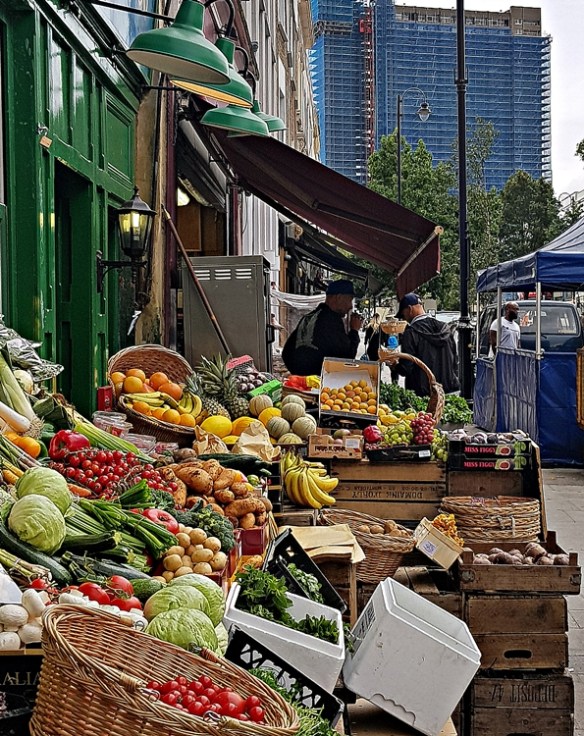
Trellick Tower in background
tall Trellick and grim Grenfell towers,
market stalls:
Portobello Road

Trellick Tower in background
tall Trellick and grim Grenfell towers,
market stalls:
Portobello Road

dendrites bifurcating
endlessly dividing:
any lovely tree
Currently, central London is infested with models of a particular wild beast
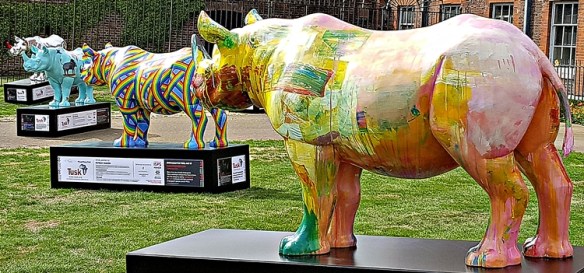
Paraded in a field
like some news, fake:
rhinoceroses glower
In the 1960s, my parents, both art-lovers, used to take my sister and me on annual trips to Florence in Italy.
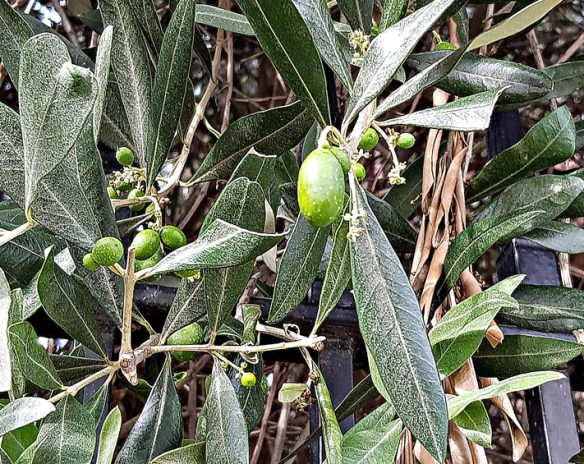
Olives growing near Portobello Rd, Sept 2018
Seeing some olives growing near Portobello Road in London reminded me of these trips. Here is what I wrote in my book, “Charlie Chaplin Waved to Me”, which is about travels I made during my childhood:
“The Oltrarno is the part of Florence on the left bank of the River Arno. It contains major sights such as the Pitti Palace, the Boboli Gardens, the Piazzale Michelangelo, the Belvedere Fortress, and the churches of S Spirito and S Maria degli Carmine. Almost every afternoon included a visit to the Oltrarno. This was made for sartorial rather than cultural reasons. My mother’s dress maker, whose name I can no longer recall, had a small shop near to S Spirito. Maybe, there is a Freudian reason for my amnesia; the visits to his shop filled me with dread. My mother had dresses made in Florence. As I have already hinted, she was a stickler for perfection. The long-suffering dress-maker in the Oltrarno must have valued her custom to have been able to put up with the unending visits we made in order to allow my mother to try the latest version of the garments that he was preparing for her. My father and us two children had to sit in the small narrow shop looking at tatty, well-thumbed magazines full of pictures of dresses whilst my mother and the tailor spent much of the afternoon dealing with the latest stage in the fabrication of her dresses. Our visits to this shop were often prefaced with my mother saying that of course we did need not wait for her there, but we knew better. Our absence would not have been well-regarded.

Adam Yamey at San Miniato, Florence, in the early 1960s
Florence was, and still is, famous for its leather work. My mother was particularly keen on one aspect of this craft: footwear. She liked good shoes, but many of them did not fit her wide feet. So, we tramped around Florence, entering many of its shoe shops and waiting patiently (or impatiently in my case) for her to try on numerous pairs of shoes. Almost all of them were unsuitable for her to wear. One shop whose name still fills me with some dread was that of Salvatore Ferragamo on the Via Tornabuoni. The fact that I remember this high-class shoe store is a testimony to the amount of time that we spent there. As was usual, if any of us showed any signs of impatience, she would tell us that we need not wait for her, but we knew that this was not what she really felt …

San Miniato, Florence. Pic by Adam Yamey in early 1960s
… Florence was not, as you may be beginning to imagine, one long round of paintings, sculptures, shoes, dresses, and brassieres. Many afternoons ended with a trip up to the Piazzale Michelangelo. This panoramic platform or terrace, which is really more of a large open space with one side overlooking the hills sloping down to the River Arno, provides a magnificent view of the city. It is a readymade vantage point for postcard makers and other photographers. A little behind the Piazzale a series of staircases flanked by pine trees leads up to a church with a wonderful black and white marble façade. This is S Miniato al Monte and was our main destination when going up into the hills. This peaceful sanctuary high above the bustling city is undoubtedly a great example of unadulterated 13th century Romanesque architecture.

Cemetery of San Miniato, Florence. Pic by Adam Yamey in early 1960s
After admiring this church, we did not return to the city centre by bus, which is how we arrived. Instead, we walked. We used to descend from the raised terrace in front of S Miniato al Monte and start walking away from the Arno along the level Viale Galileo, which follows a gently sinuous contour along the left side of the river valley. After almost a mile, we would then turn right onto the narrower Via S Leonardo. This road descends gradually, passing the walled gardens of well-separated villas. The branches of olive trees in these gardens overhung the road.
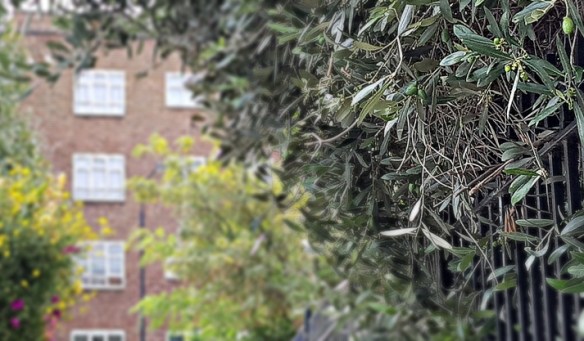
Olives growing near Portobello Rd, Sept 2018
Every year, my mother used to break off a small twig bearing greyish green olive leaves and several, usually unripe, olives. She would take it back to London to remind herself of the great pleasure that she derived from being in Florence.”
I remember finding a sprig of desiccated young olives and dried leaves amongst her possessions long after her early death in 1980.
Adam Yamey’s book “CHARLIE CHAPLIN WAVES TO ME” is a collection of tales of journeys made during the author’s childhood.
In paperback, click: HERE, please
For Kindle version, click: HERE, please

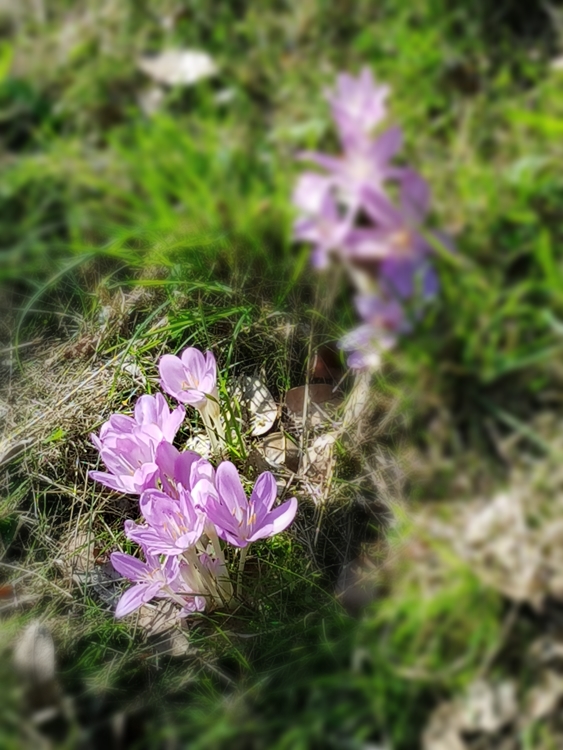
Some trees in the gloaming
swan on the lake
imminently eventide
While away an hour and a bit
On a London bus
Public transport

The graffiti on the wall fades
the stones weather
memories wither

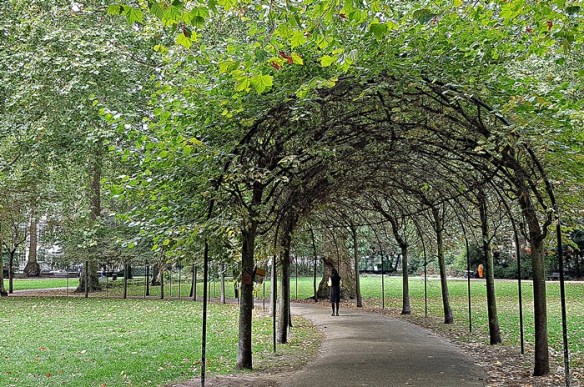
SHE WALKS BENEATH THE ARCHES
HER EYES ON HER PHONE
IGNORING NATURE
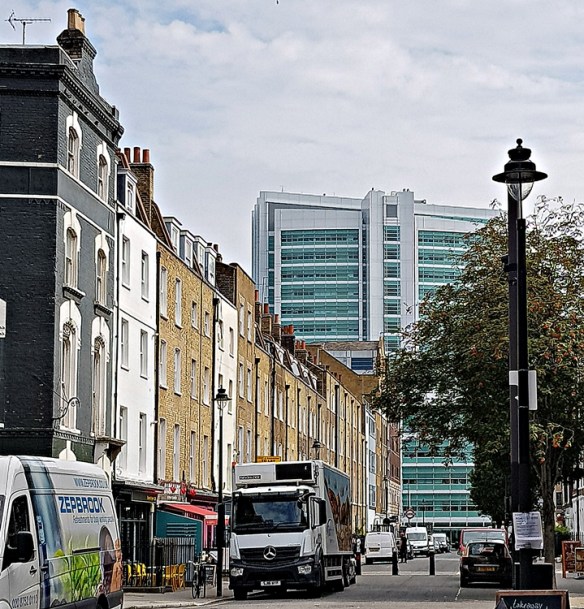
Warren Street is a station on the Northern and Victoria Lines of London’s Underground network. Situated at the intersection of Tottenham Court Road and Euston Road, both important arteries, Warren Street itself is comparatively small and of minor significance in the greater scheme of things. Be that as it may, this short street, which runs south of and parallel to Euston Road, has had some importance in my life.
When the Underground Station was opened in 1907, it was named ‘Euston Road’. In 1908, it acquired the present name. By the time that I began using the station regularly (in 1970), the Victoria Line had been serving the station for two years. Warren Street itself was built in the late 18th century as part of the Fitzroy Estate. It was named after Anne Warren (1737–1807), who married Charles Fitzroy (1737-1797), First Baron Southampton.

In the early 1970s, when I was studying at University College London (‘UCL’), one of my fellow students on my BSc course in physiology was a young Indian girl, Lopa, who is now my wife. She spent a couple of years living at the International Students House (‘ISH’) which faces Great Portland Street Underground Station. She and other Indian students introduced me to really good Indian food. This was served at the now no longer existent Diwan-i-am restaurant on Warren Street. It was here and at other nearby restaurants, such as Diwan-i-khas, Lal Qila, and Agra, that food was cooked by Indians and Pakistanis rather than by Bangladeshis, who operated the majority of so-called Indian restaurants in the UK. While Bangladeshi cuisine might be excellent, much of the ‘Indian’ food cooked by Bangladeshis is less satisfactory.

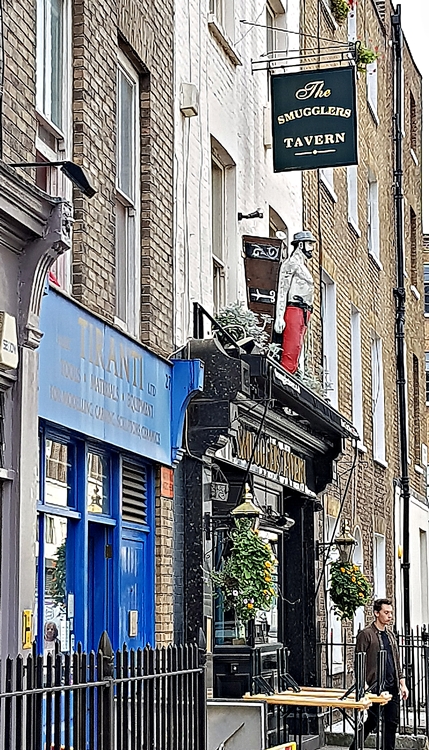
When the Diwan-i-am was in business, so were many car dealers who had their premises on Warren Street. These have long since disappeared. One business that still exists and predates the Diwan-i-am is Tiranti, an important supplier of, to quote their website: “…materials, equipment and tools to sculptors, modelmakers, mouldmakers, designers, prototypers, woodcarvers, stonecarvers, specialist plasterers, building picture and furniture restorers, potters and ceramicists.” Giovanni Tiranti started this enterprise in High Holborn in 1895. The company first began using premises near Warren Street in 1945. I am not sure when the Warren Street shop opened, but it was about 20 years ago at least. I never purchased anything there but my late uncle S, an engineer by profession and a keen sculptor in his spare time, was a regular customer.
I studied at UCL for twelve years. During the last five of these, I was studying dental surgery at the now, sadly, no longer existing Dental Hospital. Warren Street Station was the most convenient place from which to reach the Dental School from my home in Golders Green. It was a few yards from the station to the passage that led from Tottenham Court Road into Mortimer Market, where one part of the Dental Hospital was housed. In those days, the passageway was flanked by an official Iraqi Tourist Office. I used to visit this occasionally to look at the fine exhibitions of photographs shown there. The staff, no doubt agents of the late Saddam Hussein, were friendly. Once, they gave me a gift of four LPs of Iraqi folk music. Many of the ancient sights in the photographs might well now have suffered damage during the troubles that afflicted Iraq long after I had become qualified as a dentist.
There were several photography suppliers’ shops on the stretch of Tottenham Court Road near Warren Street. Their windows displayed a huge range of camera bodies and lenses. I bought my first SLR camera at one of these shops. They have mostly gone now. So also has Sterns. This electrical shop was well-known for its superb stock of African music LPs. Some years after I had left UCL finally (in 1982), Sterns, which opened in the early 1950s, moved from its somewhat aged premises on Tottenham Court Road to a newer shop around the corner on Euston Road. This has also disappeared, but Sterns still goes on in the form of an on-line firm.
One rainy early Monday morning, I emerged from Warren Street Station, and walked to the Dental School. The streets seemed emptier than usual. When I arrived at the school, the doors were locked closed. I was puzzled. Then, I bumped into another student, also soaking because of the weather. Shamefacedly, we realised that we had turned up on a bank holiday.

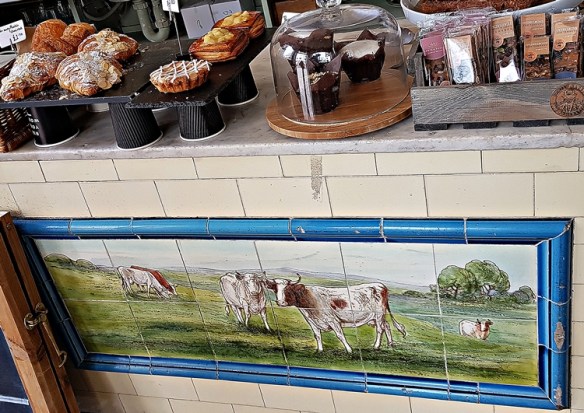
Some time during the mid to late 1970s, a branch of McDonalds opened on the corner of Warren Street and Tottenham Court Road. Occasionally, I used to pop in there for a snack on my way home. Now, some decades later, Warren street is lined with ‘trendy’ eateries, one of which is housed in an old dairy on the corner of Conway Street. Much of the original tilework of the former dairy of J Evans has been preserved. Although there are many newer buildings on Warren Street, a few of the original late 18th century structures have survived.
While Warren Street is not worthy of a long detour, it provides much more than a name for an Underground Station.
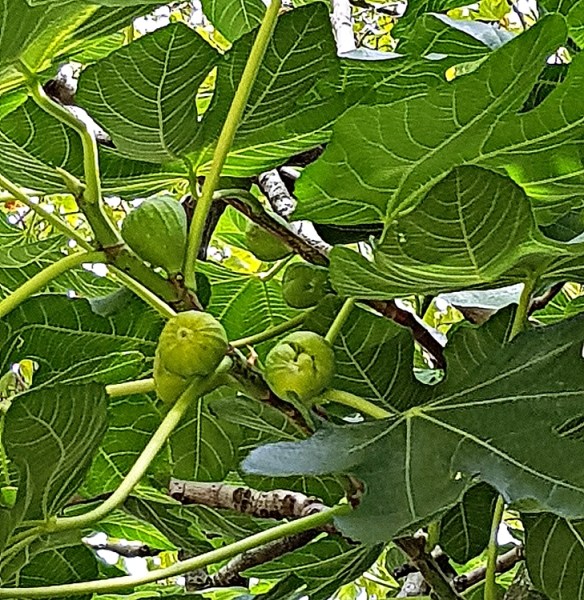
FIGuratively speaking
fruifully regarded:
arborial

 yamey
yamey 