His sister was a pioneer of the labour movement in India

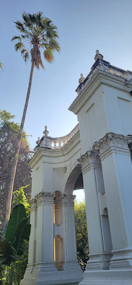
A LARGE WHITE MANSION stands in lovely grounds not far from the Sidi Saiyed mosque in central Ahmedabad. If you look carefully, you will see that in various places the outside of the building has cartouches consisting of an A intertwined with an S.

This edifice was a home of the textile magnate and philanthropist Ambalal Sarabhai (1890-1967).
Ambalal’s sister was Anasuya Sarabhai (1885-1972). She became a pioneer and founder of the women’s labour movement in India. Also, she helped Gandhi set up his Sabarmati Ashram in Ahmedabad.

Initially, Anasuya studied medicine, but gave it up. She was a Jain and dissecting corpses was abhorrent to her. She gave it up, and went to London where, in 1912, she studied at the London School of Economics, where many years later my father became a professor.

In 1914, she organised a textile workers strike in Ahmedabad. No doubt, her brother’s factories would have been affected. In 1917, the Ahmedabad Textile Labour Association (Majdoor Mahajan Sangh) was formed and Anasuya was made its lifelong president by Gandhi.

I do not know where Anasuya lived in Ahmedabad, but seeing her brother’s house made me think of her. [It is possible that she resided in Ambalal’s mansion.]

The villa is now the home of the Shanti Sadan institute.
My father the professor

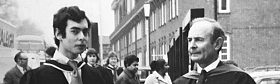
MY FATHER, BASIL Yamey (1919-2020), lived until he was over 101. Between about 1950 and 1991, he lived in our family home in Hampstead Garden Suburb. From my birth until 1982, I lived there, and afterwards I visited my then widowed father almost every weekend.

My graduation in 1973

Dad was an academic, an economist,  at the London School of Economics (‘LSE’). He became a senior professor long before he retired.

Although I have no knowledge of economics even at an elementary level (and this is not me being modest), I lived with an acknowledged leader in the field of microeconomics. Recently, the LSE published some of my memories of living with a professor: my late father. These memories are published on an LSE blog: https://blogs.lse.ac.uk/lsehistory/2022/07/06/at-home-with-basil-yamey-as-recalled-by-his-son/

I hope that you will enjoy these glimpses of the home life of a significant academic.

The Wall

DDR


The Berlin Wall ceased to be a barrier between capitalist West Germany and socialist East Germany in late 1989. It marked the ending of the ‘Cold War’ and the recent collapse of the former USSR. 

At that time, my father made an interesting observation, which I want to sahre with you. He is a retired academic at the world famous London School of Economics (‘LSE’). The LSE had a large number of academics with an expert interest in politics. He told me that the end of the Cold War had come as a complete surprise to his colleagues, who professed to be experts on the subject. Not one of them had predicted either the downfall of the USSR or the ending of the Cold War. I was staggered by this information, and my faith in ‘experts’ reduced a bit.

So, now when I listen to ‘expert’ after ‘expert’ giving opinions on the outcome of ‘Brexit’ and the future of politics in the UK (or elsewhere), I take what they say with the proverbial ‘pinch of salt’.


Picture: The emblem of the DDR, sourced from Wikipedia