ARTIST RODNEY GRAHAM (1949-2022) was born in Canada. There is an exhibition of some of his works at the Lisson Gallery in London’s Bell Street until 11 April 2026, It contains several sets of his artworks.
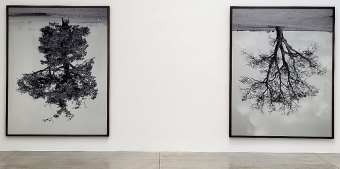
One of the sets is called “Oxfordshire Oaks”. It consists of six oak trees, each photographed with a pin-hole camera. Because the image in the camera appears upside down, Graham made the enlarged prints from the camera upside down. The trees in the photographs are impressive examples of oaks, and look surprisingly good upside down.
Another of the exhibits is a film, “Edge of a Wood”, projected onto two neighbouring screens. This did not impress me, but the third collection that includes image that form part of two installation: “Lobbing Potatoes at a Gong” and “Potatoes Blocking my Studio Door”, was both attractive and amusing.
I had never come across Rodney Graham before. The exhibition at Lisson Gallery was a delightful surprise.
THE PROVOCATIVE CHINESE artist Ai Weiwei was born in Beijing in 1957. He now works in places around the world including Beijing. In 2011, he was arrested in Beijing and held without charge for 81 days. At other times, he has been harassed by the Chinese state. Despite this and his overtly artistic criticism of the ruling regime of the People’s Republic of China and several periods of exile from that country, he now spends some time working in his studio in a house near Beijing. The rest of his time is spent working in various places including Cambridge (UK), Lisbon (Portugal), and Berlin (Germany). At the Lisson Gallery in Bell Street (near London’s Edgware Road stations), there is a small but wonderful exhibition of works by Ai Weiwei, which will continue until 15 March 2025.
The exhibits on display at the Lisson Gallery demonstrate the incredibly inventive and imaginative nature of Ai Weiwei’s creations. Two of the works on display are rusted cast-iron sculptures. Two huge images, one in the style of Van Gogh and the other in the style of Gauguin, are made using many thousands of tiny toy (? Lego) bricks of different colours. From a distance these, and other large pictures made with the tiny bricks seem as if they are painted, but seen close-up it is obvious that the images are a complex mosaic of toy bricks.
Other exhibits also employ Lego bricks. These are not flattish creations like the ones mentioned above, but three-dimensional sculptures. In each case, the artist has taken an object (e.g., a rusting military helmet or a porcelain model of a lion) and partially enclosed it within a structure made of Lego bricks.
Buttons are extensively employed in other exhibits. Ai Weiwei sourced the buttons from the now closed A Brown and Co Buttons factory. The buttons, which are variously coloured, are used like the Lego bricks to produce mosaics depicting words and images. The buttons are sewn on to fabrics and in one case onto a ring of sandals.
Without doubt, each of Ai Weiwei’s creations are based on his interpretation of events historical and contemporary. However, although knowing the ideas behind his artworks adds to the understanding of the show, the exhibition at Lisson Gallery can be enjoyed without any knowledge of what was going through the artist’s head while he was creating the works.
OTOBONG NKANGA WAS born in Kano (Nigeria) in 1974. Her artistic training was carried out in Ile Ife (Nigeria), then in Paris (France). Now, she lives and works in Antwerp (Belgium). I doubt that I would have come across her work had we not visited the Lisson Gallery near London’s Edgware Road, where some of her artworks are on display until the 3rd of August 2024.
The exhibition contains sculptures, two attractive tapestries, and several framed works on paper. The sculptures, which are pleasant enough, are made with materials including clay, glass, and fibres. A leaflet with a text written by the artist describes how she is portraying her connections with nature. Without this text, I would have been hard pressed to realise what she described.
What impressed me most in the exhibition were Nkanga’s delicately executed framed works on paper. These, more than the other exhibits, convinced me that she is a highly talented artist. As I compared them to the sculptural works, I was remined of my thoughts about the artist Damien Hirst. At first, I thought that his works were interesting although often gimmicky, and did not display his deepest artistic feelings. I changed my mind about his inherent talents when, some years ago, I saw an exhibition of his paintings at the White Cube Gallery in Bermondsey. Great artists like Picasso and David Hockney, who are known for their experimental exploration of artistic expression, were, in their younger days, highly skilled exponents of what might be considered ‘traditional’ composition style. This was what I felt about the framed works on paper by Nkanga – although she clearly enjoys experimenting with a variety of media (including with recorded sounds – a soundscape, which is included in the exhibition), she is clearly able to express herself beautifully in the traditional art of sketching and painting.
Had we enough wall space and sufficient spare cash, I would have happily bought several of Nkanga’s lovely works on paper.
DURING OUR TRIP to India in late 2023 and early 2024, we saw works of art that have been created using ceramics. The creators of these ceramic artworks shape clay into a form that they have in mind, glaze it, and fire the object in a kiln. The artists hope that what emerges from the kiln after firing and cooling will resemble what they had in mind. The resulting sculptures and other artworks bear the conceptual imprints of the artists’ visions – usually with considerable accuracy.
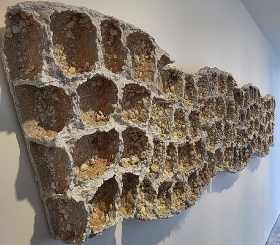
Today, the 7th of February 2024, we visited an exhibition in London’s Lisson Gallery in Paddington. On until the 10th of February 2024, it is a display of the creations of the Japanese sculptor Masaomi Yasunaga (born 1982), who works in Japan. All the exhibits are bizarre but beautiful – quite unlike anything I have ever seen.
Yasunaga is part of an avant-garde group of Japanese artists, Sodeisha, which was formed after WW2. The movement rejected and challenged previous Japanese artistic traditions. It also introduced non-functional ceramic objects as an artform. The objects on display at the Lisson Gallery were created as follows. Yasunaga used glaze rather than clay as his starting material. Combining it with raw materials such as feldspar, whole rocks, metal and glass powders, he created artistic forms. Then, he buried the creations in layers of sand and kaolin, before subjecting the whole lot to heat in a high temperature kiln. After the firing and cooling, the sculptures were carefully excavated from the beds (of kaolin and sand) in which they were fired.
Apart from fusing the various elements of each artwork, the heat of the furnace also produces unexpected transformations (both chemical and morphological) of the work so that although it bears some resemblance to what existed before firing, it has acquired characteristics that the artist would not have been able to foretell. The action of the fire in destroying the artist’s original conception is described by Yasunaga as follows:
“…melting the material and letting gravity take hold of its shape once again, eradicating the ego along the way …”
Further, he explained:
“… the ultimate goal of my art is not self-expression but what’s left of self, after being filtered through fire.”
The effects of the heat are uncontrollable, but as the website of the Lisson Gallery explained:
“… Yasunaga describes how beauty can be discovered in the most uncontrollable situations, referring to the process of his sculptures transitioning in the fire, evolving from something artificial to natural, and yielding a beauty that is perfectly pure.”
Regardless of how and why these sculptures have been created, they are a joy to behold. One of the many roles of an artist is to show us the world in a new light and to open our minds to new ideas. Yasunaga has achieved both aims in a wonderful way.



 yamey
yamey 