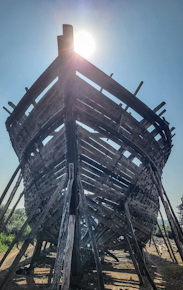
Building boats by hand at a port in Kutch, (Gujarat, India)

THE SEAPORT MANDVI in the Kutch district of the Indian state of Gujarat was founded by Maharao Khengarji I, the ruler of the kingdom of Kutch, in 1580. It became an important, thriving centre of trade for several centuries. And for over 400 years it has been a place where dhows have been built. Today, these huge wooden ships can be seen in various stages of construction along the banks if the Rukmavati River on whose shore lies the town of Mandvi.


The dhows are constructed largely by hand as they have been done for over 400 years. They are built with timber, sal wood, imported from Malaysia. Today, the timber is landed at the port of Kandla in Kutch  a d brought by road to Mandvi.


According to an article in the The Hindu  newspaper dated April 2017:

“As maritime trade grew, traders—belonging to the seafaring Kharva community of both Hindus and Muslims—developed a new expertise: boat-making and repairing to add to their traditional navigational skills.”


Furthermore ,  the arti le related, the dhows:

“… built by hand by craftsmen who are barely literate and have no training in engineering, the ships come up expertly without so much as a sketch being referred to.”

I found this to be quite amazing.


The dhows take several year to be built. When they are completed,  they are usually  towed to the Persian Gulf where they are fitted with engines. Occasionally,  engines are fitted in Mandvi.


Having been fitted with engines in the Gulf, they return to Mandvi with a small crew. Back in Mandvi,  the dhows are loaded with cargo and a larger crew before sailing back to the Middle East.  About a year after they have been completed,  the dhows are sold in the Gulf or East Africa.


Whereas in the past, the dhows had a capacity of about 40 Tonnes, some of those being built today can carry up to 2000 Tonne.


Whenever we visit my wife’s cousins, who lives close to Mandvi, we take a walk along the road next to stretch of shore where the dhows are being made. The huge timber structures, upon which men are assembling the ship using hand held tools. The workmen appear to cling to the beams of timber as they worked on the ship. They do not wear safety harnesses.


The ‘embryonic’ dhows are surrounded by piles of uncut timber as well as the planks that have been cut prior to being attached to the ships being constructed.  Apart from the building  materials, the area contains numerous stray dogs and the occasional foraging cow.


Mandvi is about 250 miles northwest of Alang (in Saurashtra,  Gujarat),  which we have visited. It is in Alang that ships that have reached the end of their lives are broken up. I was interested to read in The Hindu article that in Mandvi:

“The boat-makers use old generators discarded from dismantled ships lying in Gujarat’s Alang ship-breaking yard. These are then modified by installing gear boxes in them and converted into boat engines.”


I have no idea for how much longer  the handmade dhows will continue to be built in Mandvi. So, if you are able, a visit to Mandvi to see this traditional boat building  is well worthwhile. It is handicraft on a huge scale.

Where royalty was cremated in Kutch (Gujarat)

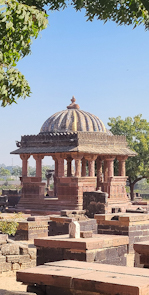
WHEN RAJPUT ROYALTY were cremated, their ashes were taken to be immersed in a holy river, usually the Ganges. However, at the spot where they were cremated, a memorial was erected, often in the form of a chhatri: a stone canopy supported by pillars. Often, the chhatris were quite elaborate and highly ornamented.

Next to one of the lakes in Bhuj, lies the city’s Chhatedi, a large area containing the chhatris (cenotaphs) of the Jadeja rulers of Kutch. Sadly, these cenotaphs suffered much damage during the earthquake of 2001. Thus, today the Chhatedi of Bhuj has become a picturesque set of ruins.

Although this is our fifth visit to Bhuj, it was only this time (December 2025) that we took a close look at the Chhatedi, now a site maintained by the Archaeological Survey of India. Apart from the remains of the grander chhatri, there are many smaller memorials. Often these bear a pair of carved footprints. I imagine that these smaller cenotaphs commemorate the cremation sites of lesser members of the Jadeja families: wives and children. One chhatri is particularly interesting because its roof is decorated with coloured tiling.

Surprisingly, the Chhatedi of Bhuj is one of the sights in the city that is less visited by tourists. It seems to be popular with young couples, who sit in shady spots passing the time of day. When we visited it one morning, there were few other tourists, but a party of local school children were being taken to see the place. They were in their pre-teens. What struck us was that many of these little girls were wearing lipstick, presumably to appear smart on their outing.

The Chhatedi provides great opportunities for photographers. While we were at the site, we saw a family of Indian tourists arrive at one of the larger cenotaphs. Their small daughter was dressed in her finest clothes. Her father got her to pose in front of a statue of a musician on the largest and most elaborate chhatri, and then clicked a photograph. Immediately after that, he told his family:
“Chalo” [‘let’s go’], and they exited the site. In my opinion, that was too rapid a visit. To enjoy exploring the Chhatedi, you should set aside about 30 to 45 minutes.

Although no longer recognised by the Government of India, the Jadeja royalty are held in high regard by many people in Kutch. During a conversation with a member of the family, he told us that the cremation of his grandfather, the last Maharao of Kutch, could not be carried out at the Chhatedi because the authorities would not allow it. In future, cremations of members of the former Royal family will probably no longer be performed in the traditional place: the Chhatedi of Bhuj.

The loss of an earring made by a jeweller in Bosnia

ONE MORNING IN Kutch (part of Gujarat), we set off to see a historical monument not far from the town of Mandvi. On the way, we stopped at a cash machine (ATM) to withdraw some cash.

We inserted the debit card and the appropriate PIN code. After keying in the amount we wanted, the machine made the normal noises, and then asked us to remove the cash and our card. To our great dismay it delivered no cash. Yet, we received an SMS stating we had just withdrawn the amount of cash we had keyed in. This worried us greatly.

Fortunately, there was a branch of our bank near the ATM. We spoke with the manager, and explained what had happened. After taking a few details, he resolved the situation and instructed the cashier to give us the cash we had wanted. From his desk, he also managed to ascertain that the ATM had suffered a technical problem.

We drove on towards our intended destination. Despite information on the Internet and on noticeboards, all of which suggested that the place would be open, it was closed. The watchman at the gate explained that the attraction was closed for repair. However, he let us go in for a couple of minutes, after telling us that if anyone saw us enter, he would be in big trouble.

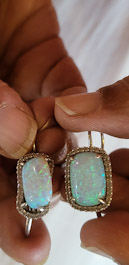
After this second mishap of the day, our driver took us to see a lovely Hindu temple a few miles away. As we began walking around the place, my wife noticed that one of her earrings had become detached. It was one of a pair that a jeweller in Sarajevo (Bosnia) had made. The pair had been made by the uncle of one my Bosnian dental patients, who, having been pleased with my dentistry, had given them to me to present to my wife. These earrings were of great sentimental value, and Lopa was most unhappy to have lost one.

After retracing our steps in the temple compound and failing to find the piece of jewellery, we decided to return to the bank and the ATM, where during the panic of the debit card problem, it might have fallen. On the way, we returned to the closed visitor attraction. We asked the watchman of he had spotted the earring. He had not.

So, we decided to search the part of the driveway, where we had stopped earlier. Lopa and I looked around in vain. Then, our driver joined the search. Within a couple of minutes, he found the earring in the gravel of the roadway. Sadly, either something had driven over it or stepped on it. The earring was intact but the silver stone setting had been distorted. We will have it repaired by Kalim, our skilful jewellery repairer in Bangalore.

They say things happen in threes. That was the case that morning in Kutch. Fortunately, two of the three problems were resolved in a good way.

Africans in a royal procession in Kutch painted in 1876

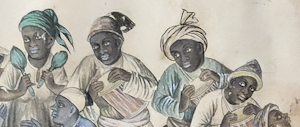
WHAT REMAINS OF the Aina Mahal Palace in Bhuj (Kutch, Gujarat) after the powerful earthquake of 2001 is now open to the public as a fascinating museum. One of its many remarkable exhibits is a painting, which is 15 metres long and 22 cm wide. Painted in 1876 by Mr Juma Ibrahin Wadha, it depicts in minute detail a Kutch State parade during the reign of Maharao Pragmalji II, who was on the throne between 1860 and 1875.

The faces in the painting are all portraits of individuals – actual depictions, not stylised images. The degree of detailing is superb – almost photographic, yet still artistic.

Amongst the many faces that can be seen on the painting are several which have unmistakably black African features. They are all soldiers dressed in armour and guarding the Maharani, the Maharao’s queen. It is possible that they might have been eunuchs, but detailed as the picture is, this cannot be ascertained by examining it!

Black Africans travelled to India (mostly as slaves) from East Africa to Gujarat and Kutch during the 14th to 17th centuries. Mainly of Bantu descent, many of them converted to Islam. Some of them rose to high positions in society. For example, one of them became a general, who founded the Sidi Saiyedd mosque in Ahmedabad. Their descendants are known as members of the Siddi community. Known as Sheedhi in Pakistan, there is apparently a significant number of them in Lowe Sindh and Karachi. Currently, there are about 50000 Siddis in India, of which about one third live not in Gujarat but in Karnataka.

There are many other interesting details on the picture of the parade, but it was the depictions of Siddi soldiers that particularly caught my attention.

A beneficient ruler of a kingdom now part of Gujarat

THE AINA MAHAL (‘Palace of Mirrors) in Bhuj (Kutch, Gujarat) was constructed in about 1750, and badly damaged during the terrible earthquake of 2001. Luckily, some of the palace survived, and several rooms containing an intriguing variety of objects can be visited by the public. Above these, there is another floor, which is not accessible to the public. A prominent member of the royal family of Kutch, with whom we have become friendly, kindly showed us around these rooms, which include the old Durbar Hall where the ruler, the Maharao, used to hold audiences. After 1868, when a new palace, the gothic revival style Pragmahal, was built, the rulers of Kutch used its larger durbar.

The old durbar Hall in the Aina Mahal contains fine painted portraits of some of the previous Maharaos. One of these depicts Maharao Desarji II, who ruled from 1819 to 1860. Amongst his many achievements he encouraged the study of mathematics, geography, and astronomy. He developed schools and hospitals. And he also put an end to slave trading in Kutch. In addition, he put an end to the practice of sati (‘self’-immolation of widows during their husbands’ cremations).

His son Pragmalji II, who ruled from 1860 to 1875, not only had the Pragmahal place built but also encouraged education. It was during his reign that the Alfred School was built. It was named in honour of Queen Victoria’s son Prince Alfred, who visited India in 1869/70.

My wife’ great great grandfather, Laxmidas Ravji Sapat, was the 11th headmaster of the Alfred High School between 1888 and 1892. This was during the reign of Maharao Khengarji III, who ruled Kutch from 1876 to 1942. He loved wildlife and took an interest in education. Amongst the many things he did was establishing the Museum of Kutch and the Jubilee Hospital – both in Bhuj. He also helped Laxmidas Ravji Sapat.

After being headmaster of the Alfred School, Laxmidas and his son-in-law went to London to study law, Mr Thacker, at Middle Temple. Going to London to study was expensive. As both Laxmidas and his son-in-law, Mr Thacker (my wife’s great grandfather) were bright, their community, the Kutchi Bhatias, clubbed together to help finance the education of these two promising men. Additional money was donated by the Maharao (Khengarji III), who, as already mentioned, was keen on promoting education.

I am grateful that we were privileged to have been shown around a part of the Aina Mahal not open to the public. Apart from seeing something new and having a member of the royal family to explain things, we managed to see portraits of his ancestors, each of which was accompanied by labels that summarised their achievements.

Red coloured meat dish from Rajasthan

LAL MAS IS a traditional meat dish that originated in Rajasthan. Its name means ‘red meat’ and its colour comes from the use of mild, fragrant, fresh red chillies. The best sort to use are those grown at Mathania in Rajasthan, but if these are not available, Kashmiri chillies can be used but they are less satisfactory. Originally, lal mas used to be prepared to feed hunters after a day of hunting. The meat being game.

We have been staying at the Sharad Baug Palace homestay in Bhuj (Kutch, Gujarat), which is owned and run by members of the Royal family of Kutch. Several members of the family are great cooks. The food they have been preparing for our evening meals has been superbly tasty.

Last night, one of the family gave us a very special treat. While we watched, he prepared lal mas on a pot heated on a wood fired brazier in the garden. The smoke from the burning wood enhances the flavour of the dish.

Even if I knew the exact recipe for lal mas, it would be pointless giving it to you. This is because to achieve a good result, the person cooking it must be constantly tasting the sauce and adding ingredients as required, as well as checking the degree of tenderness of the meat. This is something that cannot be described in writing.

That said, this is, roughly speaking, how he prepared the lal mas. First, good quality cold-pressed mustard oil was heated to a high temperature. Then, he added whole spices including the Mathania chillies. Next, chopped onions, followed by pureed onions and pureed Mathania chillies. Following this, the goat meat was added. Later, chopped tomatoes followed by ginger and fresh green chillies – both minced. After a while at various stages, other ingredients including ground cumin, turmeric, coriander powder, fenugreek leaves (added at the end), hot red chilli powder, salt, and water were added to the stew. Throughout the cooking process, which took almost two hours, the stew has to be stirred often, and water added as required so as to maintain the sauce’s thick consistency and to prevent the spice mixture from burning.

I can say, without exaggeration, that the resulting dish was one of, if not, the very best Indian meat dishes I have ever eaten. It was fragrant, tasty, and not too piquant. It was without fault.

We are very grateful that our host took the time and care to produce this miracle of culinary art for us.

Piles of stones and prayers by those seeking to build a home

THE PUARESHWAR MAHADEV Shiv temple is about 24 miles west of Bhuj. Built about 1200 years ago, it is possibly the oldest surviving Hindu temple in the Kutch region of Gujarat. Partially restored, this attractive small mandir is still in use but has lost most of its roof.

At Puareshwar

As we approached the temple, I noticed that near it, there were numerous small piles of stones. Each of the precarious looking piles consisted of several rock’s or fragments of masonry piled carefully, one on top of another. I asked our driver, who had suggested we visit this temple on our way to Narayan Sarovar, about these small piles. He said that they were constructed by people, praying to obtain or build a home of their own.

After visiting, Narayan Sarovar, its lake and mandir, we stopped to see the mandir at Koteshwar, which is on a spit of land near India’s border with Pakistan. Outside this temple, there were many piles of stones just like we had seen at Puareshwar.

Although I have visited many Hindu temples in India during 30 years of travelling to the country, it was only yesterday, the 27th of November 2023, that I first became aware of these small stone offerings. According to one online article I found (https://medium.com/six-word-photo-story-challenge/prayer-stone-stacks-a-belief-b7fc0edc5d9a), stones are piled outside temples all over India by people hoping to build their own homes. I will now look out for them whenever I visit a mandir.

Painting behind glass in the Palace of Mirrors

PARTLY DAMAGED BY the great earthquake that struck Kutch (Kachchh) in 2001, what remains of the Aina Mahal in Bhuj contains a fascinating museum. Constructed in about 1750 for Rao Lakhpatji, ruler of Kutch, the palace is named because of the many mirrors (‘aina’) contained within it. Miraculously many of these fragile items survived the earthquake. The same is true for a set of reverse glass paintings.

A reverse glass painting

First developed in Europe, it was introduced to China by an Italian artist Giuseppe Castiglione (1688-1766). During the 18th and 19th centuries, Kutch traders brought them back from China as gifts for the rulers of Kutch. The traders commissioned them from Chinese artists, having first explained what subject matter was to be depicted. Later, glass painting became popular in both Kutch and Saurashtra, where it began to be done.

The technique of reverse glass painting is difficult. Paint is applied to the side of the glass away from the viewer. The artist must begin by painting what will be at the front of the picture. For example, if painting a portrait, the eyebrows, eyelashes, moustache, hair, and beard must be painted first. Then, the rest of the face needs to be created, and then the background. Adding to this difficulty is that the artist is painting on glass as thin as paper.

The reverse glass paintings and the ageing mirrors are but a few of the amazing exhibits on display in the Aina Mahal. We have visited the place several times, each time noticing things we had not seen before.

Feeding the faithful at a Hindu temple in Kutch (Gujarat)

THE DHRABUDI TRMPLE complex is near the sea about 5 miles east of the town of Mandvi (Kutch, Gujarat). It is located ated next a small Freshwater lake, where pilgrims can bathe. Our driver told us that baby boys are brought to be blessed at the temple when they reach their first birth anniversary. When we visited, we saw a group of people doing a puja in the open air. They were respecting the first death anniversary of one of their relatives.

While wandering around the temple compound, we saw a group of Rabari women seated in the shade, under a large banyan tree. The Rabari are nomadic cattle and camel herders, as well as shepherds. In India, they aremost frequently found in Gujarat, Punjab, and Rajasthan.

Worshippers come from far and wide to do pujas at the mandir. The temple offers free meals to pilgrims. These are served in a large dining hall. One wall of this is lined with numerous portraits of people who have died. We were told that diners pick up a thali and other eating utensils before lining up to be served food.

Pit containing glowing charcoal for cooking

The kitchen, which is next door to the dining hall is vast. It was spotlessly clean. I saw a few gas rings, but what really fascinated me was the other method by which food is heated up. I saw three or four pits sunk into the floor. Each one is shaped like a large spoon. Glowing charcoal is heaped in the bowl of the ‘spoon’, and can ve spread along the stem. Pots are placed above the charcoal. The arrangement reminded me of the Turkish ocakbaşı. I imagine that the cooking speed can be adjusted by varying the amounts of glowing charcoal beneath each of the enormous cooking pots.

We did not stay to join the pilgrims having lunch. Although the temple cooks kindly invited us, we had lunch awaiting us at my wife’s cousin’s home.

I always enjoy visiting place of worship. What made Dhrabudi special for me was being shown its wonderful kitchen.

LOOKING FOR A HEADMASTER IN BHUJ: FURTHER EXPLORATION OF FAMILY HISTORY

AT THE END OF January 2023, I wrote:


“My wife’s mother’s great grandfather was one Laxmidas Ravji Sapat (aka Sampat), who was born in the mid-19th century, or a bit earlier. Along with Gokaldas Parekh, Laxmidas was one of the first teachers in the Alfred High School in Bhuj (founded by Rao of Cutch, Pragmalji II in 1870). It is likely that he was its headmaster for a time. I have yet to see it, but his portrait hangs in the school. One of my wife’s relatives, also a descendant of Laxmidas, arranged to have it restored a few years ago.
In 1890, Laxmidas left the school. Later, along with his son-in-law, Cullyanji Murarji Thacker, he went to London (UK) to become a barrister. He studied for the Bar at Middle Temple and was called to the Bar on the 27th of June 1900, along with his son-in-law, Mr Thacker, who was my wife’s mother’s grandfather.” (https://adam-yamey-writes.com/2023/02/02/running-in-the-family/)

Laxmidas Ravji Sapat

Today, the 25th of November 2023, we visited the Alfred School in Bhuj in search of the portrait of Laxmidas Ravji Sapat. We were shown a board on which the headmasters of the school were listed. On it we discovered that Laxmidas had been headmaster between 1888 and 1892. He was the school’s eleventh headmaster. It appears that he left the school two years later than I had been told.

As for the portrait of Laxmidas, the officials at the school had no knowledge. They suggested we try the museum next door. Part of this now owns the school’s original building, which was restored after the 2001 earthquake that destroyed much of Bhuj. Despite being part of the museum, the old school building stands disused and being renovated.

At the Bhuj Museum, we asked about the portrait. We were told that it is not in the museum. So where is it? In a few days time we will return to the school to visit its current headmaster. Maybe, he might know where it is. Until then, watch this space!