Feeding the pigeons in Jaipur (Rajasthan)

Here is a brief excerpt from my book “88 DAYS IN INDIA: A JOURNEY OF MEMORY AND DISCOVERY”, In this sample, I am writing about pigeons in Jaipur (Rajasthan) and elsewhere:

While we were being driven around the city, we passed areas where food and
water were being distributed to some of the city’s many pigeons. The provision
of food for pigeons (as well as street dogs and other animals) is commonly
found in many other cities and villages we have visited in India. In Jaipur, we
saw vendors selling passersby seeds for the birds. Earlier in 2024, when we
were in Istanbul, we saw similar vendors at an area (near the Spice Bazaar)
where pigeons were plentiful. As a child during the early 1960s, my parents
used to buy me cones full of corn for feeding the pigeons in the Piazza Signoria
in Florence (Italy). Long ago, I remember pigeon feed being sold in London’s
Trafalgar Square. However, now Londoners regard pigeons as pests, which
should not be fed. One of London’s former Mayors, Ken Livingstone, who
ended selling of pigeon food in the square in 2001, called pigeons: “rats with
wings”.

Although feeding pigeons has caused India’s population of these
creatures to increase to alarmingly high levels, Shreemoyee Chakraborty
(quoted in an article published by theprint.in in November 2024) noted:
In India feeding pigeons is not just a habit; it has a religious and
cultural significance as well.

In an online article about Vastu Shastra (published on vastulabh.com), it was
pointed out that:

“Pigeons have long been associated with Goddess Lakshmi, the deity
of wealth and prosperity. According to Vastu Shastra, pigeons are
believed to bring positive energy and good fortune into the home.
However, there are differing opinions and specific guidelines on how to
interpret their presence.”

So, it is likely that feeding these winged creatures in India has a good chance of
continuing despite the occasional attempts of some municipal authorities,
including in Jaipur, to reduce their population.

If you wish to purchase a copy of this book, hasten to Amazon’s website:

Your comments about this introduction to a new book about India would be very welcome

I am at present writing a book about my recent travels in India. I would be most grateful if you would read through this draft of my opening paragraph, and send me your observations about it. Would you want to read further? The paragraph is beneath this photograph taken in Jaipur.

Early one morning in February 2025, our British Airways Boeing 777 jet began moving away from the oddly designed, apparently ‘eco-friendly’, Terminal Two at Bangalore’s International Airport. As the aeroplane taxied smoothly towards the runway, I watched the parched airport terrain and its assortment of buildings, some painted with red and white checkerboard patterns, slipping past. Then with a certain suddenness heralded by an increase in the noise of our jet engines, we accelerated along the runway. Soon, we became detached from the soil of India. As the aircraft rose higher and higher, random memories flashed through my mind. These included eating laal maas on a rooftop in Jaisalmer; a distraught restaurant owner in Jodhpur; a Dutch cemetery on the Coromandel Coast; hawkers wandering up and down a railway carriage in West Bengal; riding through Bangalore in a Jesus autorickshaw; blessing a newly married couple in Pondicherry; tasting homemade nolen gur in Murshidabad; attending an aarti on the Ganges; eating ravioli in Auroville; the ghost of Tipu Sultan; and much more. After flying over the west coast of India, all these experiences and a whole host of others that we had enjoyed during our 88 day stay in India (between November 2024 and February 2025) became, like the Indian coastline over which we flew, distant memories which I hope will remain etched permanently in my mind. In the pages of this book, I will revive these and a whole host of other reminiscences and explore them in detail. I want my readers to enjoy and understand what we experienced during our almost three month long stay in India.

He took his own drinking water from India to England in 1902

THE MOST DISAPPOINTING tourist ‘attraction’ in Jaipur, is the City Palace. After more than 3 weeks travelling in Rajasthan, I can safely say that this royal palace is the least interesting place we have visited. Architecturally, it lacks the finesse seen in other royal palaces. In addition it is far less interesting historically.

Not wishing to seem too negative about the place, I will mention one item that did catch my attention. It is a huge silver vessel, a jar: possibly the largest silver jar that has ever been made. It and several others were made to carry water from the Ganges to England. The water was for the use of Maharaja Sawai Madho Singh II during his visit to England to attend the coronation of King Edward VII in 1902. Each of the jars could carry about 400 gallons of water.

While this is a fascinating exhibit, I do not believe that the palace is worth visiting. Its admission fees are exorbitant by local standards: minimum of £10 for non-Indians and minimum of £3 for Indians. Additional charges are levied to see certain exhibits within the palace compound. These prices must be compared with the admission fees for the palace’s far more beautiful and much more fascinating neighbour, the Jantar Mantar (non-Indians pay £2, and Indians pay 50 pence).

Memorials commemorating the lives of royalty near Jaipur

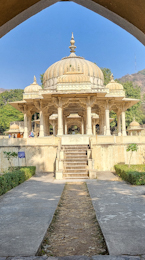
THE AMBER FORT, which we visited yesterday (17 December 2024), was swarming with noisy, jostling tourists. It was not pleasurable visiting that place. In contrast, today we explored a beautifully peaceful site between Jaipur and Amber Fort: Gatore ki Chhatriya, which I will abbreviate to ‘Gatore’.

Situated between two steep hills, one of which is home to a popular Ganesh temple, the Gatore is a set of three walled enclosures. Each of them contains several ornate domed chhatris (pavilion; ‘chhatri’ means umbrella). Each chhatri was erected over the spot where a member of Jaipur’s royal family (the Kachwaha dynasty) was cremated. After each cremation, the ashes of the deceased were carried to the sacred city of Haridwar, where they were consigned to the waters of the River Ganges.

The earliest of the chhatris at Gaitor was put up in 1743, after the cremation of Sawai Jai Singh II. Despite the fact that Indian royalty is no longer officially recognised, the most recent chhatri was constructed in 2011, when the titular ruler, Sawai Padmanabh Singh, died. In addition to the larger chhatris dedicated to the maharajas, there are smaller ones to royal children, who died before adulthood.

Unfortunately, none of the chhatris have any labels that help the visitor know for whom each of these structures was erected. An official at the entrance to the Gaitor compound told us that there had been wooden signs by each chhatri, but locals had apparently stolen them … for use as fire wood, maybe.

Apart from the peacefulness of the Gaitor compound, it is filled with the beautiful chhatris, which are set within well maintained gardens. And the whole place is flanked by the wooded slopes of the hills surrounding it.

If you do not have a long time to explore Jaipur, you should not miss visiting both the Gaitor and the Jantar Mantar. If you have a longer time, the Gaitor is a lovely place to linger.

The palace that became submerged by the lake


THE JAL MAHAL (Water Palace) was constructed in about 1699. In the early 18th century, the lake next to it was enlarged, and the palace became partially submerged. Despite many attempts to clear the water from its lower storeys, the palace has remained partially submerged.

An autorickshaw driver told us that he believed that a djinn (supernatural spirit) resides in the Jal Mahal. Every time an attempt is made to drain the palace, four times as much water as has been removed comes back to flood the edifice.

Recently, an entrepreneur bought the palace, hoping to convert it into a luxury hotel. However, his attempts to dry it out have been a failure,  and he has given up.

An astronomical extravaganza in the heart of Jaipur

Happy Christmas

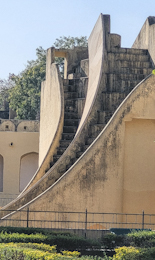
IT LOOKS LIKE MODERN sculpture at first sight. On closer examination, these fascinatingly shaped objects have carefully constructed scales, like the markings on a ruler or a protractor, attached to them. They are astronomical instruments that were constructed for the Rajput king Sawai Jai Singh (1688-1743), and they were completed by 1734. Together, they comprise Jaipur’s Jantar Mantar (literally ‘calculating instruments’). They were used to construct what has turned out to be extremely accurate astronomical tables.

Sawai Jai Singh was very interested in mathematics, astrology, astronomy, architecture, and literature. He studied scientific works by, for example, Ptolemy, Newton, Flamstead, and Euclid. He had Euclid’s “Elements of Geometry” translated into Sanskrit. His interest in astronomy might have been inspired in1702 by his tutor Jagannatha Samrat.

The Jantar Mantar in Jaipur contains 18 separate stone instruments with metal attachments . My knowledge of astronomy is minimal. So, I will not try to explain for what purpose each was, and still can be, used. A Wikipedia page (https://en.m.wikipedia.org/wiki/Jantar_Mantar,_Jaipur) can help with explaining their purposes.

To a visitor, like me, who is unversed in astronomy, and to those who are familiar with modern astronomical instruments, the Jantar Mantar presents the visitor with one of the most extraordinary looking tourist sights that India has to offer. It is not unique. In addition to the one in Jaipur, Sawai Jai Singh built four others in northern India. However, the one at Jaipur is the largest and best preserved.

If one did not know its purpose, the Jantar Mantar observatory compound would seem as if it is one of the world’s most superb sculpture parks.

An amazing cinema in the heart of Jaipur

HAPPY CHRISTMAS EVE

THE RAJ MANDIR cinema was completed in 1976. It was designed in the Streamline Moderne ( or late Art Deco) style by WM Namjoshi for Kushalchand Surana. It was conceived by Mehtab Chandra Golcha. According to Wikipedia, it is the largest single screen theatre in Asia.

We went to see a film called “Pushpa part 2”. It was made in the Telugu language and dubbed into Hindi. It is about sandalwood smuggling and corruption. Despite not being able to follow much of the dialogue,it was extremely exciting and beautifully filmed. It was so dramatic that we left the cinema feeing exhausted.

The cinema is spectacular visually. One enters from the street into a huge, circular foyer decorated in an opulent fashion. The auditorium is spacious and, like the foyer, spectacularly decorated. The screen is curved, and the surround sound system very good.

Even if one cannot follow a film because it is in a language that you do not know, a screening at this cinema is an experience not to be missed in Jaipur.

A first peek at the Pink City of Rajasthan

FOR VARIOUS REASONS, we hired an autorickshaw to give us a first glimpse of Rajasthan’s Pink City: Jaipur. Although the Pink City is the oldest part of Jaipur, its main thoroughfares were laid out centuries ago in a grid pattern typical of modern cities. A complex warren of narrow streets and courtyards lead off from the main roads. We have yet to explore these byways.

The city is so-named because its buildings are all painted with various shades of pink paint. Apparently, this has been done since the structures were first built in order to hide the inferior quality of the stones used in their construction.

After our elderly Bihari driver, Ganesh, had driven us along the straight main roads of the Pink City as well as some of the twisty, narrow lanes leading off them, he took us to see two factories. At one, we were shown men at work making the silver settings for precious stones. At the other, we were shown the way block printing on fabrics is carried out by hand.

At both factories, after we had been shown how the goods were prepared, we were (not surprisingly) invited to make purchases. We bought a few small objects. After leaving each factory, Ganesh asked us how much we had spent. This was not idle curiosity. He told us that he received 1% of whatever his passengers had spent. He told us that the factories, which sell their goods at wholesale prices, give him a much smaller commission than retail outlets.

I am glad that Ganesh took us to the factories rather than the retailers because it was interesting to watch the manufacturers at work.

An interesting exhibition of painting combined with photography: doctored images

THE MUSEUM OF ART and Photography (‘MAP’) on Kasturba Road is a relatively new addition to Bangalore’s cultural scene. When it opened in February 2023, we were amongst its first visitors. Privately financed by the Poddar family, it is housed in a recently constructed edifice. I prefer the appearance of its interior to that of its exterior.

MAP describes itself as a museum of art and photography. The institution is home to a large collection of photographs created over the many years since the technique was invented. Much photography is in my opinion also art. However, the present exhibition at MAP, which is on until the 24th of March 2024, combines a traditional art form – painting – with photography. The show is called “What the camera didn’t see”.

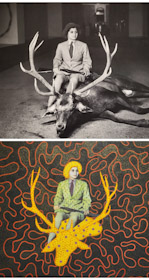
The British born artist Alexander Gorlizki (born 1967) , who holds a higher degree from the Slade School of Art (at University College London) and now works in NYC, has teamed up with Pink City Studio – a group of miniaturist painters in Jaipur – to present historic photographs in a new light.

The exhibition at MAP consists of several old photographs from the museum’s collection and new reproductions or prints of these vintage images. Gorlizki and his colleagues have taken the reproductions and painted over them in the traditional Mughal miniature style, but leaving faces in the photographs uncovered by paint.

The resulting ‘doctored’ photographs are mostly quite whimsical and witty. The highly imaginative ideas of the artists are skilfully and beautifully superimposed on the reproductions of the old photographs. Thus, the art of the original photographers has been metamorphosed by contemporary painters in Jaipur in collaboration with their curator, Alexander Gorlizki. The results, which are on display at MAP, are both amusing and most pleasing aesthetically . This is an exhibition well worth seeing.

Faces of India for Queen Victoria

THE CORRIDORS LEADING to the spectacular Durbar Room in Osborne House on the Isle of Wight are lined with portraits of people born in pre-independence India, either painted or photographed during the 19th century. Most of these images depict members of the Indian aristocracy (e.g., rulers of Princely States). A few depict less exalted persons, such as craftsmen and the designer of the Durbar Room.

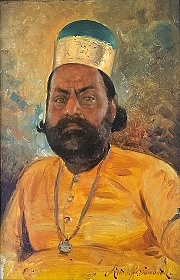
Maharajah Duleep Singh (1838-1893), who surrendered the Koh-i-Noor diamond to Queen Victoria, is portrayed in a few pictures, notably one by the famous German artist Franz Xaver Winterhalter (1805-1873). Many other paintings were created by the Austrian painter Rudolf Swoboda (1859-1914). Queen Victoria liked his painting style and commissioned him to create more than 40 portraits of Indian people. In 1886, the queen paid for him to travel to India, and gave him £300 in travelling expenses. Her instructions to the young artist were:

“The Sketches Her Majesty wishes to have – are of the various types of the different nationalities. They should consist of heads of the same size as those already done for The Queen, and also small full lengths, as well as sketches of landscapes, buildings, and other scenes. Her Majesty does not want any large pictures done at first, but thinks that perhaps you could bring away material for making them should they eventually be wished for.” (www.rct.uk/collection/403755/gulzar).

Many of these can be seen hanging in Osborne House. Amongst his many Indian portraits, there is at least one painted not in India but in England. Queen Victoria had several servants, who were born in British India and the Princely States associated with it. The best known of these ‘imported’ servants was her favourite Mohammed Abdul Karim (1863-1909), her ‘munshi’ (teacher), who helped her study Hindustani, which she learned to write competently in the Urdu script. Amongst Swoboda’s paintings of Indians hanging in Osborne House, there is one of a non-Indian, a lady from Cyprus, and another, a Cape Malay woman from  Cape Town (South Africa). Why they are there, I have not yet found out, but maybe Swoboda spotted them at the Colonial Exhibition held in London in 1886.

Not all the portraits of Indians are painted. Some of them are hand-coloured photographs. A few of these photos are signed by their creators, one of which was the photographic studio of Gobind Ram and Oodey Ram in Jaipur. Along with a studio in Calcutta the Ram brothers were pioneers in photography in 19th century India. One source (www.indiatoday.in/lifestyle/whats-hot/story/tryst-with-colonial-india-205124-2014-08-22) stated:

“Apparently, studio photography was practised by many Maharajas as a means of leisure, mostly using their courtesans as subjects. The Ravi Varma Studios of Calcutta and Gobind Ram-Oodey Ram Studio in Jaipur are just two examples.”

As can be seen at Osborne, these photographers also made portraits of the maharajahs and their families.

Although Queen Victoria loved Osborne House, I cannot see its appeal apart from the wonderful Durbar Room. For me, seeing this lavishly decorated hall and the collection portraits of the Indian people are the main delights of this otherwise rather gloomy residence.