
“Dreams Have No Titles”: An exhibition at the Whitechapel Gallery in London

IT DISAPPOINTS ME when I sleep without being aware of dreaming. Even nightmares are better than no dreams at all. What I enjoy about dreaming is that what I perceive in my dreams is on the one hand so realistic – lifelike and credible, and on the other hand simultaneously so completely unrealistic. The art of cinema can achieve the same ambiguity between realism and fantasy, which is why I enjoy watching films. Until the 12th of May 2024, there is an excellent exhibition at London’s Whitechapel Gallery, which explores what I enjoy about films and dreams. Called “Dreams Have No Titles”, it displays the multi-media creations of the Franco-Algerian artist Zineb Sedira, who was born in 1963 – the first year that Algeria was independent of the French, who had colonised it since 1830.

The exhibition, which was first shown in the French pavilion at the Venice Biennale of 2022, consists of a series of film sets. On one of the film sets, an elegantly dressed couple of actors perform ballroom dancing ( https://youtube.com/shorts/kUrD3aJP9s0?si=zez0VWoRqWmJMy4l ) for a few minutes at various times of the day. Each film set reproduces a scene from one of several films made in the 1960s – each one referencing events that took place during the period when Algeria was fighting for its independence. Within the film sets there are video sequences about that period, and about the artist and her life. Born in France, she came to the UK in 1986. One of the exhibits is a wonderful film with the same title as the exhibition. In it she explores film, its creators, its actors, imagination, dreams, and her artistic approach. Each of the film’s 24 minutes is wonderful. The film and other video works in the exhibition are in harmony with what I find so similar between experiencing dreams and watching cinematic films. I came away from the exhibition feeling elated and full of admiration for Zineb and her artistic work.
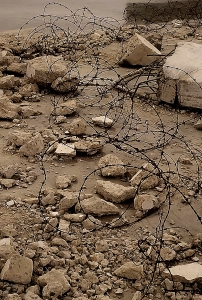
Anselm Kiefer at the White Cube in Bermondsey

TODAY, I MADE MY second visit to the Anselm Kiefer exhibition, which is on at the Bermondsey White Cube gallery until the 20th of August 2023. I was pleased to visit it again because after my first visit, I left it feeling oppressed and somewhat depressed. This might be what the artist (born at the end of WW2 in Germany) intended when he created the extraordinary series of scenes of dereliction and decay on show in Bermondsey. My second visit (on the 15th of August 2023) left me with a slightly more favourable impression, but my opinion that the artist has depicted an image of a world of confusion, conflict, and decay, remains unchanged.

The works, which are distributed in several rooms and the central corridor of the gallery, are, so I read in an information sheet, Kiefer’s reactions to, and representation of, a novel by James Joyce – “Finnegan’s Wake”. The artist has written short quotations from the book on many of the items that together make up the amazing art installations. As I have not read the book, I cannot comment on the appropriateness of what he has created.

In one room of the gallery, there are mainly huge paintings, which I found attractive. On close examination, one can see that the paint has been applied to that it is far from flat. The three-dimensional surfaces create interesting illusions, which change according to from where you view the pictures.

Another room has a huge pile of sand littered with discarded, corroded supermarket trolleys – an impressive but sad sight. In yet another room, most of the floor is covered with barbed wire and huge pieces of concrete – the ruins of a large building. As a friend of ours said, it looked as if it had been imported straight from a bombsite in Ukraine.

Would I recommend visiting this exhibition? It is certainly inappropriate for people who suffer from claustrophobia or depression. However, if you are of an adventurous frame of mind, do head for this show before it ends.

William Kentridge at the Royal Academy of Art in London

THE ARTIST WILLIAM Kentridge (born 1955), son of a prominent lawyer, is a South African. His creations are usually highly imaginative and often politically challenging and critical of the subjugation of non-European African people. This is fascinating given his privileged background – having been brought up in a South Africa where the ‘white’ people were a highly advantaged section of the population until the ending of the apartheid regime (and maybe even now to some extent).

His artworks are frequently dramatic, often employing cinematographic and sometimes theatrical techniques. The messages they convey to the viewers can be both disturbing and humorous, sometimes both simultaneously. Whenever I have seen them, I have been both fascinated visually as well as moved emotionally.

The Royal Academy of Art in London’s Piccadilly has a large retrospective exhibition of Kentridge’s work until the 11th of December 2022. Apart from numerous drawings, tapestries, and other static artworks, there are plenty of his cinematographic installations on display. In fact, there are too many of these installations. Each one is amazing to see, but having so many together in one place spoiled their intended impact. Just as the first chocolate from a box is wonderful, eating all of them at once gives one indigestion, and this was the case with the Royal Academy’s crowded assemblage of Kentridge’s works. Too much was crammed together in insufficient space. To be fully enjoyed, each of his installations should be seen on their own in a sufficiently spacious environment – they need ample room to breathe and express themselves.This overcrowding was a pity because the exhibition does not allow his works to shine in their full glory.