A resourceful lady and a book about a famous Turkish architect in Istanbul

THE ARCHITECT MIMAR SINAN (c1489-1588) was the greatest of Turkish architects. There are many wonderful buildings of all sizes and for a wide variety of purposes designed by him all over Istanbul.
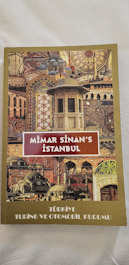
When visiting a tourist information office on the Asian side of Istanbul, I noticed several copies of a book called “Mimar Sinan’s Istanbul”. Beautifully illustrated with a detailed text, I quickly decided that I would love to own a copy. I asked if I could buy a copy. The official said that he could not sell me one because they were for reference only. I asked where they were sold, and was told that I could buy one at the publisher’s bookshop. The book is published by Turing. The discovery of the book occurred on a Friday.

On the following Sunday, we found the Turing shop. It was shut. We went again on Monday, and found a notice stating that it was always closed on Mondays. Tuesday was a public holiday. So, we did not bother going to the shop. On each of our abortive visits, I could see the book on a shelf in the shop, but could not quite see its title.

On Wednesday, the shop was open. We entered it, and discovered that they only stocked the Turkish edition. As it is beautifully illustrated and remarkably cheap given its fine quality, we purchased a copy.

Later that day, my wife Lopa had an ingenious idea. We were not sure whether it would work, but it was worth a try, especially as the tourist office was close to where we wanted to go the next day.

On the following day, we took the ferry to the Asian side, carrying with us the brand new copy of the Turkish edition of the book about Sinan, and returned to the tourist office. Lopa asked the official, who remembered us, whether we could exchange our Turkish book for one of the office’s books in English. Without hesitating, the official said:
“Why not. We don’t have a copy in Turkish.”

He handed us a copy of the book in English, and we gave him our Turkish copy. I was very pleased and full of admiration for Lopa’s resourcefulness – especially as it was her birthday.

Getting around the planning regulations in London and Oxo cubes

DESPITE THE PRESENCE of many distinctive buildings constructed on the south bank of the River Thames since the end of WW2, the OXO tower built in about 1929 is still a noteworthy and unusual landmark. OXO, just in case you do not already know, is a company that is most famous for its meat extract cubes, which can be dissolved to make soups, nutritious teas, and gravies. The company uses a process for making meat extract (in liquid form) that was invented in 1840 by the German scientist Baron Justus von Liebig (1803-1873). In 1866, Liebig’s Extract of Meat Company (‘LEMCO’) was founded in Britain. At first it produced the liquid form of the meat extract, which was quite costly. So, they developed a cheaper solid form, which was sold as OXO cubes, and they are still available today.

In the 1920s, LEMCO acquired the riverside building (opposite St Paul’s Cathedral), which had been first used as a power station for the Post Office. The company modified it considerably to produce an edifice with Art Deco features. This was designed by the company’s architect Albert Moore between 1928 and 1929. LEMCO wanted their effectively new building to include a tower with illuminated advertising signs. However, at that time, planning permission for skyline advertising near the riverfront was refused.  The architect came up with a brilliant solution to get around the planning regulations.

The square tower was designed with three windows on each of its four external walls. Each set of windows were shaped as a pair of circles separated by a cross shaped like an ‘X’. Thus, each of the four sets of windows spelled the name ‘OXO’. Even during daytime, when there are no lights switched on behind the windows’ glass panes, the name OXO can be seen from quite a distance. Because they were designed as windows, the planning authorities were in a weak position to object, and LEMCO got away with their attempt to use the tower to advertise.

By the 1970s, the OXO building had fallen into disuse. In the 1990s, the building along with its distinctive tower began to be redeveloped for use as housing, retail, and recreational purposes (including a now famous restaurant). At night the windows on the tower now are surrounded by neon lighting and the windows spelling out ‘OXO; can be seen from afar. OXO still exists, but it is now owned in the UK by Premier Foods.