
AN ICON IS a person or symbol worthy of veneration. These days ‘iconic’ has come to mean “widely known and acknowledged especially for distinctive excellence”. Thus, for example, the Taj Mahal and the Gateway of India are now described as being iconic.
Today, we visited a pavement shoe-repairer (‘cobbler’ or ‘mochi’) in Bangalore. All over India, one can find these useful street side artisans. Often, they work from small open fronted huts, which contain their tools and materials as well as footwear that is either waiting to be repaired or already fixed. One could say that the mochis are iconic features of the streets of India.
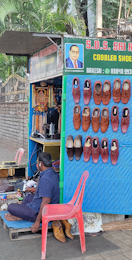
Apart from being iconic, many mochis adorn their huts with icons. These icons always include at least one picture of BR Ambedkar (1891-1956). He not only drafted the Constitution of India but also fought for the political rights and social freedom of the Dalits (once known as the ‘untouchables’).
Traditionally and still today, mochis are almost always from Dalit communities. This is why mochis have images (icons) of Ambedkar on their huts. The mochi we visited today on St Marks Road had not only some images of Ambedkar but also one of a Mr Haris, the local member of the Karnataka legislative assembly. And this is not all. Within his hut, the mochi had an image of Shrinatji, who is the God Krishna represented as a young child. This was garlanded with flowers as was one of the pictures of Ambedkar hanging beside it.
The iconic mochi polished my well-worn leather sandals while I sat beside his hut covered in icons

 yamey
yamey 